Why Does My Exhaust Clamp Keep Rusting? SS304 vs Mild Steel Explained
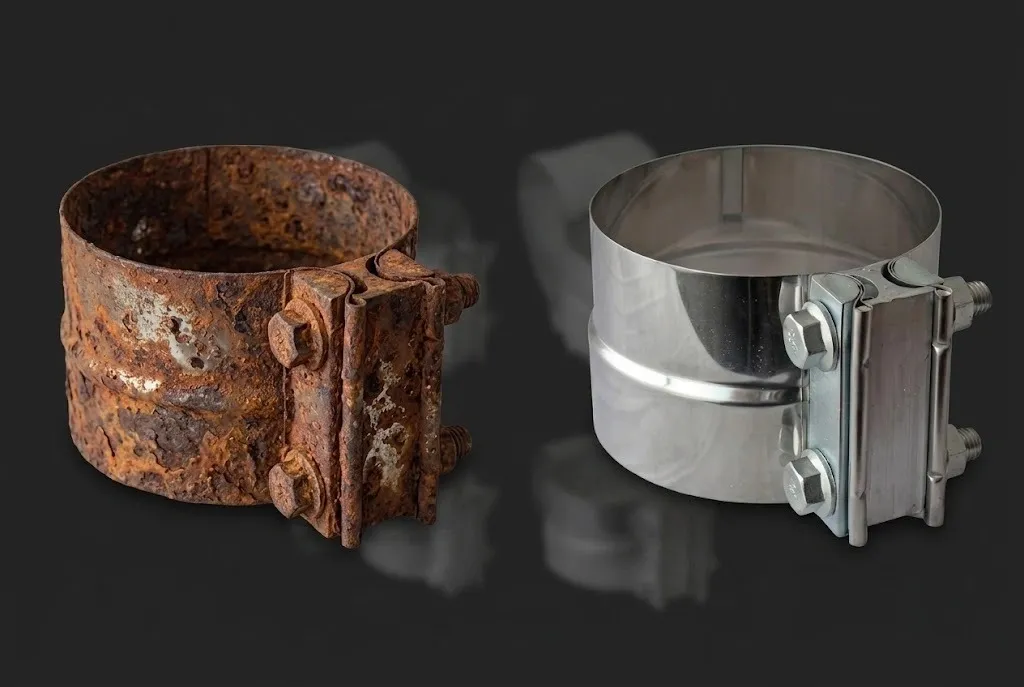
The Clamp That Locked Up After Six Months
I still remember the phone call. It was a Tuesday evening, and the voice on the other end belonged to a guy named Marcus — a regular at the shop, the kind of guy who treats his truck like a second child. He’d just installed a brand-new exhaust system six months earlier. Paid good money for it. Drove maybe twelve thousand miles. And now the [exhaust clamp](https://ledaut.com/product/stainless-steel-lap-joint-exhaust-band-clamp/) was so rusted solid that we couldn’t get it off without a cutting torch.
“Six months,” he said. “I paid for stainless steel, and it looks like it’s been sitting in a salt mine since the Cold War.” A rusting exhaust clamp shouldn’t look like that after six months, but Marcus wasn’t alone.
I told him what I tell most folks who walk through my door with the same complaint: chances are, it wasn’t stainless steel at all. Not the real kind, anyway.
Here’s the thing about exhaust clamps — they live in one of the nastiest environments on your entire vehicle. They sit right where the hot exhaust gases meet the outside air. They get baked, soaked, frozen, and hammered with road salt. Exhaust clamp rusting starts the moment the material can’t handle that kind of abuse. It doesn’t just look ugly. It fails. And when a clamp fails, you’re looking at exhaust leaks, failed inspections, and a repair bill that makes you wish you’d paid a few extra bucks up front.
So let’s talk about why exhaust clamp rusting keeps happening, and more importantly, what you can actually do about it.
The Truth About Why Exhaust Clamps Rust
Most clamps on the market — and I mean the vast majority of what you’ll find on shelves at auto parts stores — are made from mild steel. Sometimes they’re coated. Sometimes they’re not. But underneath any surface treatment, the base metal is plain old carbon steel. And carbon steel has exactly zero natural ability to fight rust.
Here’s how exhaust clamp rusting works on mild steel: iron in the steel reacts with oxygen and moisture to form iron oxide. That’s rust. Once it starts, it doesn’t stop — it accelerates. The rust flakes off, exposing fresh metal, which then rusts, and the cycle repeats until there’s nothing left but a crumbling mess. On a rusting exhaust clamp, that means the band loses tension, the bolts seize, and eventually the whole joint starts leaking.
Now, some manufacturers try to solve this with galvanization — coating the steel with a layer of zinc. And that works great, right up until the exhaust system heats up. Because here’s the problem nobody tells you about: zinc coatings start to degrade at around 400°F. By the time your exhaust hits normal operating temperature — which is typically between 600°F and 900°F for most passenger vehicles — that protective zinc layer is essentially cooked off. Once it’s gone, you’re back to bare mild steel, sitting in a hot, wet, salty environment. Exhaust clamp rusting isn’t just likely at that point. It’s inevitable.
And let’s be honest — exhaust systems don’t just get hot. They get hot and cold, over and over, every single time you drive. That thermal cycling creates condensation inside and around the clamp. Add road salt in the winter, and you’ve basically created a rust laboratory bolted to the underside of your car — exhaust clamp rusting accelerates fast in these conditions.
Why SS304 Stainless Steel Actually Works
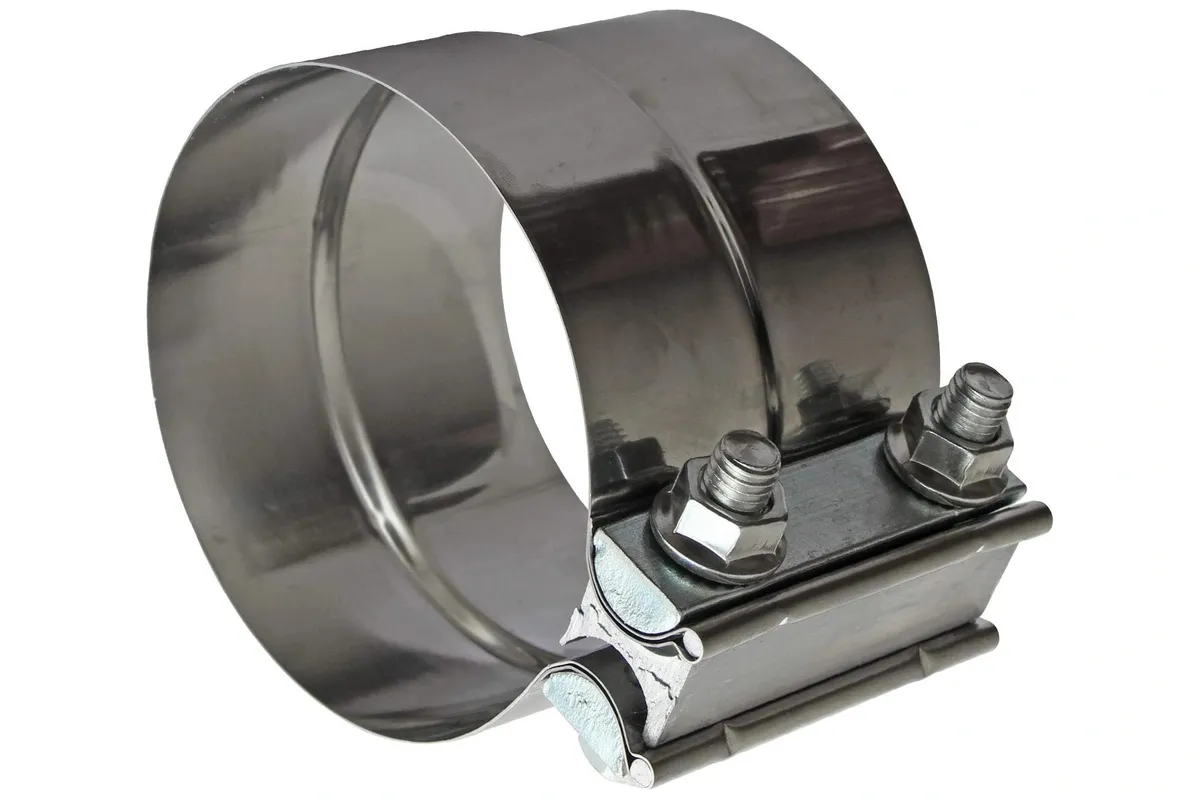
So what makes stainless steel different? It’s not magic. It’s chemistry — specifically, the chemistry of chromium and nickel.
Grade 304 stainless steel — often called SS304 — contains between 17.5% and 19.5% chromium and 8% to 10.5% nickel, according to material specifications documented by AZoM[AZoM]. That chromium is the star of the show. When it’s exposed to oxygen, it forms an incredibly thin, invisible layer of chromium oxide on the surface of the metal. This passive layer is what makes stainless steel “stainless.”
But here’s the part that really matters: that layer is self-healing. If you scratch it, bend it, or wear it down through normal use, the chromium in the underlying metal reacts with oxygen again and reforms the protective layer. It’s like the metal has its own immune system. As long as there’s chromium in the alloy and oxygen in the air, the protection keeps coming back.
Nickel plays a supporting but critical role. It stabilizes the austenitic crystal structure of the steel, which gives SS304 its excellent formability, toughness, and corrosion resistance — especially in acidic and chloride-rich environments. That last part matters a lot if you live anywhere that uses road salt in the winter.
Temperature resistance is where SS304 really separates itself from mild steel and even from aluminized steel. SS304 maintains its oxidation resistance up to approximately 1,598°F (870°C) in intermittent service. Your exhaust system will never get that hot under normal conditions, which means the material’s protective properties are never compromised by heat. Compare that to galvanized mild steel, where the zinc coating burns off at 400°F, and the difference is night and day.
In terms of lifespan, the contrast is stark. Mild steel exhaust components — including clamps — typically last one to three years before significant corrosion sets in. SS304 components, by contrast, routinely last ten years or more. That’s not a marginal improvement. That’s the difference between replacing a part every other year and installing it once and forgetting about it.
As OnAllCylinders notes in their exhaust material comparison, the gap between mild steel and 304 stainless steel isn’t just about looks — it’s about fundamental material performance under real-world conditions[OnAllCylinders].
The Weakest Link Nobody Talks About: The Bolts
Here’s a scenario I see all the time, and it drives me crazy. A customer buys what they think is a stainless steel clamp. The band itself is SS304 — looks great, feels solid, doesn’t rust. But the bolts? The bolts are mild steel.
Six months later, the bolts are corroded solid. The clamp band is fine, but you can’t adjust it, you can’t remove it, and you can’t reuse it. The entire clamp is effectively dead because of two cheap bolts.
This happens because manufacturers cut costs on the hardware. SS304 bolts cost more than mild steel bolts. Not dramatically more, but enough that budget-minded manufacturers make the swap. And most buyers never notice until it’s too late.
Here are three things you can do to protect yourself from this:
First, check the bolts before you buy. If the clamp body is stainless but the bolts look dull gray or have a zinc coating, that’s a red flag. Real SS304 bolts have the same bright, silvery finish as the band. If the manufacturer won’t tell you what the bolts are made of, assume they’re mild steel.
Second, apply anti-seize compound during installation. A quality stainless steel anti-seize on the bolt threads makes a huge difference. It prevents galling — which is when stainless threads cold-weld together under heat and pressure — and it also creates a barrier against moisture and salt. This is something every mechanic should be doing, and frankly, most aren’t.
Third, inspect your clamps at least once a year. Don’t wait for a leak to tell you something’s wrong. A quick visual check under the car takes two minutes. If you see orange discoloration around the bolts, catch it early. A replacement bolt kit costs a fraction of what a full clamp replacement costs, and it’s a lot easier to swap a bolt than to cut a seized clamp off your exhaust pipe.
Three Ways to Tell If Your Clamp Is Really SS304
The market is full of products labeled “stainless steel” that aren’t SS304. Some are 201-grade stainless (which has less nickel and corrodes faster). Some are 409-grade (better than mild steel but nowhere near 304). And some are just mild steel with a shiny coating that washes off after a few rainstorms.
Here’s how to tell the difference:
Test one: the magnet test. SS304 is austenitic stainless steel, which means it’s essentially non-magnetic. A strong magnet will not stick to genuine SS304 — or if it does, the attraction will be very weak. Mild steel, 409 stainless, and most coated steels are strongly magnetic. Keep a small neodymium magnet in your toolbox. It’s the fastest field test you’ll ever use.
Test two: the timeline test. If a clamp you bought as “stainless steel” starts showing exhaust clamp rust within three to six months, it’s not SS304. Period. Real 304 stainless doesn’t rust in that timeframe under any normal driving conditions. Surface discoloration from heat is normal — a golden or blue tint is just heat tempering and doesn’t indicate corrosion. But orange-brown rust? That’s iron oxide, and it means the material contains significant iron without enough chromium to protect it.
Test three: the price test. This one isn’t foolproof, but it’s a strong indicator. SS304 raw material costs significantly more than mild steel or lower-grade stainless. If you’re buying an [exhaust band clamp](https://ledaut.com/product/stainless-steel-lap-joint-exhaust-band-clamp/) for $1.50 to $2.00 or less, it is almost certainly not SS304. The math doesn’t work. You can’t buy SS304 sheet, form it into a clamp, add SS304 bolts, package it, ship it, and sell it at that price. Real SS304 clamps typically cost two to three times more than mild steel equivalents. If the price seems too good to be true, it is.
What Real Buyers Are Saying
I don’t just rely on material specs and lab data. I talk to people who actually use these products day in and day out. Here’s what they’ve told me:
One buyer, a fleet maintenance supervisor in Ohio, had been replacing mild steel clamps on his delivery vans every winter. Salt roads were eating through them in under a year. He switched to SS304 clamps across his entire fleet and hasn’t replaced a single one in over two years. His exact words: “The old iron clamps looked like they’d been buried in a swamp. The SS304 ones still look new. I should’ve done this years ago.”
Another customer runs a small turbo shop in Colorado. He kept getting callbacks because customers’ turbo outlet pipes were leaking at the clamp joints. The clamp wasn’t failing structurally — exhaust clamp rusting was causing them to corrode and lose tension, which created small gaps that let exhaust gas escape. After switching to SS304 clamps with matching stainless bolts, the callback rate dropped to nearly zero. “The clamp was the weak link,” he said. “Once we fixed that, the whole system held up.”
These aren’t isolated stories. They’re the kind of feedback you get when you put the right material in the right place. And the pattern is always the same: people who upgrade to SS304 stop thinking about exhaust clamp rusting altogether. Which is exactly what you want from a part that’s supposed to just sit there and do its job.
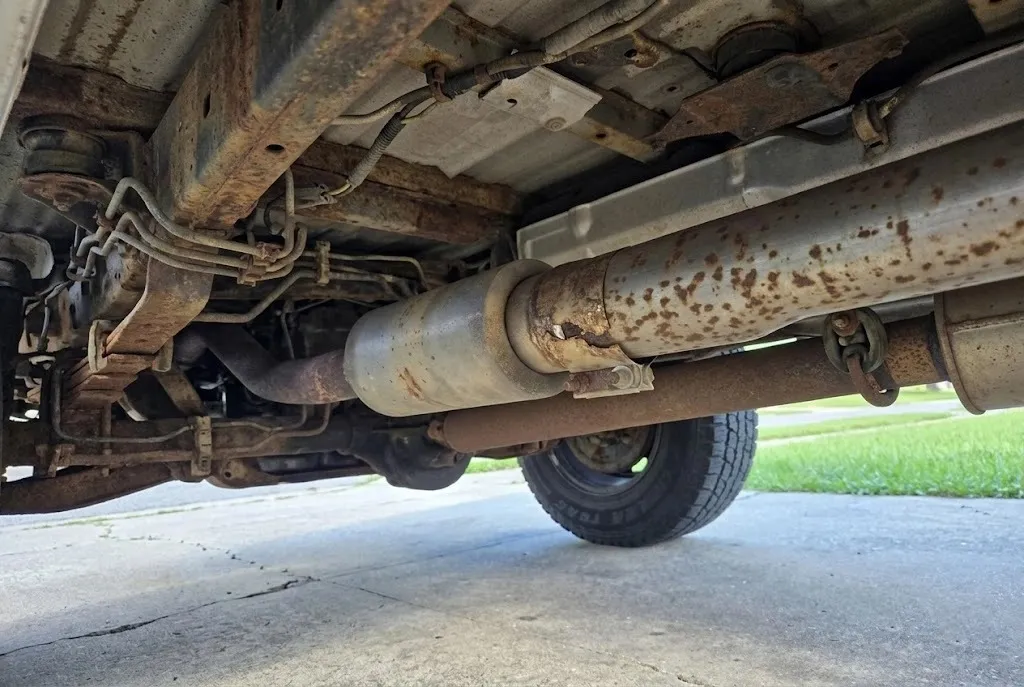
The LEDAUT SS304 Exhaust Clamp
If you’re looking for a clamp that actually lives up to the “stainless steel” label, here’s what we offer at LEDAUT.
The clamp body is made from genuine SS304 stainless steel — not 201, not 409, not coated mild steel. The bolts are also SS304, so you don’t have the weak-link problem I described earlier. The clamp fits pipe diameters from 2.5 inches to 5 inches, which covers the vast majority of passenger vehicles, light trucks, and performance exhaust setups. Whether you’re working on a daily driver or building a custom exhaust cutout system, this clamp handles the job.
We manufacture these in our own factory and sell them direct, which means there’s no middleman markup. You’re getting SS304 quality at a price that makes sense — not the cheapest option on the shelf, but not overpriced either. Fair price for real material. That’s the deal.
The product identifier is B082SBTBZG, so you can find it easily. We’ve had thousands of units ship out, and the feedback has been consistently positive. People buy them, install them, and then they don’t have to think about them again. That’s the best kind of review — and the best outcome for anyone tired of dealing with a rusting exhaust clamp.
Bottom Line
Your exhaust clamp doesn’t have to be a recurring expense. Exhaust clamp rusting doesn’t have to be the problem you dread inspecting before winter. It doesn’t have to seize up and force you to cut it off with a grinder at eleven o’clock on a Saturday night.
The material matters. Mild steel clamps will rust — exhaust clamp rusting is not a question of if, but when. Galvanized coatings help for a while, but exhaust heat destroys them. SS304 stainless steel, with its chromium-rich self-healing oxide layer, is the material that actually survives the environment it lives in.
Next time you’re replacing a clamp — whether it’s routine maintenance or you’re building something new — spend the extra few dollars on real SS304. Your future self, standing under a car in January with a wrench in one hand and a flashlight in the other, will thank you.