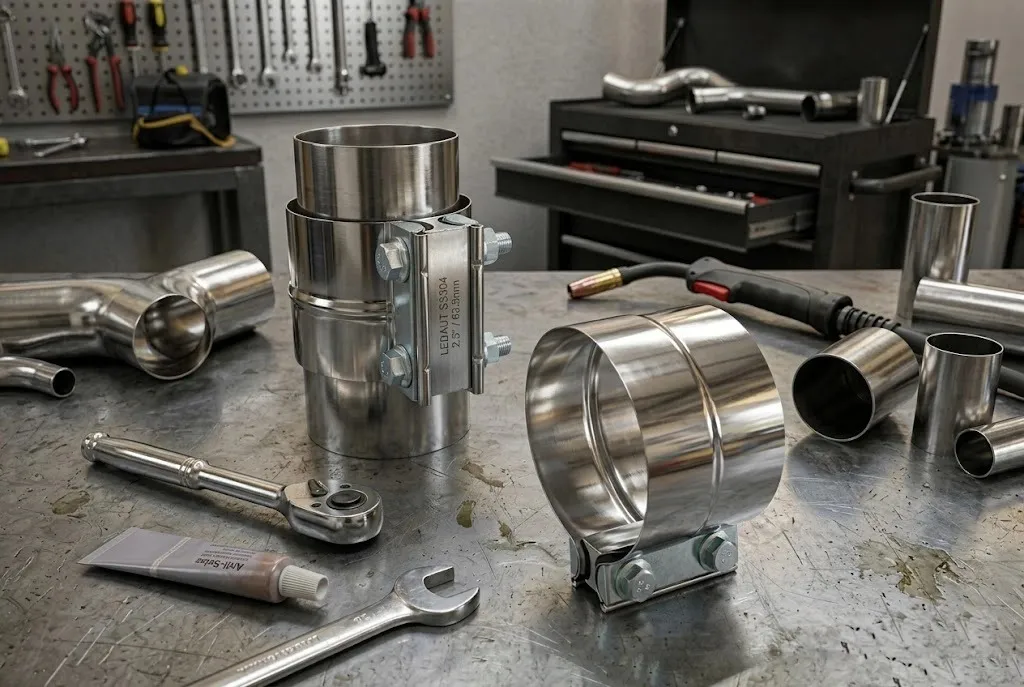
Exhaust Clamps
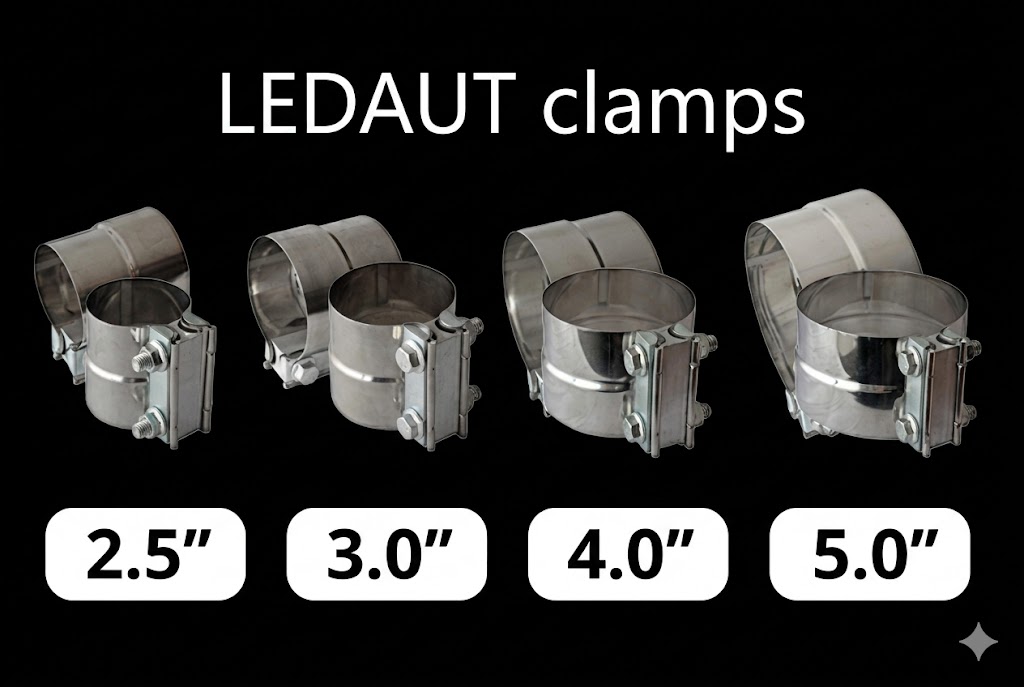
Sized 2.5" to 5".
A lap joint band clamp seals the joint without crushing the pipe — the reaction block spreads bolt torque across the full 360° circumference instead of denting it like a U-bolt. Every clamp below is SS304, sized by pipe outside diameter, and ships in 2-pack or 4-pack retail configuration.
Exhaust Clamp Sizes:
Match the Pipe OD, Not the Bore
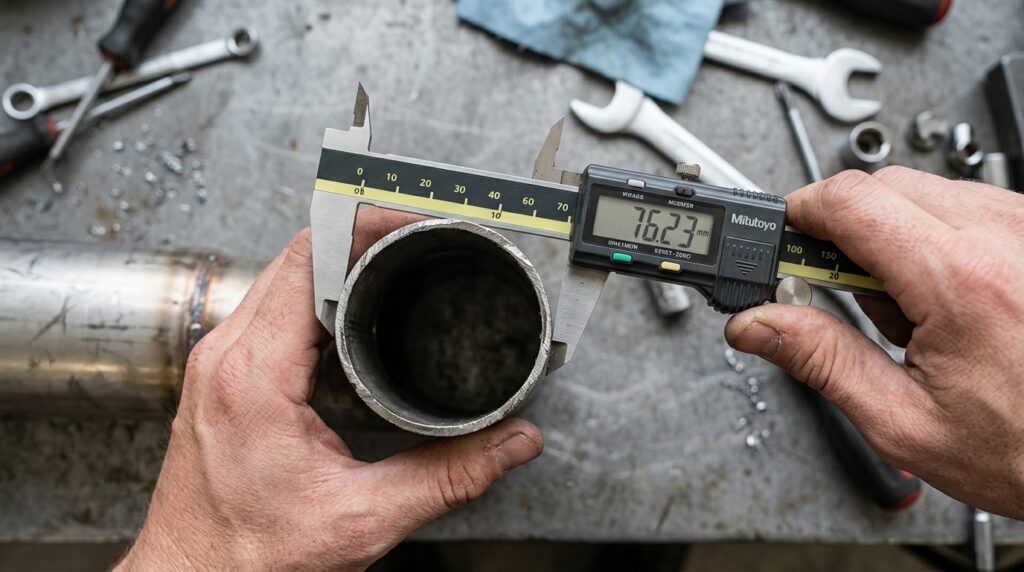
Measure the outside diameter of the pipe you are clamping — wrap a tape around it and divide by 3.14, or use a caliper across the end. Clamps are named after that number, so a 2.5" clamp goes on a pipe that measures 2.5" across the outside, not 2.5" inside. If your caliper reads 63 mm, you need the LE-LC-250.
| Model | Fits Pipe OD | Metric | Pack | Status |
|---|---|---|---|---|
| LE-LC-250 | 2.5" | 63 mm | 2 or 4 | In stock |
| LE-LC-300 | 3.0" | 76 mm | 2 | In stock |
| LE-LC-400 | 4.0" | 102 mm | 2 or 4 | In stock |
| LE-LC-500 | 5.0" | 127 mm | 2 or 4 | In stock |
Need 2.0", 2.25" or 3.5"? Those are tooled to order rather than held in stock — send us the quantity and we will quote a lead time. Custom diameters are also available for OEM programmes.
How to Measure & Tighten.
Two mistakes cause almost every leak: measuring the wrong diameter, and overtightening until the band stretches.
-
1
Measure the OD
Caliper on the cut end, or tape around the pipe divided by 3.14. Write the number down — do not match by eye, because 2.5" and 2.25" pipe look almost identical until the clamp is on.
-
2
Slide the wider end over the larger pipe
A lap joint clamp has a pre-formed step. The short, wider half goes over the outer pipe; the narrow half grips the inner pipe. Reversing it means the step cuts into the joint instead of sealing it.
-
3
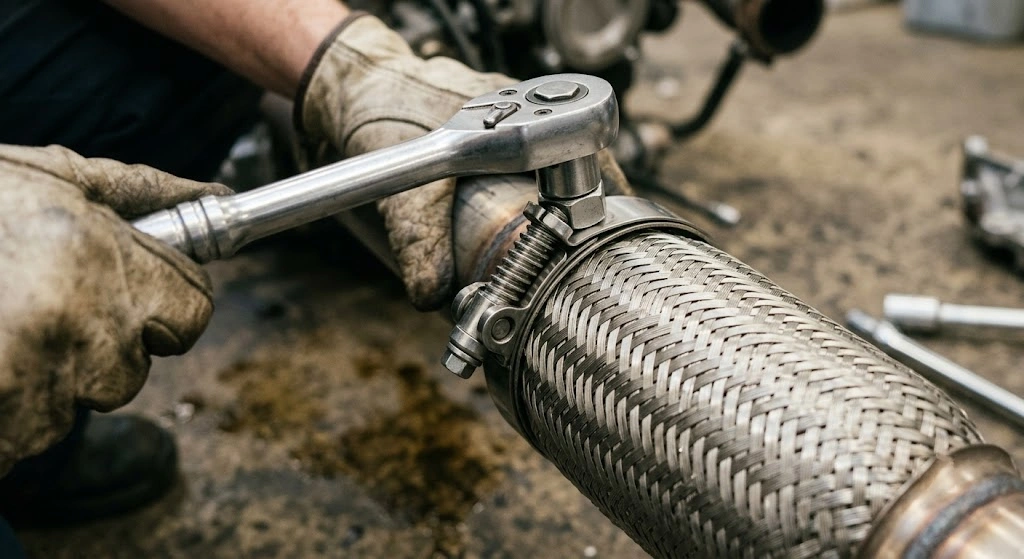
Snug both bolts evenly
Alternate between the two bolts in small increments so the reaction block stays parallel. This is what keeps the band from walking off the step and creating a leak path.
-
4
Torque, then re-check hot
Bring it to the low end of the range below, run the engine to full temperature, let it cool, then re-torque. Stainless moves under heat cycling — the second pass is what stops the tick you hear a week later.
How Tight Should Exhaust Clamps Be?
Tight enough to seal, not tight enough to stretch the band. A stretched band loses its spring and will never re-torque again. These are the ranges we quote for SS304 lap joint clamps:
| Pipe size | ft-lb | N·m |
|---|---|---|
| 2.5" | 25–30 | 34–41 |
| 3.0" | 30–35 | 41–47 |
| 4.0" | 40–50 | 54–68 |
| 5.0" | 50–60 | 68–81 |
Typical ranges for SS304 band clamps — always confirm against the label on your clamp and the pipe manufacturer’s spec. Thin-wall tube dents well before these numbers, so stop early on 16-gauge.
Types of Exhaust Clamps
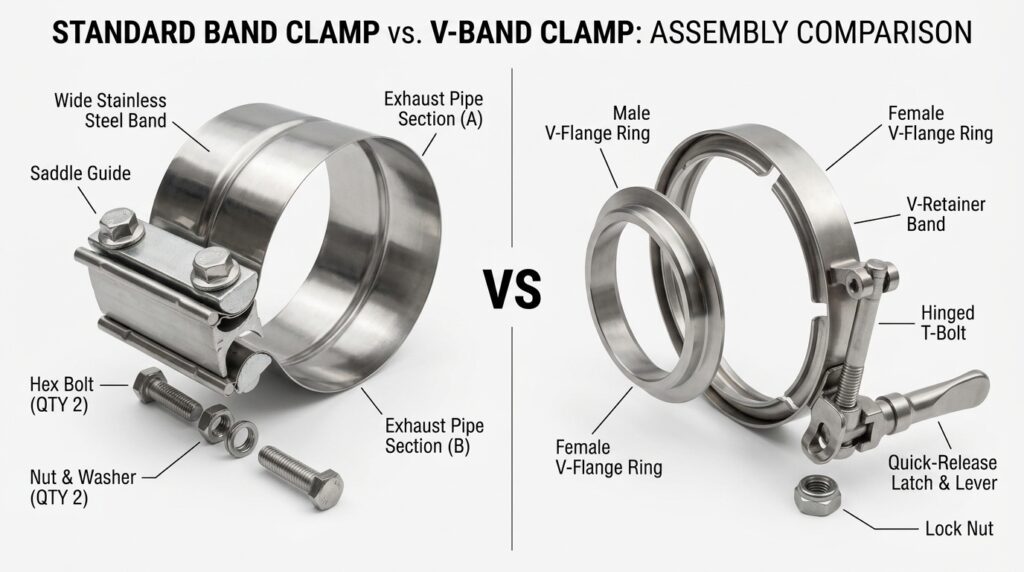
Five shapes cover almost every exhaust joint on the road. The right one depends on whether the pipes overlap, butt together, or bolt through a flange.
| Clamp Type | Use It When | Pipe Distortion | Reusable |
|---|---|---|---|
| Lap Joint Band Clamp | One pipe slips inside another | None (360° even force) | Excellent |
| Butt Joint Band Clamp | Two equal pipes meet end to end | None | Good |
| V-Band Clamp | Mating flanges on turbo or downpipe | None | Excellent (fastest removal) |
| Sleeve Clamp | Bridging a gap or patching a split | Minimal | Fair |
| U-Bolt Clamp | Cheap permanent mounting, not sealing | High (crushes pipe) | Poor (usually destroyed) |
Our Clamp Products.
Precision-formed to create a seamless 360-degree seal without distorting your exhaust piping.
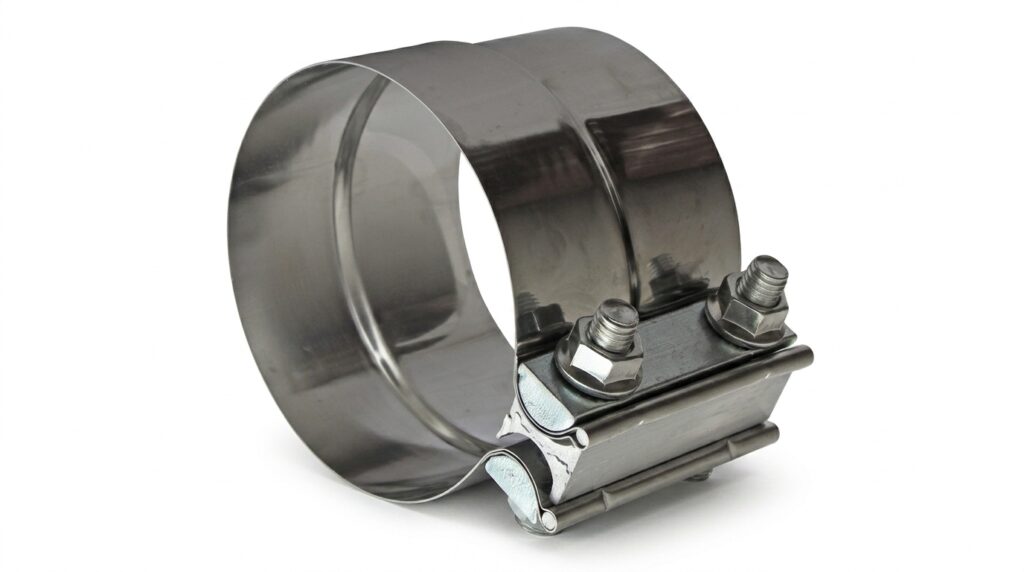
SS304 Lap Joint
Exhaust Band Clamp
Our only line that seals a slip fit properly. A wide SS304 band wraps the overlap while a rigid reaction block turns bolt torque into even circumferential force, so the pipe keeps its round shape and the joint comes apart again next season.
- 2.5" / 3.0" / 4.0" / 5.0" in stock
- 2-pack and 4-pack retail ready
- Laser-marked with size and material
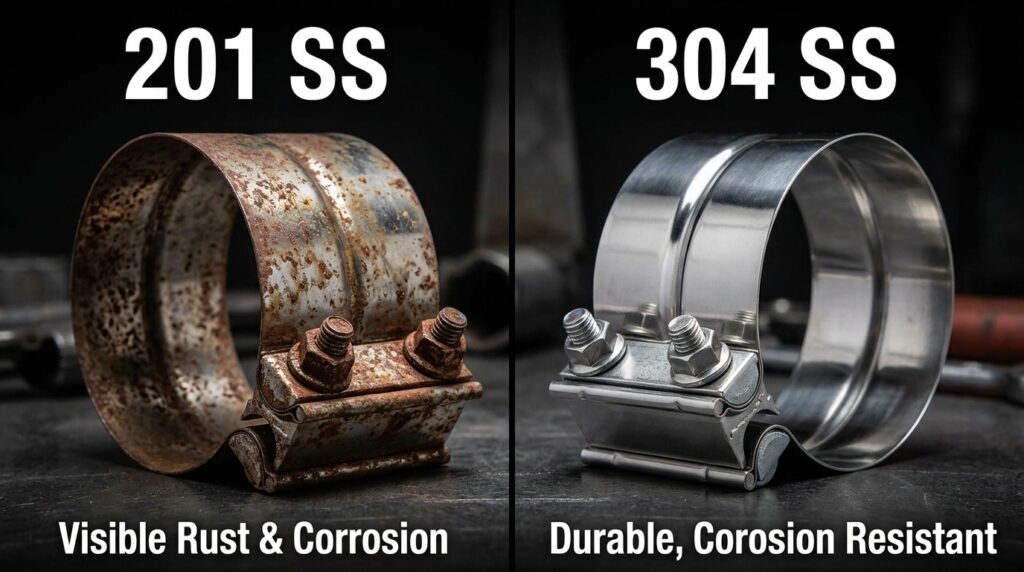
Why SS304 and Not 201
A 201-grade clamp and a 304-grade clamp look identical on the shelf and cost about the same to buy. They do not age the same. SS304 carries 18% chromium and 8% nickel; that nickel content is what lets the passive oxide layer re-form after the band is scratched during installation or stretched under torque.
On a daily driver in a salt-belt state, a 201 clamp starts showing surface rust in the first winter and pits through the band by the second. The joint then leaks, the customer comes back, and the labour to replace a clamp costs more than the price difference on a hundred of them.
We buy SS304 coil directly and form, weld and laser-mark in-house, so the grade on the label is the grade in the band. Sizes and material are marked on every clamp — if a clamp arrives without that marking, it did not come from us.
Common Applications
-
Performance Workshops
Custom fab shops rely on band clamps to allow temporary fitting and adjustment before final welding — no crushed pipe when the system comes back apart.
-
Muffler & DPF Replacement
The joint that gets cut and rejoined most often. A lap joint clamp seals it without welding and without cracking the inlet stub.
-
Aftermarket Retail & OEM
2-pack and 4-pack kitting with your own branding, for jobbers and tuning brands who need shelf-ready hardware.
What Goes Wrong
If a clamp already leaks, it is almost never a faulty clamp. It is one of these:
- Clamp sized to the pipe bore instead of the OD — sits loose by 3–5 mm
- Lap joint slipped on the wrong way round, so the step digs into the joint
- Overtorqued on thin-wall tube — the band stretched and lost spring
- Slip fit bottomed out with no room for expansion, cracking the weld
- Reused a U-bolt and re-dented the same spot twice
Why Source From LEDAUT
- True SS304 coil, not 201 relabelled
- In-house TIG welding & forming
- Laser-marked size and grade
- Quality control aligned to IATF 16949
- Custom kitting, polybag and branding
Exhaust Clamps FAQ
The questions we answer on the phone most weeks.
1. What size exhaust clamp do I need?
Measure the pipe’s outside diameter, not the bore. Calipers across the cut end gives you the number directly; a tape around the circumference divided by 3.14 works if you have no calipers. A 2.5" pipe measures 63 mm across the outside and takes an LE-LC-250. Our full size table is above.
2. How tight should I torque an exhaust clamp?
For SS304 lap joint clamps: 25–30 ft-lb at 2.5", 30–35 at 3.0", 40–50 at 4.0" and 50–60 at 5.0". Start at the low end, alternate between the two bolts, then re-torque after one full heat cycle. Going past these figures stretches the band permanently rather than sealing harder.
3. Lap joint or butt joint — which clamp do I have?
Look at the pipes. If one slides inside the other, you need a lap joint clamp and its pre-formed step. If two equal pipes meet face to face with no overlap, you need a butt joint clamp. Fitting a lap clamp to a butt joint leaves a gap the step cannot bridge, and it will leak.
4. Will a band clamp really seal without welding?
Yes, on a clean slip fit with correct sizing. The band compresses a full 360° ring around the overlap instead of pinching one spot. It is not a substitute for welding on a high-boost turbo manifold, but for cat-back, muffler and DPF joints it is the standard repair and holds for years.
5. Can I reuse an exhaust clamp?
A band clamp, yes — several times, as long as it was not overtorqued and the band has not stretched. A U-bolt, no: the saddle leaves a permanent dent in the pipe and the threads usually gall on removal. That is the main reason shops standardise on band clamps for anything they might take apart again.
6. Do you sell 2", 2.25" and 3.5" clamps?
Those three are tooled to order rather than held in stock. Send us the size and quantity and we will quote a lead time — typically a few weeks depending on the current run schedule. Custom diameters are available for OEM programmes.
7. What is your MOQ, sample policy and lead time?
Standard MOQ is 200 pieces. Samples are available for qualification before you commit to volume, with shipping covered by the buyer. Stocked 2.5"–5.0" sizes normally ship in 7–10 days; custom packaging or OEM marking runs about 25–30 days.
8. How do I know the clamp is really SS304?
Every LEDAUT clamp is laser-marked with the size, material grade and model number — you can see it on the workshop photo at the top of this page. 304 is weakly magnetic after forming at best, while 201 is usually more strongly attracted to a magnet; a magnet test plus the marking gets you most of the way. We will also send mill certificates with bulk orders on request.
Request a
Wholesale Quote.
Tell us the pipe sizes, the quantity and how you want them packed. We quote stock sizes directly and confirm tooling lead times for anything non-standard.
Email Us
sales@ledaut.com