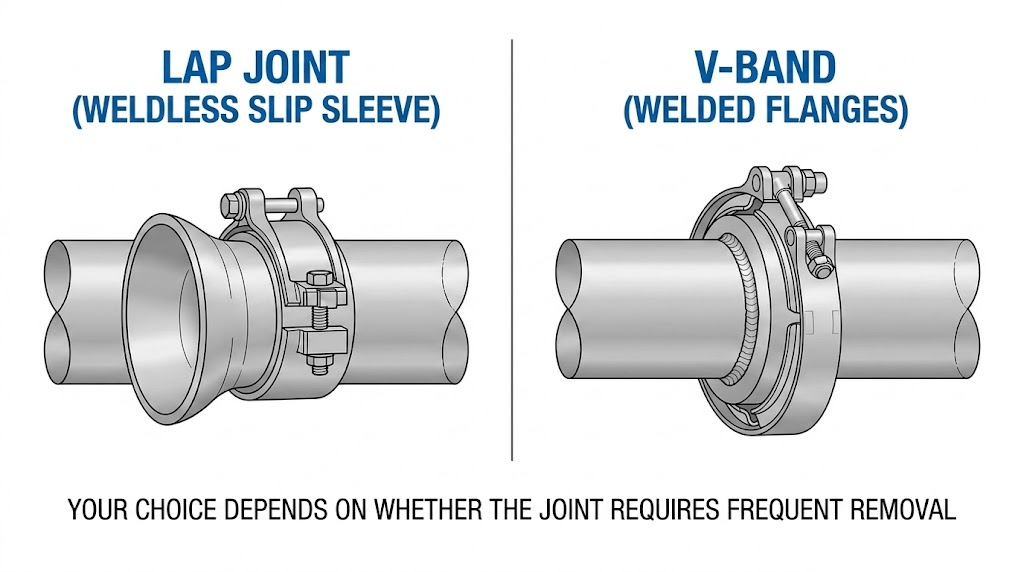
Ask most builders which clamp needs welding, and they’ll point at the lap joint. It’s actually the opposite. Lap joint clamps are weld-free — you slide one pipe into the other and clamp the sleeve down with a bolt or two. It’s the V-band that needs welding: a matched pair of flanges welded onto each pipe end before the ring can even go on. Getting that backwards is exactly why so many DIY builds end up welded when they never needed to be.
Choosing between lap joint vs v-band clamps isn’t about which is “better” — it’s about matching the clamp to the job. Get it wrong, and you’re looking at leaks and comebacks.
TLDR
- Lap joint clamps use a sleeve-and-bolt design that requires no welding — ideal for street cars and budget-conscious builds.
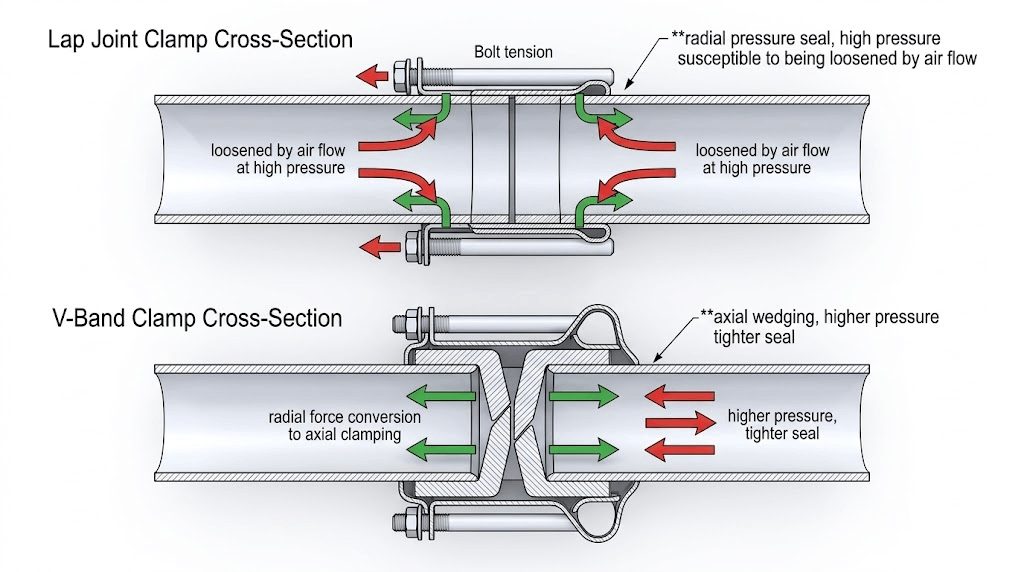
- V-band clamps pair a hinged ring with machined flanges, converting radial bolt force into axial clamping pressure for superior sealing under boost.
- Lap joints seal reliably (better than U-bolts) but aren’t designed for frequent disassembly or extreme pressure.
- V-band systems cost more due to precision-machined flanges and additional welding labor.
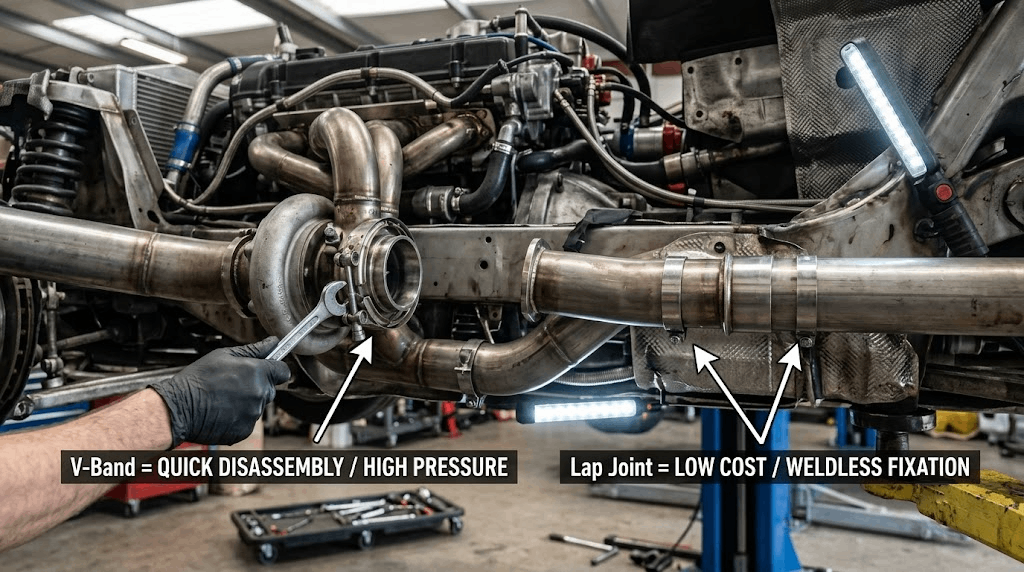
- For turbo applications, track cars, or any setup requiring regular service access, v-band is widely used.
Quick Comparison Table
| Feature | Lap Joint Clamp | V-Band Clamp |
|---|---|---|
| Installation | Slip-on, no welding required | Requires welding paired flanges to pipe ends |
| Sealing Performance | Reliable for street use (better than U-bolt); not optimal for high boost | Widely used for high-pressure/turbo applications |
| Serviceability | Moderate — loosening bolts allows some adjustment | Excellent — single bolt release for quick removal |
| Cost | Lower — no machining, minimal labor | Higher — machined flanges + welding time |
| Ideal Use | Fixed street exhausts, budget builds | Turbo setups, race cars, frequent service needs |
Lap Joint Clamps Overview
A lap joint clamp is a cylindrical sleeve that overlaps two pipe ends, secured by one or two bolts tightened around the circumference. Slide the pipes in, align them, torque the bolts — no welding, no special tools, no precision machining.
LEDAUT manufactures lap joint clamps in SS304 stainless steel with silicone sealing rings, available across our full product line with OEM/ODM support for distributors and modification shops.
The appeal is obvious: a first-time builder can install one with nothing more than a socket set. No risk of warping thin-wall tubing, no need for a skilled welder, no concern about flange alignment. For a street car that mostly sits and drives, that means lower upfront cost and faster installation.
But simplicity has limits. The seal relies entirely on bolt tension, and thermal cycling — the repeated heating and cooling of an exhaust system — gradually relaxes that tension. Over time, you may need to retighten the bolts, or you’ll start hearing that telltale tick of an exhaust leak.
Lap joint clamps seal reliably and outperform basic U-bolt designs, but aren’t engineered for frequent disassembly or sustained high-pressure operation. Their edge is cost savings and weld-free installation — ideal for street cars with fixed connections.
When we supply lap joint clamps to shops, we always ask: “Will this system ever need to come apart?” If it’s a permanent install on a daily driver, lap joints are a perfectly valid choice. If the answer is yes, keep reading.
For builders evaluating clamp options, our lap joint exhaust clamps line covers common diameters from 2 to 4 inches, with both single-bolt and dual-bolt configurations depending on pipe size.
V-Band Clamps Overview
A v-band system has three components: two mating flanges with angled (V-shaped) faces, and a hinged clamp ring that wraps around them. Tightening the single bolt pulls the flanges together axially, pushing the faces directly against each other to create a metal-to-metal seal around the entire circumference.
Instead of relying on circumferential compression, a v-band converts the bolt’s radial force into axial clamping pressure — a seal that improves under pressure rather than fighting it. That’s why v-band clamps are widely used in turbocharged and motorsport applications.
The trade-off is complexity. A v-band system requires welding a matched pair of flanges to the pipe ends, precisely aligned — even a few degrees off prevents the V-faces from seating and creates a leak path no bolt torque will fix. This demands skilled TIG welding or a jig setup, adding labor cost and turnaround time for shops without in-house welding.
But once installed correctly, a v-band joint is exceptionally durable, and the single-bolt design allows rapid disassembly — undo one nut and the section comes free. For a race team that swaps turbos between events, that serviceability is worth the extra upfront cost.
If your system may evolve — adding a turbo later, swapping mufflers for sound tuning, or servicing regularly — v-band is the smarter long-term play. LEDAUT doesn’t manufacture v-band clamps, so for these connections source the flanges and ring as a matched set — mismatched flange geometry is the most common cause of v-band leaks.
Key Differences: Lap Joint vs V-Band Clamps
Installation Method
Lap joint clamps are slip-on designs. Cut the pipe to length, slide both ends into the sleeve, and tighten the bolts. No welding, no fixtures, no alignment jigs — a competent DIYer can finish in under thirty minutes with basic hand tools.
V-band clamps require welding. Each pipe end gets a matching flange welded in place, and those flanges must be coaxial: centerlines aligned, V-faces parallel. Even a few degrees of angular deviation creates gaps that prevent proper sealing, so most shops use a jig or fixture to hold the flanges while tack-welding, then finish the beads after confirming alignment.
The skill floor is higher for v-band. If your shop lacks a certified welder, factor in outsourcing or a local fabrication partner. For lap joints, the skill involved is using a torque wrench correctly.
Sealing Performance
In a lap joint, the seal depends on bolt tension compressing the sleeve against the pipe. At atmospheric pressure this works fine, but as exhaust pressure climbs the gas pushes radially outward, trying to force the pipe out of the sleeve. Under about 10 PSI the bolt tension holds; in the 10–15 PSI range the seal starts to become marginal; and above 15 PSI — or under sustained thermal cycling — the bolt has to fight the pressure continuously while vibration slowly reduces its preload until the seal degrades.
A v-band seal works by wedging: the angled flange faces force each other together axially, creating a metal-to-metal contact ring around the whole joint. Higher exhaust pressure helps this seal, pushing the flanges harder together rather than apart. This is why v-band clamps are widely used for high-pressure and turbocharged applications.
Lap joints seal reliably for street use and outperform basic U-bolt clamps, but aren’t built for sustained high pressure or frequent disassembly. V-band systems hold their seal better under boost and repeated service cycles.
Serviceability
If you ever need to remove a section of exhaust, v-band wins decisively. Loosen one nut, separate the flanges, and the section comes free. Reinstallation is just as fast — slip the flanges back together, tighten the bolt, and you’re done. No realignment needed if the flanges were welded correctly the first time.
Lap joints require more effort: loosen both bolts, slide the sleeve back, and deal with possibly seized bolts from heat cycling. Reassembly means realigning the pipes in the sleeve — doable, but not the five-minute job a v-band offers.
For race teams, tuners, or anyone who anticipates regular system modifications, this difference in service time adds up quickly over the life of the vehicle.
Cost Comparison
Lap joint clamps are cheaper for a straightforward reason: no machining, no welding labor, no precision fixtures. For a budget build or a high-volume production run where margin matters, this cost advantage is significant.
V-band systems carry a premium. Each flange is machined from billet or cast stock, requiring CNC time and quality control. Then there’s the welding labor — even a skilled welder needs 15–20 minutes per joint. Across four or six joints in a full custom exhaust, the labor alone can cost more than the clamps themselves.
V-band clamps cost more overall because the system includes the clamp plus a pair of machined flanges and additional welding labor, with flanges requiring precise alignment.
That said, total cost of ownership depends on use case. A car that never comes apart: lap joints save money upfront. A platform that evolves — new turbos, different mufflers, sensor upgrades — pays for the v-band’s serviceability in reduced future labor.
When to Use Each Type
Choose lap joint clamps when:
- You’re building a fixed street exhaust for a daily driver.
- Budget is a primary constraint, or your shop lacks welding capability.
- The system won’t need regular disassembly, or you’re working with thin-wall tubing sensitive to weld heat.
Choose v-band clamps when:
- You’re building a turbocharged or supercharged application.
- The vehicle sees track use, or you need regular service access (sensor swaps, upgrades).
- Long-term serviceability matters more than upfront cost.
There’s also a hybrid approach: v-band clamps at critical junctions (turbo outlet, downpipe) where pressure and heat are highest, lap joints further downstream. This balances cost and performance, though it adds complexity to the bill of materials.
FAQ
Q: Can I use lap joint clamps on a turbocharged car?
You can, but it’s a judgment call that hinges on boost level. Under about 10 PSI (mild builds) lap joints are workable but near their limit. In the 10–15 PSI range it’s a gray zone where a v-band is the safer call. Above 15 PSI, or for track use where thermal cycling is extreme, v-band clamps are the right choice.
Q: Do v-band clamps require special tools to install?
No special tools beyond standard welding equipment. However, a welding jig or alignment fixture is highly recommended to ensure the flanges are coaxial. Without a jig, achieving proper alignment relies entirely on the welder’s skill and patience.
Q: How often do I need to retighten lap joint clamp bolts?
On a well-installed street car, you might never need to, but thermal cycling gradually reduces bolt preload. Check torque after the first 500 miles, then annually or when you notice exhaust noise. Use a torque wrench — overtightening strips threads, undertightening causes leaks.
Q: Are v-band clamps worth the extra cost for a street car?
If the car stays stock and never needs service access, probably not. But if you plan to modify the exhaust later or sell to an enthusiast, v-band adds resale value and flexibility.
Q: What size v-band clamp do I need for my exhaust pipe?
Match the v-band inner diameter to your pipe’s outer diameter. A 2.5-inch pipe needs a 2.5-inch v-band clamp — v-band sizing follows the pipe OD, not the flange. When in doubt, measure the pipe OD with calipers and order accordingly.
Choosing the clamp follows directly from the joint type — the exhaust clamp size guide covers measuring and matching.
Conclusion
Choosing between lap joint vs v-band clamps comes down to matching the hardware to your application. Lap joints win on cost and simplicity for fixed street builds; v-bands win where pressure, heat, and serviceability matter. Before you order, ask one question: will this system ever need to come apart? If the answer is no, save the money. If it’s yes, buy the v-band once and stop thinking about it.
Ready to Spec Your Clamps?
LEDAUT manufactures lap joint clamp systems in SS304 stainless steel, with silicone sealing options and full OEM/ODM support for distributors and modification shops worldwide. Contact LEDAUT for specifications on custom diameters, material grades, and integration kits.
For a broader look at clamp technologies, see our guide to Types of Exhaust Clamps.