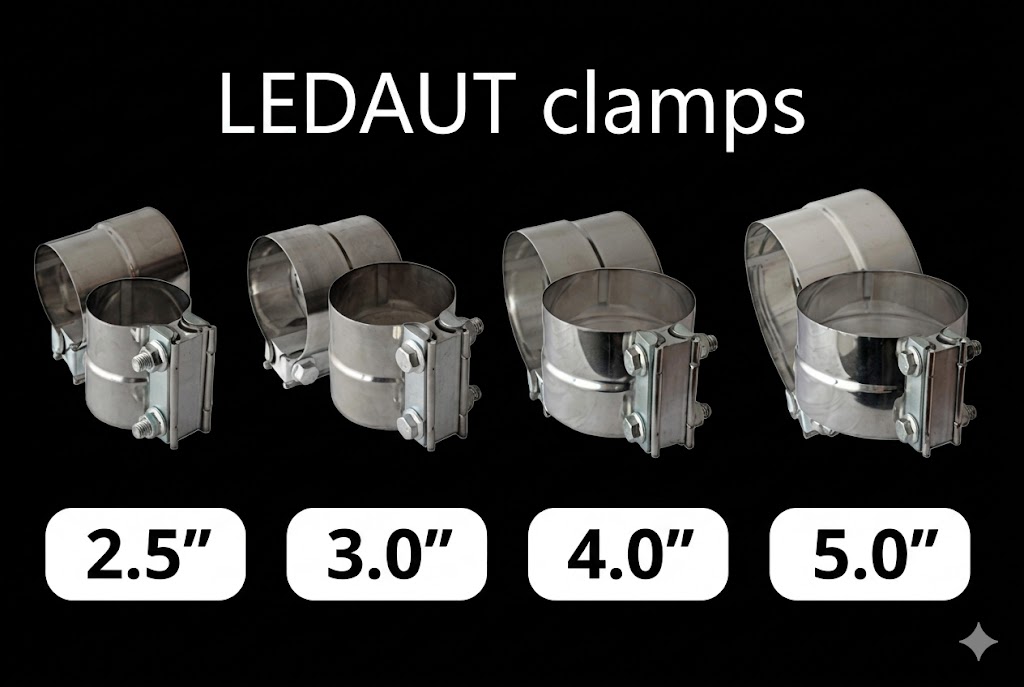
Looking for the right exhaust clamp size? This exhaust clamp size chart covers everything from 2.5″ to 5″ pipe diameters, so you can match the correct clamp to your exhaust system the first time.
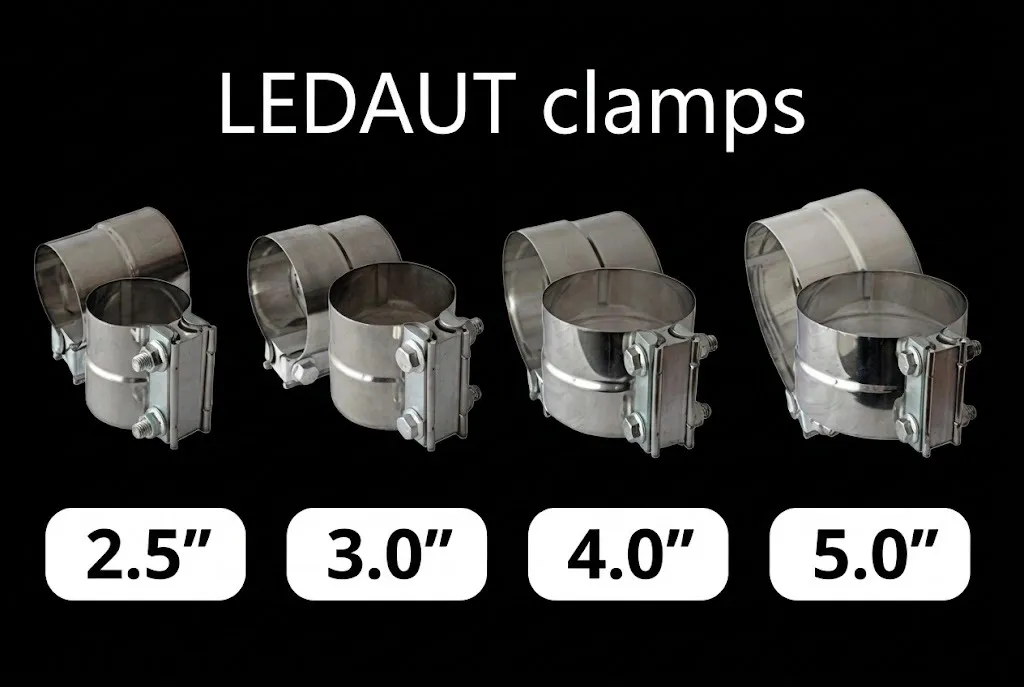
Last month, a guy pulled into our shop with a trunk full of clamps he’d ordered online. He’d spent three weekends trying to install a new exhaust on his Civic. Every exhaust clamp size he’d ordered was wrong — either too tight to slide over the pipe or so loose it spun freely. He looked at me like I held the secrets of the universe when I told him the first thing he needed was a tape measure, not another box of hardware.
I’ve seen this scene more times than I can count. A customer drives in frustrated because the clamp they bought doesn’t fit. They assumed “3-inch exhaust” meant a 3-inch clamp. It doesn’t. That one assumption cost them hours of work and a return shipping label.
This guide will save you that trip. Whether you’re a weekend DIYer or a shop buyer, you’ll know exactly what size to order, how to measure, and which clamp type works for your build.
Exhaust Clamp Size Selection Guide
You might think a clamp is just a clamp. Tighten it down and you’re done. But getting the size wrong creates problems most people don’t see coming.
Too Small: You Can’t Even Get It On
If your pipe’s outside diameter is 3 inches and you buy a clamp rated for 2.5 inches, it physically won’t go over the pipe. No amount of prying or creative swearing will change that. You’ll strip the bolt threads trying to force it open, and then you’ve got a bent clamp and a scratched pipe.
Too Large: It Won’t Seal
Here’s the sneaky one. A 3.5-inch clamp on a 3-inch pipe slides on easily. You tighten the bolt, it feels snug, and you call it done. But the band isn’t making full circumferential contact. There are gaps, and gaps mean exhaust leaks.
An exhaust leak from the wrong exhaust clamp size isn’t just annoying noise. It lets hot gases escape before they reach the catalytic converter, which can trigger your check engine light. Oxygen sensors downstream read false lean conditions because fresh air gets pulled into the exhaust stream. Your engine runs richer to compensate, fuel economy drops, and you’re chasing a phantom problem that started with a half-inch sizing error.
The Ripple Effect
A bad seal also means vibration. When a clamp doesn’t grip properly, the joint becomes a pivot point instead of a fixed connection. That vibration travels through hangers, into the chassis, and eventually shows up as a rattle you can’t locate. I’ve seen customers tear apart half their exhaust chasing a noise that traced back to an undersized band clamp on a slip joint.
How to Measure Your Exhaust Pipe Correctly
This is where most people go wrong. Let me be clear: exhaust pipe sizes are nominal, not exact. And they refer to the outside diameter, not the inside.
OD Is What Matters
When a pipe is labeled as “3-inch,” that’s the outside diameter (OD). The clamp wraps around the outside, so the OD is the number you need. Some manufacturers list the inside diameter (ID), which is smaller by twice the wall thickness. A 3-inch pipe with 0.065-inch wall thickness has an ID of about 2.87 inches. If you measure the ID and order a clamp for that size, you’re going to have a bad time.
The Tape Measure Method
Wrap a flexible tape measure around the pipe where the clamp will sit. That gives you the circumference. Divide by π (3.14159) and you’ve got your OD.
Real example: you wrap a piece of wire around the pipe, mark where it meets, and measure the wire at 9.42 inches. Divide 9.42 by π and you get exactly 3.0 inches. That’s your pipe OD. You need a clamp rated for 3-inch pipe.
No flexible tape? Use a zip tie, a piece of string, even a strip of paper. Mark the overlap, lay it flat against a ruler, and do the math.
Measure at the Right Spot
Pipes aren’t always perfectly round after years of heat cycling and road vibration. Measure in at least two places around the circumference and at two points along the length where the clamp will sit. Use the largest reading. A clamp needs to fit over the widest point.
Common Pitfalls
- Don’t measure the old clamp. Clamps stretch and deform. Measure the pipe itself.
- Don’t guess based on the vehicle model. A “3-inch exhaust” on a Honda Fit might actually measure 2.875 inches OD. An aftermarket system on a Corolla might be a hair over 3 inches. Measure every time.
- Account for overlaps. If you’re clamping a lap joint where one pipe slides inside another, the outer pipe at the overlap will be slightly larger. Measure at the overlap, not on the straight section.
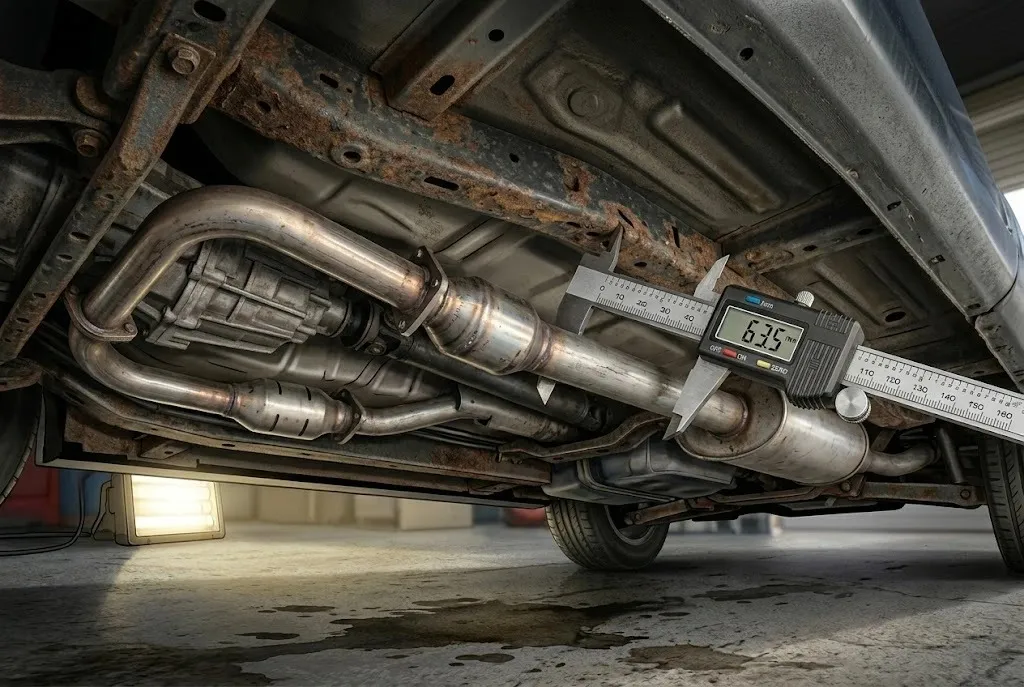
Exhaust Clamp Size Chart by Pipe Diameter
Use this reference table to quickly match your measured pipe outside diameter (OD) to the standard automotive clamp size required for your project.
| Pipe OD (Measured) | Clamp Size | Application Type |
|---|---|---|
| 2.45″ – 2.60″ | 2.5 Inch | Compact Cars, Daily Drivers, OEM Cat-Backs |
| 2.95″ – 3.10″ | 3 Inch | Sport Compacts, Performance Turbos, V6/V8 Exhausts |
| 3.45″ – 3.60″ | 3.5 Inch | Light-Duty Trucks, V8 Performance Upgrades |
| 3.90″ – 4.10″ | 4 Inch | Heavy-Duty Trucks, Diesel Performance Systems |
| 4.90″ – 5.10″ | 5 Inch | Extreme Diesels, Commercial Vehicles, Race Cars |
Common Exhaust Clamp Sizes: 2.5″, 3″, 3.5″, 4″, 5″
Here’s a practical exhaust clamp size reference breakdown for the most standard piping on the market.
2.5-Inch Exhaust Clamp
Typical OD range: 2.45″ to 2.60″
The most common size for stock and mild aftermarket exhausts:
- Honda Fit / Jazz (stock exhaust)
- Toyota Corolla (OE and many aftermarket systems)
- Mazda 3 (factory exhaust piping)
- Most compact sedans and hatchbacks from the 2010s onward
If you’re doing a cat-back on a daily driver, there’s a very good chance you need a 2.5-inch clamp. It’s also the go-to exhaust clamp size for resonator deletes and muffler swaps on smaller displacement engines.
3-Inch Exhaust Clamp
Typical OD range: 2.95″ to 3.10″
The standard for performance builds:
- Turbocharged builds (Subaru WRX, Mitsubishi Evo, VW GTI)
- Aftermarket cat-back systems on V6 and small-block V8 platforms
- Most universal performance mufflers and resonators
- Mid-pipe upgrades on sport compacts
If you’ve gone turbo or you’re running a performance exhaust system, this exhaust clamp size is your baseline. Many shop buyers keep a box of 3-inch clamps on hand because they cover the majority of performance applications.
3.5-Inch Exhaust Clamp
Typical OD range: 3.45″ to 3.60″
The intermediate mid-size standard often utilized for:
- Upgraded full-size V8 truck exhausts (e.g., Ford F-150, Chevy Silverado 1500)
- High-horsepower naturally aspirated street/strip builds
- Mid-pipe transitions for large-frame turbo piping systems
This mid-range exhaust clamp size serves as a critical bridge between standard high-performance applications and high-volume heavy-duty diesel piping setups.
4-Inch Exhaust Clamp
Typical OD range: 3.90″ to 4.10″
Big-pipe territory:
- Heavy-duty trucks (Ford F-250/350, Chevy Silverado 2500HD, Ram 2500)
- Diesel performance exhausts (Duramax, Power Stroke, Cummins)
- Large-displacement V8 builds (LS swaps, big-block Chevys)
- Off-road and overland rigs with upgraded exhaust systems
Diesel trucks in particular run larger piping to handle increased exhaust volume from turbo setups. If you’re working on a diesel, measure twice — the right exhaust clamp size matters with these large-diameter pipes.
5-Inch Exhaust Clamp
Typical OD range: 4.90″ to 5.10″
The heavy-hitter size:
- Race builds and drag cars
- Commercial vehicle exhaust upgrades
- Extreme diesel performance (compound turbo setups)
- Custom fabrication on large-frame vehicles
You won’t see 5-inch piping on a daily driver. This is for builds where exhaust flow is the limiting factor. If you’re ordering 5-inch clamps, you probably already know what you’re doing — but measure anyway.
Lap Joint vs U-Bolt vs V-Band: Which Clamp Type?
Size is only half the equation. The clamp type determines how well the joint holds up under heat, vibration, and time.
Lap Joint (Band) Clamps
A lap joint clamp — sometimes called an exhaust band clamp — uses a wide stainless steel band that wraps around the pipe overlap. A single bolt draws the band tight, creating 360-degree clamping force around the entire circumference.
This is the type we manufacture at LEDAUT, and there’s a reason it’s our flagship product. The wide band distributes pressure evenly, which means no hot spots, no pipe deformation, and a seal that holds up through thousands of heat cycles. The lap joint design also accommodates slight misalignment between pipes, which is incredibly useful when you’re working under a vehicle with limited access.
According to industry guidance from Speedway Motors, lap joint clamps are generally preferred for their even pressure distribution and ease of installation compared to traditional U-bolt designs. They’re the standard in European and Japanese OEM applications for good reason.
Exhaust Clamp Size and Material Selection
The stainless steel construction matters. Our clamps use SS304, which contains approximately 18% chromium and 8% nickel — the composition that gives it excellent corrosion resistance and the ability to withstand exhaust temperatures without degrading. This is the same grade used in marine environments, so it handles road salt and condensation without issue. Choosing the correct clamp size paired with high-quality SS304 material guarantees your installation remains leak-free indefinitely.
U-Bolt Clamps
U-bolt clamps are the old-school design: a U-shaped bolt passes through two saddle brackets on either side of the pipe, and nuts on both ends pull everything tight.
They’re cheap and widely available. The problem: clamping force concentrates at two points rather than distributing around the full circumference. This can cause the pipe to ovalize over time, especially on thinner-walled aftermarket piping.
U-bolts are fine for temporary fixes or budget builds. For anything you want to last, I’d recommend a band clamp.
V-Band Clamps
V-band clamps use a two-piece flange system with a V-shaped groove and a band that locks the flanges together. They’re common in turbo plumbing because they allow quick disassembly — loosen one bolt and the joint comes apart.
The downside is cost and complexity. You need matching V-band flanges welded onto both pipes, which means you can’t just slip a V-band clamp onto existing piping. They’re also more expensive per unit. If you’re building a turbo system where you need to swap components frequently, V-bands are worth it. For a standard exhaust repair, they’re overkill.
Three Real-World Scenarios
Scenario 1: 2.5-Inch Bell Mouth on a Daily Driver
A 2020 Corolla comes in with a cracked flex pipe. The replacement uses a bell mouth connection slipping over the existing pipe. The OD measures 2.5 inches at the overlap.
Solution: Two 2.5-inch lap joint clamps, spaced about an inch apart. The bell mouth creates a natural step, and the wide band seals that transition cleanly. Two clamps give you redundancy if one loosens from vibration. Install takes ten minutes.
Scenario 2: 3-Inch Turbo Back on a WRX
A Subaru WRX owner installs a full turbo-back exhaust. Downpipe, mid-pipe, and cat-back are all 3 inches, with four slip joints along the route.
Solution: Four 3-inch exhaust clamp units, one at each joint. Turbo applications run higher exhaust gas temperatures, so stainless steel is non-negotiable. Many builders also pair clamps with an exhaust cutout for switchable sound — the cutout kit itself needs properly sized clamps at both connections.
Scenario 3: Resonator Replacement with Four-Clamp Setup
A truck owner wants to replace a failed resonator. The new unit has slip-fit connections on both ends, and the existing piping is 3.5 inches OD. The manufacturer recommends two clamps per connection.
Solution: Four 3.5-inch lap joint clamps. The four-clamp approach distributes sealing force across a longer section of the overlap, which is especially important on larger-diameter piping where a single clamp might not generate enough uniform pressure. Buying in a four-pack makes economic sense too.
Where to Buy the Right Clamp
You’ve measured your pipe. You know the exhaust clamp size. You’ve picked the clamp type. Now where do you get them?
Factory Direct
Buying direct from the manufacturer cuts out the middleman markup. At LEDAUT, we make our own stainless steel lap joint clamps in-house, which means we control the material quality, the tolerances, and the pricing. You get SS304 stainless steel hardware at a price that reflects actual manufacturing cost, not three layers of distributor markup.
Amazon
For speed and convenience, our clamps are available on Amazon. Search for our store or look for ASIN B082SBTBZG — that’s our stainless steel lap joint exhaust band clamp listing. Prime shipping means you can order on a Tuesday and have the clamps in your garage by Thursday. The reviews are from real customers who’ve used them on real builds.
What to Look For
- Material: SS304 stainless steel minimum. Avoid mild steel or coatings that rust within a year.
- Size range: Make sure the adjustable range covers your measured OD with room to tighten.
- Bolt quality: The bolt is the weakest point. Look for stainless bolts with proper thread engagement, not cheap zinc-plated hardware.
Final Thoughts
Choosing the right exhaust clamp size isn’t complicated, but it does require you to stop guessing and start measuring. Grab a tape measure, wrap it around the pipe, divide by π, and order accordingly. It takes thirty seconds and saves you hours of frustration.
The clamp type matters just as much as the exhaust clamp size. For most applications, a stainless steel lap joint band clamp gives you the best combination of sealing performance, durability, and ease of installation. U-bolts work in a pinch, and V-bands are great for race builds — but for the vast majority of DIY installs and shop jobs, the band clamp is the right tool.
We’ve been making these clamps for years, and the feedback from customers tells the same story: measure first, buy quality, and don’t cheap out on the hardware that holds your entire exhaust system together. A ten-dollar clamp is a small price to pay for a quiet, leak-free exhaust that lasts.
Frequently Asked Questions
What size exhaust clamp do I need for a 2.5 inch pipe?
For a 2.5″ exhaust pipe (which is actually 2.5″ outside diameter, ~2.5″ OD), order a 2.5″ exhaust clamp. Always measure your actual pipe OD with a caliper or tape measure before ordering — pipe nominal sizes can vary slightly between manufacturers. If your pipe is between standard sizes, round up to the next standard clamp size for a tighter seal.
How do I measure exhaust pipe diameter for a clamp?
Use a digital caliper for the most accurate reading. Measure the outside diameter (OD) of the pipe — not the inside. Place the caliper perpendicular to the pipe axis, measure across the widest point. Tape measures work in a pinch, but they can compress the pipe slightly and give false readings. For 2.5″ nominal pipe, the actual OD is usually 2.5″ ±0.05″.
What’s the difference between lap joint and U-bolt clamps?
Lap joint clamps (also called band clamps) wrap fully around the pipe joint and provide even 360° sealing pressure. They’re best for high-torque applications and slip joints. U-bolt clamps use a U-shaped bolt with two nuts to compress a saddle — they’re cheaper and easier to install, but create uneven pressure points and can warp thin pipes. For performance exhaust or any application where leak prevention matters, lap joint clamps are the better choice.
Can I use a 2.5 inch clamp on a 2.25 inch pipe?
No — a 2.5″ clamp on a 2.25″ pipe will be too loose. The clamp needs to match the pipe OD, not the joint OD. If you’re connecting a 2.5″ pipe to a smaller component, you need a reducer or a stepped clamp, not just a larger clamp. Using the wrong size clamp is the most common cause of exhaust leaks.
How tight should an exhaust clamp be?
Tighten the clamp until the joint is fully sealed and there’s no visible gap, but don’t over-torque. For lap joint band clamps, aim for 25-30 ft-lbs of torque on the bolt. For U-bolt clamps, tighten until the saddle makes full contact with the pipe and the nuts are snug — typically 15-20 ft-lbs. Over-tightening can crack the clamp or warp the pipe.
What size exhaust clamp do I need for a 3 inch pipe?
For a standard 3″ exhaust pipe (3″ OD), order a 3″ exhaust clamp. This is one of the most common sizes and fits most factory-style systems. If your pipe has been resized or you’re running aftermarket tubing, always measure the actual OD. Some 3″ mandrel bent systems use 3.0″ actual OD while others may be 3.00″ ±0.05″.
Do I need a different clamp for stainless steel vs aluminized exhaust?
Use the same clamp size for both materials — the clamp doesn’t need to match the pipe material, just the OD. However, use a stainless steel clamp on stainless steel exhaust to prevent galvanic corrosion. Mixing mild steel clamps with stainless pipes causes the mild steel clamp to rust out within 1-2 years, even if the pipe is fine.
What’s the largest exhaust clamp size available?
Standard exhaust clamp sizes go up to 5″ or 6″ for most automotive applications. LEDAUT offers exhaust clamps from 2″ to 6″ OD. For truck diesel or industrial applications, larger sizes (up to 8″ or 10″) are available as special order. If you need a non-standard size, contact us for custom manufacturing.