Types of Exhaust Clamps
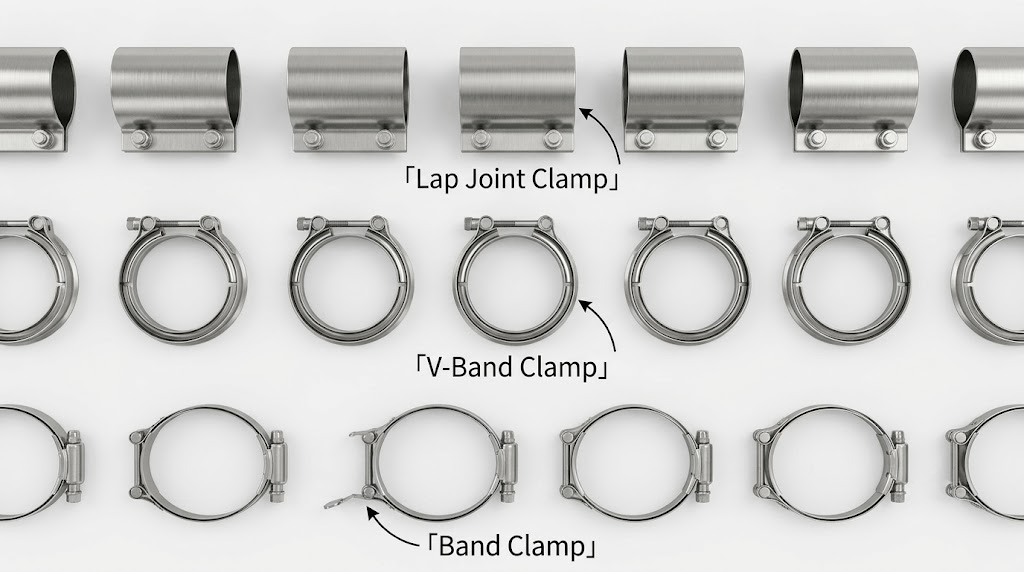
The most expensive exhaust clamp isn’t the best choice for most jobs. In fact, the humble lap joint clamp — the one that looks “basic” sitting next to a polished V-band — is what holds most exhaust systems together, because it’s simple, weld-free, and easy to service. Fancy V-bands have their place, but they’re not a universal upgrade.
We’ve been supplying exhaust components for over twenty years, and the most common failure we see is someone grabbing whatever clamp fits the pipe diameter without considering joint type — then calling us three weeks later because it’s leaking or the pipe collapsed under clamping pressure. That’s the trap: a clamp that “fits” isn’t necessarily the right clamp for the job. The difference between a clean install and a callback comes down to understanding how each clamp type works with the joint geometry. Here’s how to pick the right clamp type for your application.
TLDR
- Lap joint clamps work on overlapping pipe ends (one tube inserted into another flared end) — semi-permanent, no welding required, easier disassembly than welded joints but harder than V-band .
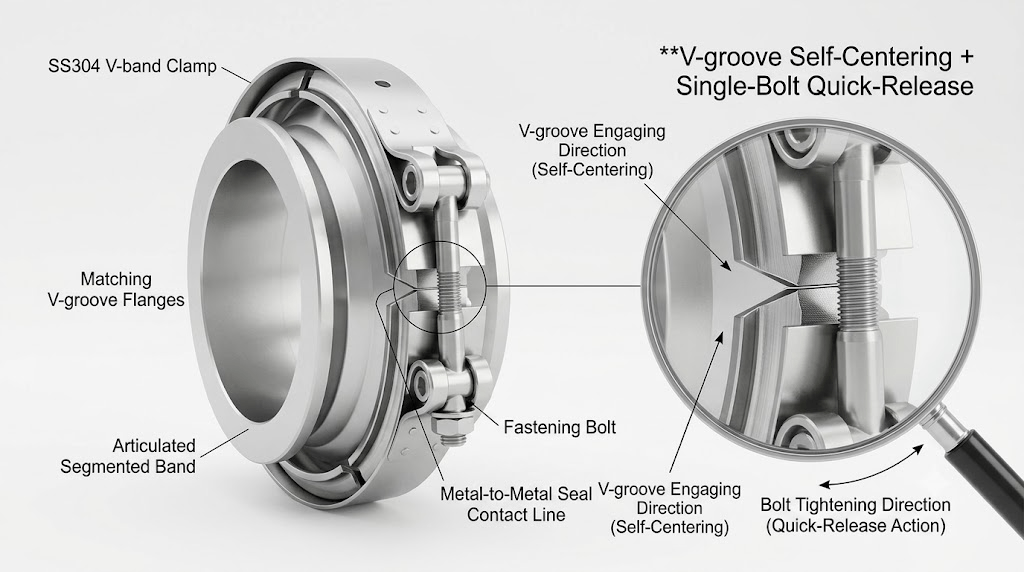
- V-band clamps are the go-to for frequent disassembly (turbo setups, race cars) — flange-to-flange connection with single-bolt quick release .
- Band clamps provide 360° uniform clamping without deforming the pipe wall (unlike U-bolts which crush tubing); best for larger diameters up to 6–8 inches and high-seal requirements .
- LEDAUT specializes in lap joint and butt joint clamps only — focused production means consistent molds and stable lead times for B2B buyers .
- Selection rule: different outer diameters → lap joint with reducer; same outer diameter flat ends → butt joint clamp.
Why Clamp Type Matters
Choosing the wrong clamp doesn’t just cause leaks — it can distort the pipe, restrict flow, or fail under thermal cycling. We see this constantly: a shop orders a generic U-bolt clamp for a stainless steel exhaust, torques it down hard, and ends up with an oval-shaped pipe section that creates turbulence and noise. The clamp held, but the system didn’t.
Clamp selection affects three things: sealing integrity, serviceability, and longevity. A clamp that seals well today might loosen after fifty heat cycles. A clamp that’s easy to remove might not hold up under vibration. Understanding the mechanics behind each type helps you match the hardware to the job.
For a broader overview of exhaust system components, see our exhaust clamps guide.
Lap Joint Clamps
Lap joint clamps are designed for overlapping pipe connections — one tube slides into another tube with a flared or expanded end. This is the standard configuration for many factory exhaust systems and aftermarket slip-fit assemblies.
Design and Application
The lap joint design relies on surface contact between the inner and outer tubes. The clamp wraps around the overlap zone and tightens to create radial pressure, holding the two pieces together. No welding is required, which makes this a popular choice for shops that want to avoid permanent modifications — there’s no heat to warp thin-wall tubing, no need for a certified welder on hand, and the job can be done with a basic socket set in a driveway rather than on a lift.
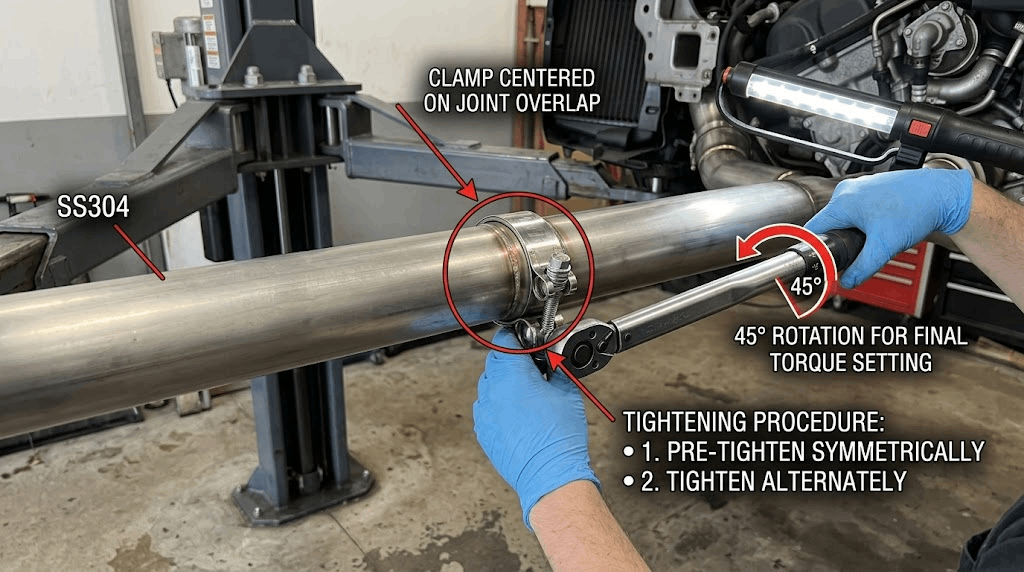
Installation is straightforward, but the bolt-tightening order matters. After sliding the inner tube into the flared outer end until it bottoms out, position the clamp so it sits centered over the overlap. Hand-tighten both bolts first to keep the clamp square, then torque them alternately in small increments — a quarter turn on one side, a quarter turn on the other — rather than running one side fully home first. This keeps the clamping pressure even across the band. For a typical 2.5-inch SS304 clamp, torque to the value on the product spec sheet — for reference, most 2.5-inch lap joint clamps land in the 25–30 ft-lb range; go past that on thin-wall tubing and you’ll crush the pipe instead of sealing it. Back off and re-seat the clamp if you feel the band bind before both bolts are snug.
LEDAUT manufactures lap joint clamps in SS304 stainless steel with silicone gasket options for enhanced sealing. Our lap joint clamps come in standard sizes covering common exhaust pipe diameters, with OEM/ODM support for custom dimensions.
The key advantage of lap joints is flexibility in pipe sizing. When you’re connecting pipes of different outer diameters, a lap joint with a reducer sleeve is the natural solution — the smaller tube inserts into the larger one, and the clamp secures the overlap. This is a daily occurrence in exhaust work: stepping up from a 2.25-inch downpipe to a 2.5-inch mid-pipe, or necking down into a resonator. Instead of machining an adapter and welding it in, you buy a reducer clamp sized to the two diameters and finish the job in minutes. This is why lap joint clamps dominate factory exhaust assemblies where manufacturing tolerances vary.
Pros and Cons
Pros:
- No welding required — faster assembly, reversible installation
- Accommodates different pipe diameters with reducer sleeves
- Lower cost than V-band systems
- Widely available in standard sizes
Cons:
- Disassembly is more labor-intensive than V-band (requires loosening clamp and separating overlapped tubes)
- Not truly permanent — better described as semi-permanent since it can be taken apart with effort – Overlap zone adds length to the exhaust run (plan for extra space)
- Seal quality depends on surface finish and clamp torque consistency
For product specifications, see our lap joint exhaust clamps page.
V-Band Clamps
V-band clamps are the racing industry standard for connections that need frequent disassembly. If you’ve ever watched a turbo swap at a track day, you’ve seen V-bands in action — one bolt, quick release, done.
Design
A V-band clamp consists of two flanged pipe ends with matching V-grooves, connected by a hinged band with a single bolt. When tightened, the band pulls the flanges together, creating a metal-to-metal seal through the V-groove interface. Some designs include a separate gasket ring for additional sealing security.
The V-groove geometry is critical — it centers the pipes automatically and distributes clamping force evenly around the circumference. This self-centering feature is why V-bands are preferred for precision applications like turbocharger mounting, where misalignment causes stress concentrations and premature failure.
That self-centering only works if the flanges are installed straight. The two V-band flanges must be welded onto the pipe ends so their faces sit parallel and centered on the same axis — even a slight tilt makes the clamp cock to one side and the seal load up unevenly. If you’re welding them yourself, tack the flanges in place with the clamp loosely fitted first, confirm the gap is even all the way around, then finish the welds. Warp from welding is a real risk on thin flanges, so let the assembly cool between passes rather than running one continuous bead. A drop of anti-seize on the bolt threads is cheap insurance against a seized clamp after a hard track session.
Pros and Cons
Pros:
- Fastest disassembly of any clamp type — single bolt removal
- Self-centering design ensures proper alignment every time
- Excellent for high-vibration environments (racing, off-road)
- Clean appearance, professional finish
Cons:
- Requires matching V-band flanges on both pipe ends (welding or machining needed)
- Higher cost per connection than lap joint or band clamps
- Limited to same-diameter connections (no reducer capability without adapters)
- Bolt can seize under extreme heat if not using anti-seize compound
V-band clamps are ideal for positions that require regular access — turbo inlet/outlet, intercooler piping, or any section you anticipate removing for maintenance or upgrades .
If your build calls for V-band connections, source the flanges and clamps as a matched set — mismatched flange geometry is the most common cause of V-band leaks.
Band Clamps
Band clamps (also called sleeve clamps) wrap completely around the pipe joint and apply uniform 360° pressure. This is fundamentally different from U-bolt clamps, which concentrate force at two points and can deform thin-wall tubing.
Design
A band clamp consists of a continuous metal band with a tightening mechanism (typically a bolt-and-nut or lever-action cam). The band sits flush against the pipe surface, distributing clamping force evenly around the entire 360° circumference. Because the band is a full circle with no dead spots, it compresses the joint uniformly — every degree of the pipe wall receives the same squeeze. This uniform pressure prevents the pipe from collapsing or becoming oval-shaped — a common problem with U-bolt clamps on stainless steel exhausts.
The sealing difference comes down to contact geometry. A U-bolt clamp squeezes at two narrow points, leaving the areas between them under-tensioned. Exhaust gas and condensate find those gaps, and over repeated heat cycles the pipe wall creeps out of round. A band clamp eliminates those gaps by design. On larger diameters — 4 inches and up — this difference becomes dramatic, because a U-bolt has to be reefed down hard to reach the far side of the pipe, which is exactly what crushes it. For a 6-inch diesel exhaust section, we always steer customers to a full-circle band clamp: lay the band over the joint, make sure it’s centered and its edges sit square to the pipe, then tighten evenly until the band seats. It should be snug, not gorilla-tight — if the band is doing its job, moderate torque is all it takes to seal.
LEDAUT produces stainless steel band clamps suitable for pipe diameters up to 6–8 inches, making them ideal for larger exhaust systems where seal integrity is critical. The SS304 construction resists corrosion, and silicone gasket options provide additional leak protection for high-pressure applications .
Band clamps excel in applications where:
- Pipe wall thickness is thin (risk of crushing with point-load clamps)
- Large diameters require uniform sealing pressure
- The joint experiences significant thermal expansion and contraction
Pros and Cons
Pros:
- 360° uniform clamping prevents pipe deformation
- Suitable for large diameters (up to 6–8 inches)
- Better seal integrity than U-bolt clamps
- Works well with thin-wall stainless steel tubing
Cons:
- Slightly more expensive than basic U-bolt clamps
- Installation requires careful positioning to ensure even band contact
- Bulkier profile than lap joint clamps (may interfere with nearby components)
- Not as quick to disassemble as V-band systems
For detailed specs, check our stainless steel band clamps catalog.
How to Choose the Right Clamp
Selection comes down to three questions: What’s the joint geometry? How often will you need to disassemble it? What’s the pipe diameter and wall thickness?
Joint geometry first. If you’re connecting pipes of different outer diameters, lap joint clamps with reducer sleeves are your only practical option. If both pipes have the same outer diameter and flat-cut ends, butt joint clamps (a subtype of band clamps) work well. If you have V-band flanges already welded on, use V-band clamps — don’t try to adapt other clamp types to V-band flanges.
Serviceability second. Ask yourself: will this connection need to come apart? If yes, how often? For frequent disassembly (turbo swaps, dyno testing), V-band is worth the premium. For occasional access (muffler replacement, cat inspection), lap joint clamps strike a good balance. For permanent or semi-permanent installations, band clamps provide reliable long-term sealing.
Pipe specs third. Thin-wall stainless steel (common in performance exhausts) demands uniform clamping pressure — band clamps or high-quality lap joint clamps with wide contact surfaces. Thick-wall mild steel can tolerate U-bolt clamps, but we still recommend band clamps for better seal consistency. For diameters above 4 inches, band clamps become increasingly advantageous as U-bolt clamps struggle to maintain even pressure.
LEDAUT focuses exclusively on lap joint and butt joint clamps — we don’t manufacture V-band or U-bolt systems. This specialization means our molds are optimized for these two categories, resulting in consistent quality and stable lead times for B2B buyers who value predictability over variety . If your project requires V-band or U-bolt clamps, source those separately and pair them with our lap/butt joint clamps for the sections where they’re the best fit.
FAQ
Questions we hear from distributors and fabrication shops:
Q: Can I use a lap joint clamp on a butt joint (flat-cut pipes)?
No. Lap joint clamps require one pipe to insert into another. For flat-cut pipes with matching diameters, use a butt joint clamp (a type of band clamp) or weld a sleeve connector first.
Q: Are V-band clamps worth the extra cost?
For connections you’ll disassemble regularly, yes. The time savings on a turbo swap or race-day adjustment pays for itself quickly. For permanent installations, lap joint or band clamps are more cost-effective.
Q: Why do you only make lap joint and butt joint clamps?
We specialize in these two categories because they cover the majority of exhaust assembly scenarios for our B2B customers. Focused production means better mold consistency, tighter tolerances, and more reliable lead times. It’s a trade-off: less variety, more reliability .
Q: Will band clamps work on aluminum exhaust piping?
Yes, but use caution with torque. Aluminum is softer than steel and deforms more easily under clamping pressure — a clamp torqued for stainless will crush 6061 tubing. Use a torque wrench and stay well below the value you’d use on steel (roughly half is a safe starting rule of thumb), and stop tightening the moment the clamp seats and the joint feels solid. Band clamps are actually preferable to U-bolts for aluminum because they distribute force evenly, reducing the risk of crushing the pipe in the first place.
Q: What’s the maximum pipe diameter for band clamps?
LEDAUT band clamps support diameters up to 6–8 inches, depending on the specific model. For larger diameters, contact us for custom solutions — we offer OEM/ODM services for specialized requirements.
Conclusion
If you only remember one thing from this guide, make it this: match the clamp to the joint, not just the pipe size. Check the joint geometry, decide how often the connection needs to come apart, then pick the clamp type that fits — and if the diameters don’t match, reach for a reducer before you reach for a bigger wrench.
Need Custom Clamp Solutions?
LEDAUT manufactures lap joint and butt joint exhaust clamps in SS304 stainless steel, with silicone gasket options and OEM/ODM support for distributors and fabrication shops worldwide. [Contact LEDAUT for specifications and OEM/ODM options] on custom diameters, materials, and packaging requirements.
—