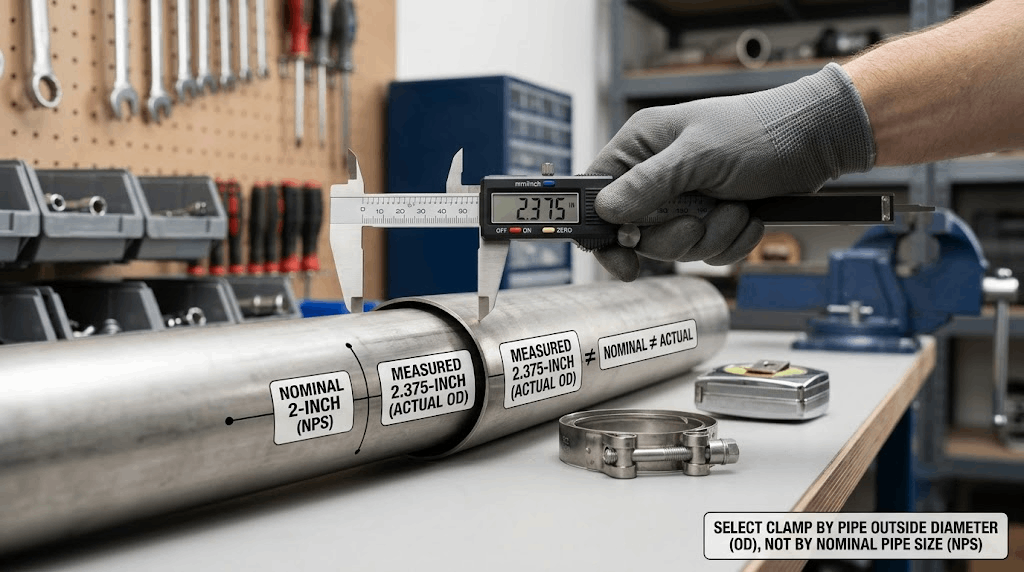
Most clamp mistakes aren’t about buying the wrong clamp — they’re about buying it to the wrong size. Ask ten techs what clamp fits a 2-inch pipe and half will quote the nominal size, not the actual outer diameter. A 2-inch NPS schedule 40 pipe isn’t 2 inches across; it’s 2.375 inches OD. Order the “2-inch” clamp and you’re short by nearly half an inch, leaving a gap no amount of tightening can seal. Measure the actual OD with calipers — or, if you don’t have a set handy, wrap a string around the pipe and divide the circumference by 3.14 — and the whole decision gets simpler. From there it’s just materials (stainless where it’s hot, aluminum only on the cool tail section) and torque to spec (band 40–45, U-bolt 30–35, V-band 10–14 ft-lbs). Here’s how to get it right the first time.
TLDR
- Size clamps by the pipe’s actual outer diameter (OD), not nominal size (NPS/DN). Use calipers or measure circumference ÷ 3.14.
- Stainless steel (SS304) handles high-temperature zones (headers, turbo); aluminum works only on cool tail sections below 200°C.
- Band clamps need 40–45 ft-lbs torque; U-bolt clamps need 30–35 ft-lbs; V-band clamps need 10–14 ft-lbs.
- Distinguish aluminum (lightweight, low heat tolerance) from aluminized steel (steel core with coating, fully suitable for exhaust).
- Avoid overtightening — it crushes pipes or snaps clamps.
How to Choose the Right Exhaust Clamp for Your Application
Before you pick a clamp, ask: where does this joint live in the exhaust system? Not all positions are equal. A clamp holding together the downpipe after a turbo sees sustained temperatures above 1,200°F and constant vibration. One on the tailpipe behind the muffler runs cooler (under 400°F) and moves less.
We see two broad categories in our customer base: performance builds and OEM replacements. Performance shops care about flow — they want minimal restriction and easy removal for tuning. Fleet operators care about durability — they want clamps that survive 100,000 miles without retorquing. Both groups share one habit that causes most of their clamp problems: sizing from memory instead of measuring the actual pipe. That’s the mistake worth fixing first, and it’s the whole point of the section below.
If you’re new to exhaust work, start with our Exhaust Clamps Guide for a broader overview of when clamps beat welding and when they don’t.
Measuring Pipe Size Correctly
This is where most failures begin. You can’t eyeball pipe diameter and expect accuracy. Even experienced techs misjudge by 1/8 inch or more — enough to cause a leak under thermal cycling.
Use digital calipers for precision. Measure the outer diameter at three points around the pipe (top, side, bottom) and average the readings. Pipes aren’t always perfectly round, especially after bending or heat exposure. If you don’t have calipers, use the string method: wrap a piece of fine wire or string tightly around the pipe, mark where it overlaps, then measure the length with a ruler. Divide that circumference by 3.14 to get the OD. This trick works in a pinch, but it’s less accurate than calipers — expect ±1/16 inch variance.
Record the measurement in decimal inches (e.g., 2.375″), not fractions. Clamps are sold by OD ranges, and fractional conversions introduce rounding errors. A clamp labeled “2.25–2.50 inch OD” won’t fit a pipe measuring 2.51 inches, even though “2.5 inches” sounds close enough.
Check for ovality. If your three-point measurements vary by more than 0.05 inches, the pipe is out of round. Standard band clamps struggle with oval pipes — consider a V-band clamp or have the pipe section replaced.
Material Selection Guide
Material choice determines whether your clamp survives one season or ten years. The exhaust environment is brutal: thermal cycling from ambient to 1,500°F, road salt, moisture, and vibration. Cheap materials fail predictably.
Stainless Steel: The Workhorse
Stainless steel dominates high-temperature applications. Two grades dominate the market:
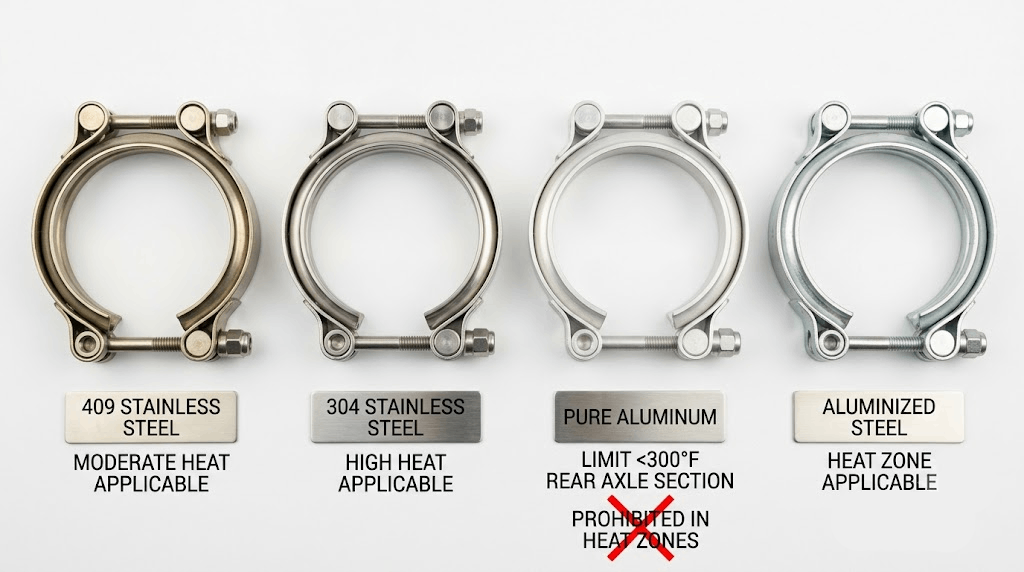
409 stainless is the economic option. It resists corrosion well but may develop surface discoloration (yellowing) or thin rust spots after extended heat exposure. This doesn’t affect structural integrity — the clamp still holds. We see 409 perform reliably in mid-pipe and muffler connections where temperatures stay below 1,200°F.
304 stainless offers superior corrosion resistance and maintains its appearance longer. It’s the go-to for visible installations (show cars, custom builds) and extreme-heat zones like turbo outlets. The higher cost is justified when aesthetics matter or when the clamp faces constant salt spray (coastal regions, winter roads).
Both grades handle the full temperature range of automotive exhaust systems. LEDAUT manufactures our clamp bodies and bands in SS304 for consistent quality across our product line.
Aluminum vs. Aluminized Steel: Know the Difference
This is the most common confusion we encounter as a supplier. Customers ask for “aluminum clamps” thinking they’re getting lightweight, rust-proof hardware. What they often receive is aluminized steel — regular steel coated with an aluminum-silicon alloy. These are different materials with different limits.
Aluminum clamps (true aluminum, not coated steel) exist and are genuinely lightweight and rust-proof. But aluminum softens above 200°C (392°F) and loses strength rapidly beyond that point. They’re suitable only for tailpipe sections behind the muffler, where temperatures rarely exceed 300°F. Never use aluminum clamps near headers, catalytic converters, or turbochargers — they’ll deform under heat and fail.
Aluminized steel clamps have a steel core with an aluminum-based coating. The steel provides structural strength at high temperatures; the coating resists surface corrosion. These are fully suitable for exhaust applications, including hot zones. The confusion arises because both materials look similar when new — silvery and bright. Check the product spec: if it says “aluminum,” verify the maximum operating temperature. If it says “aluminized steel,” it’s safe for standard exhaust use.
When in doubt, default to stainless steel. It eliminates the guesswork and handles every position in the system.
Clamp Type Decision Tree
Not all clamps work everywhere. Your choice depends on accessibility, required strength, and whether you need future removal.
Band clamps wrap around the joint and tighten via a bolt. They distribute pressure evenly, making them ideal for butt joints (two pipes butted end-to-end). Band clamps require 40–45 ft-lbs of torque for proper sealing. They’re removable, which helps during maintenance, but they need adequate clearance for the tightening tool. See our “Types of Exhaust Clamps” article for detailed comparisons.
U-bolt clamps use a U-shaped bolt that passes through two ears on the clamp body. They’re simpler to install than band clamps but concentrate force at two points, which can distort thin-wall pipes. Torque specification: 30–35 ft-lbs. Works well for slip-fit joints where one pipe inserts into another.
V-band clamps feature a flanged connection with a segmented ring that tightens via a single bolt. They provide the strongest, most leak-proof seal and are standard in racing and turbo applications. However, they require matching V-band flanges on both pipes — you can’t retrofit them to plain pipe ends. Torque: 10–14 ft-lbs. For a deeper dive, read our V-band clamp types comparison.
Quick rule: If you need maximum strength and have matching flanges, use V-band. If you’re joining plain pipe ends and want removability, use band clamps. If budget is tight and the joint is simple, U-bolt works.
Common Sizing Mistakes
These errors show up as customer callbacks and rework:
Ordering by nominal size. As noted earlier, NPS labels don’t match physical dimensions. Always measure OD.
Ignoring wall thickness. Two pipes with the same OD can have different wall thicknesses (schedule 10 vs. schedule 40). A clamp sized for thin-wall pipe may bottom out before securing thick-wall pipe, leaving a gap.
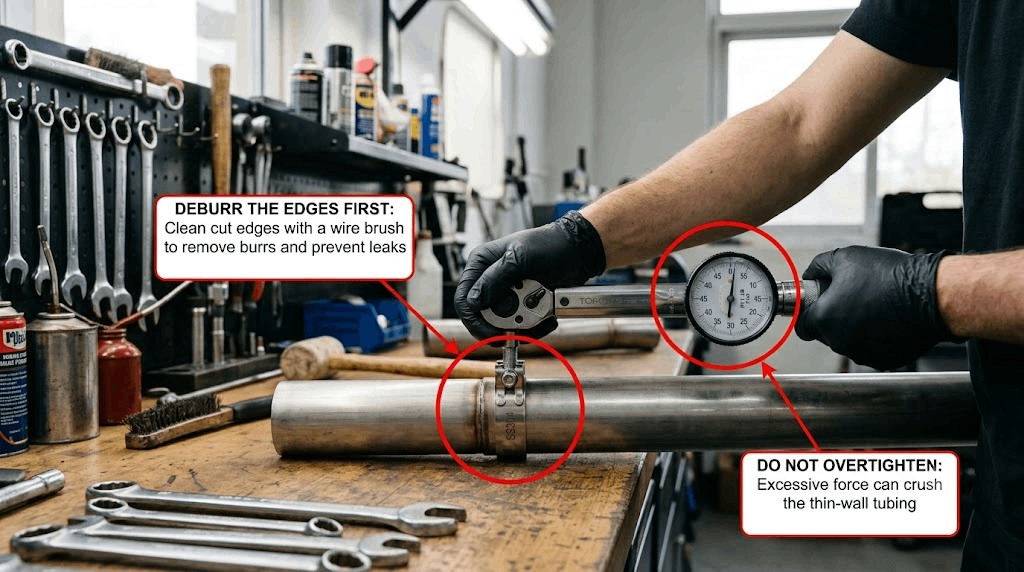
Overtightening. More torque isn’t better. Exceeding the recommended ft-lbs crushes the pipe, distorts the clamp, or strips threads. Use a torque wrench — don’t guess. Over-tightened band clamps snap at the bolt hole; overtightened U-bolts bend the ears.
Undertightening. Loose clamps leak immediately and worsen with vibration. Retorque after the first heat cycle — thermal expansion loosens bolts.
Mixing materials. A stainless clamp on a mild steel pipe will see the mild steel side rust first where moisture sits — that’s galvanic corrosion at the dissimilar-metal contact. Anti-seize on the hardware won’t stop it, but it does keep the joint serviceable so you can still get the clamp off later.
Skipping deburring. Rough cut edges dig into clamp bands, creating stress points that crack under vibration. File or grind cut edges smooth before installing any clamp.
FAQ
Q: Can I reuse an exhaust clamp?
It depends. Band clamps and U-bolt clamps can be reused if the bolt threads aren’t stripped and the band isn’t cracked. Inspect for deformation — if the clamp looks bent or the bolt holes are elongated, replace it. V-band clamps are generally reusable if the flanges are undamaged.
Q: What happens if I use the wrong size clamp?
A clamp that’s too small won’t fit. A clamp that’s too large won’t seal, even when fully tightened. The gap allows exhaust gases to escape, causing leaks, noise, and potential carbon monoxide entry into the cabin. In severe cases, escaping hot gas can damage nearby components (wiring, brake lines).
Q: Do I need special tools to install exhaust clamps?
For band and U-bolt clamps, a socket wrench or torque wrench suffices. V-band clamps often require a specific Allen key or socket. Use a torque wrench to avoid overtightening — guessing leads to failure.
Q: How do I choose exhaust clamp size for irregular pipes?
Measure the largest OD you encounter. If the pipe is significantly oval (more than 0.05 inches variance), standard clamps won’t seal properly. Consider replacing the pipe section or using a flexible coupling designed for non-round pipes.
Q: Are stainless steel clamps worth the extra cost?
For high-temperature or corrosive environments, yes. Stainless lasts longer, resists rust, and maintains appearance. For temporary fixes or low-heat tailpipe sections, aluminized steel or even mild steel with coating may suffice. But given the labor cost of reinstallation, upgrading to stainless upfront usually saves money long-term.
For the full range of clamp types and materials, see the exhaust clamps collection.
Conclusion
Choosing the right exhaust clamp comes down to three things: measure the actual OD, match material to temperature, and torque to spec. Skip any of these, and you’re inviting a callback.
Ready to Spec Your Clamps?
LEDAUT manufactures a full size range of lap joint and butt joint clamps in SS304 stainless steel and silicone-sealed configurations, with OEM/ODM support for distributors and modification shops worldwide. Contact LEDAUT for specifications and OEM/ODM options on custom diameters, material grades, and integration kits.