Why Modification Shops Prefer SS304 Band Clamps Over Cheap Alternatives
The Day I Stopped Selling Cheap Clamps
I’ve been running a small exhaust parts factory for ten years now. When I first opened the doors in 2016, my sales pitch was simple: “We have the lowest prices in the region.” I stocked everything from zinc-plated U-bolts to mild steel sleeve clamps, and the phone rang off the hook. Volume was great. Margins were thin, but thin margins still pay the rent — or so I thought.
Then the calls started coming back. Not reorder calls. Complaint calls.
A shop owner named Tony — we’ll get to his story in a minute — drove two hours to my warehouse, slammed a rusted-out clamp on my desk, and said, “Your cheap part cost me a customer.” That moment changed how I think about this business entirely. It wasn’t about the price of the clamp. It was about the cost of the failure.
Today, our factory ships almost exclusively SS304 exhaust band clamps to modification shops across the country. Not because they’re cheaper — they’re not. But because the shops that switched haven’t called back with complaints. They’ve called back with reorders.
If you run a modification shop or handle purchasing for one, and you’re evaluating the right modification shop exhaust clamp for your builds, this article is written for you. I’m going to tell you what I learned the hard way, so you don’t have to.
The Material Truth Behind Cheap Clamps
Let’s talk about what those bargain-bin clamps are actually made of, because the label rarely tells the whole story.
Mild Steel: The Rust Magnet
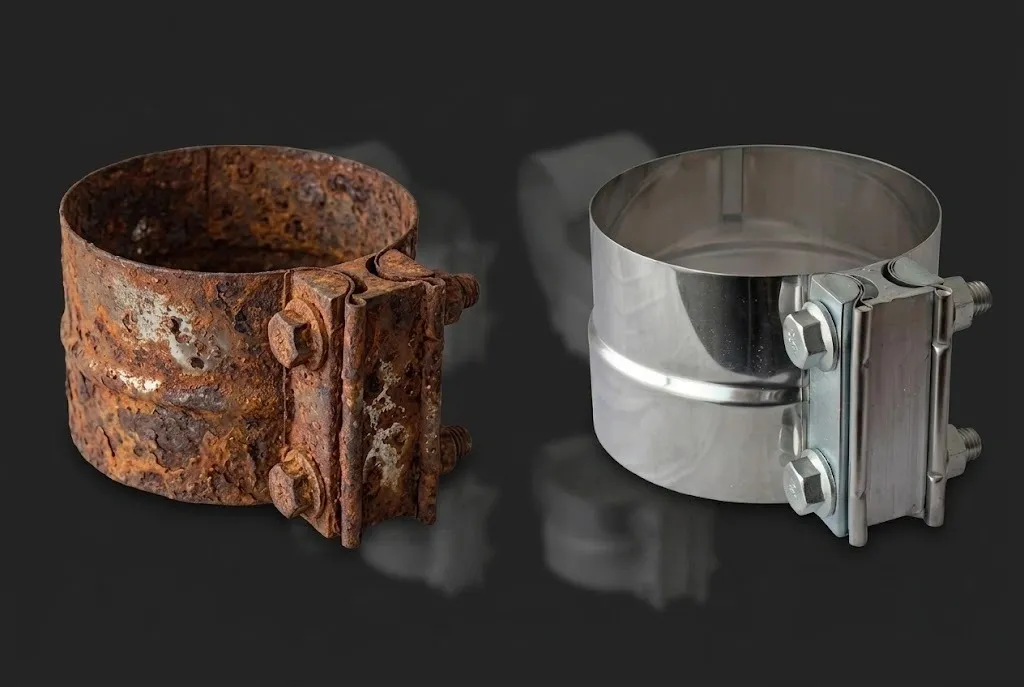
Most sub-$5 exhaust clamps are made from low-carbon mild steel. We’re talking roughly 0.05% to 0.25% carbon content with virtually no corrosion-resistant alloying elements. Mild steel is cheap to stamp, easy to weld, and it rusts — fast. In an exhaust environment where temperatures cycle between ambient and 1,200°F, and where road salt, moisture, and acidic condensate are constant companions, mild steel doesn’t stand a chance. You’ll see surface oxidation within weeks. Structural weakening follows within months.
Galvanized: A False Sense of Security
Galvanized clamps add a zinc coating, and that does buy you some time. The zinc sacrificially protects the underlying steel — until it doesn’t. Once the zinc layer wears through at bend points, bolt holes, or anywhere the clamp flexes under vibration, the exposed steel corrodes at an accelerated rate. Worse, the zinc itself begins to degrade at sustained temperatures above 390°F, which means it’s fundamentally unsuited for anything near the exhaust manifold or downpipe. What looks like protection on day one becomes a corrosion accelerator by month six.
201 Stainless: The Imposter
Here’s where it gets tricky. Some suppliers label their product as “stainless steel” and technically they’re not lying — it’s just the wrong grade. 201 stainless contains only about 0.15% carbon, 16-18% chromium, 3.5-5.5% nickel, and 5.5-7.5% manganese. That manganese substitution for nickel is the cost-cutting move. The result? Significantly reduced corrosion resistance, especially in chloride-rich environments (think coastal roads or winter salt). 201 will pit and crevice-corrode where 304 simply keeps performing.
SS304: The Real Deal
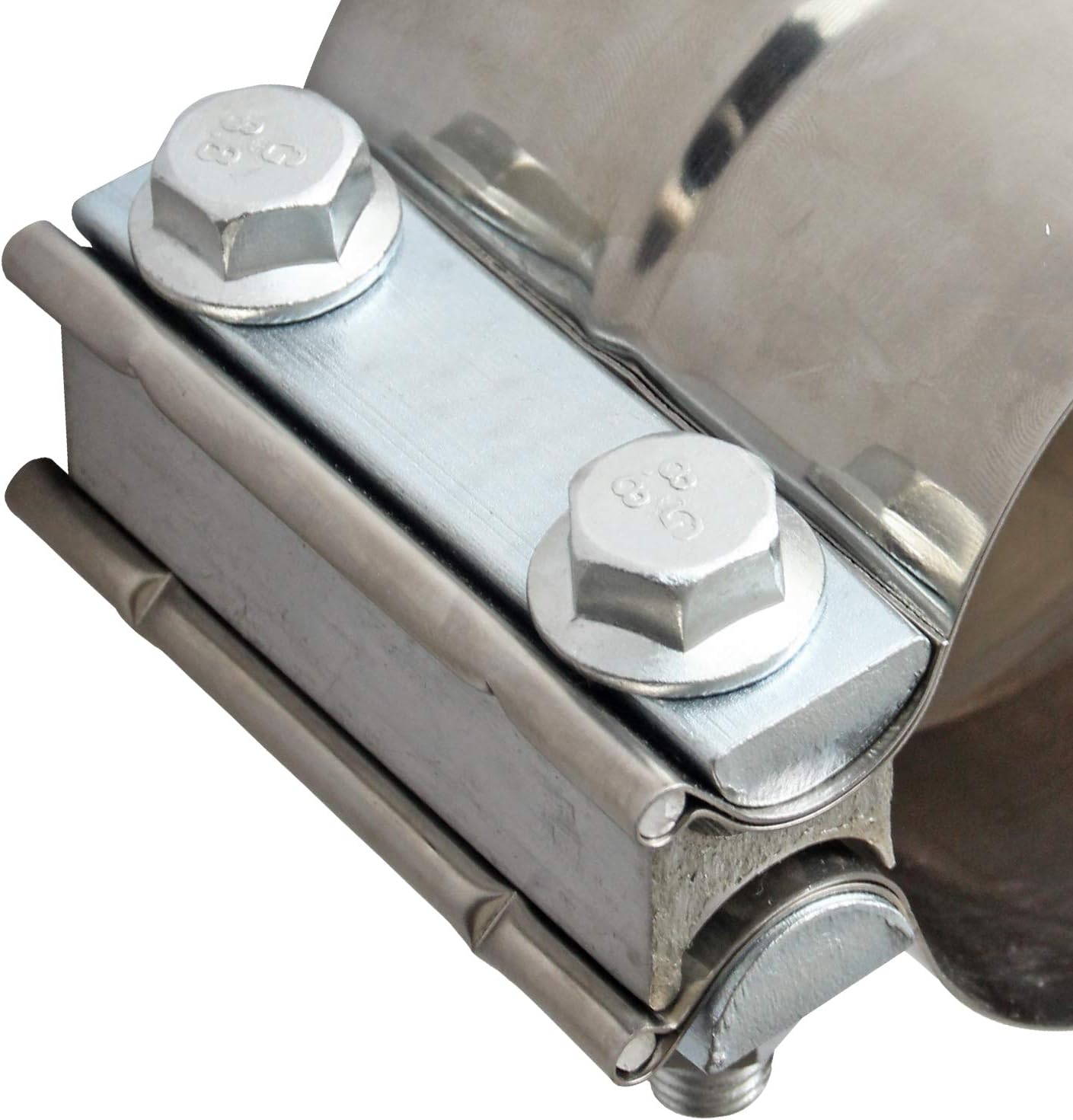
Grade 304 stainless steel contains 17.5-19.5% chromium and 8-10.5% nickel, with a maximum of 0.08% carbon. That chromium-nickel balance is what creates the passive oxide layer — a self-healing film of chromium oxide that reforms instantly when scratched or worn. It’s not a coating. It’s the material itself. And it’s why an SS304 exhaust band clamp made from 304 stainless is the gold standard for food processing, marine hardware, and yes, performance exhaust systems.
The Four Hidden Costs of Cheap Clamps
When you buy a $6 clamp instead of an $15 one, you save $9 on paper. Here’s what that $9 actually costs you in the real world.
Comeback Labor: $40-60 Per Visit
A failed modification shop exhaust clamp means the customer comes back. That’s a bay occupied, a technician pulled from a revenue-generating job, and a warranty repair that eats into your margin. At a conservative labor rate of $80-120/hour, a clamp comeback represents 30-45 minutes of lost productivity — that’s $40-60 in direct labor cost, not counting the opportunity cost of the job that didn’t get done. One comeback wipes out the savings from twenty cheap clamps.
Customer Trust: The Unpriced Asset
Every time a customer returns with a problem, trust erodes. They don’t think “bad clamp.” They think “bad shop.” That’s the psychological reality of the service business. The customer paid you to fix their exhaust system. If it fails, the failure is yours in their mind, regardless of which component caused it. Rebuilding that trust takes more than a free re-install — it takes time, and time is the one resource you can’t reorder.
Inventory Chaos: The Multiplier Effect
Cheap clamps fail at unpredictable rates. That means you can’t forecast warranty returns, which means you can’t plan inventory efficiently. You end up overstocking replacement clamps “just in case,” tying up capital in parts that might not move. Meanwhile, you’re also carrying the original cheap clamps because you bought them in bulk to get the volume discount. Two SKUs doing the job of one, both costing you shelf space and cash flow.
Forum Reputation: The Digital Word-of-Mouth
The modification community talks. Enthusiast forums, Facebook groups, Reddit threads — a single post about a failed exhaust install can reach thousands of potential customers. “Went to [Shop Name] for a new exhaust, came back three weeks later because the clamps rusted out” is the kind of review that doesn’t show up on Google but absolutely shows up in the places your next customer is reading before they call you.
Why SS304 Exhaust Band Clamps Win on Every Metric
The chromium content of 17.5-19.5% in SS304 is what makes the magic happen. When chromium in the alloy contacts oxygen, it forms a microscopic layer of chromium oxide (Cr₂O₃) on the surface. This layer is only a few atoms thick, but it’s dense, stable, and — critically — self-repairing. If you scratch it, bend it, or cut it, the exposed chromium immediately reacts with ambient oxygen and reforms the protective film. No maintenance required. No reapplication needed.
That’s why an SS304 exhaust band clamp routinely lasts 10 years or more in real-world driving conditions. The nickel content of 8-10.5% adds ductility and toughness, ensuring the clamp can handle the thermal cycling and vibration of a performance exhaust without becoming brittle or cracking.
The Lap Joint Advantage
An SS304 exhaust band clamp — specifically the lap joint design — is the preferred choice among modification shops for a reason that goes beyond material. The lap joint configuration wraps around the exhaust pipe overlap and distributes clamping force evenly across a 360-degree circumference. Unlike U-bolt clamps that concentrate pressure at two points (creating deformation hot spots and potential leak paths), a properly torqued band clamp creates a uniform seal.
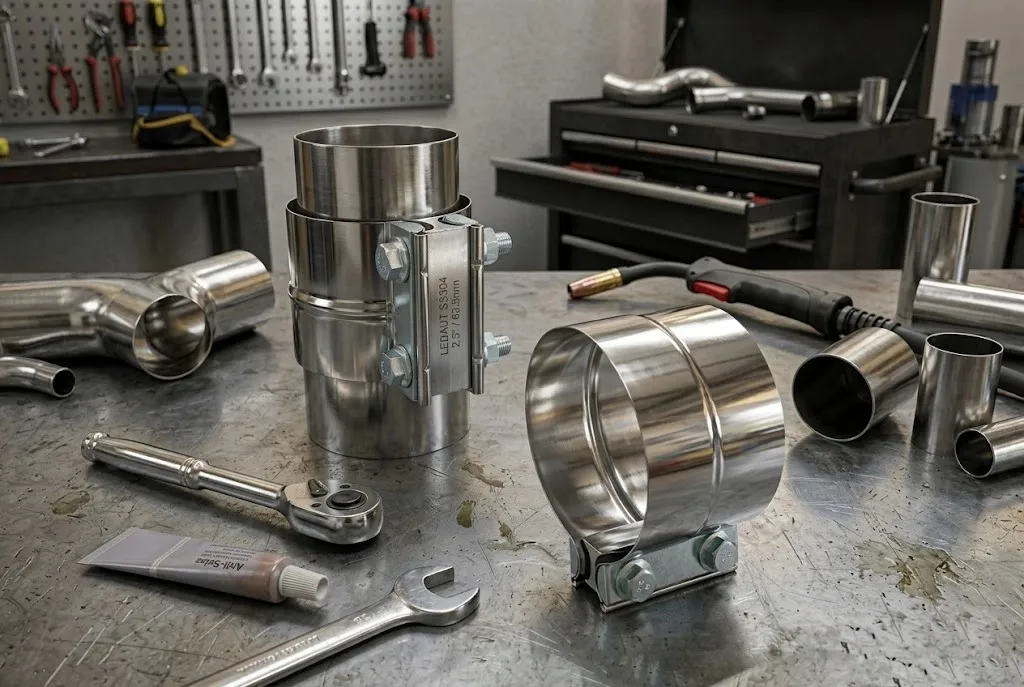
For a band clamp for workshop environments that require repeated installations and adjustments — think custom fab work, track car setups, or customer preference changes — the lap joint band clamp can be loosened, repositioned, and retorqued multiple times without losing clamping integrity. That’s a workflow advantage that directly translates to faster turnaround times and fewer warranty callbacks.
Three Failure Symptoms That Signal a Bad Clamp
When a clamp starts to fail, it doesn’t always announce itself with a dramatic exhaust leak. The symptoms are often subtle at first, which is exactly what makes them dangerous — for the shop’s reputation and for the customer’s vehicle.
Exhaust rattle or ticking noise. This is usually the first sign. As the clamp loses tension — whether from corrosion, thermal fatigue, or improper initial torque — a small gap opens between the pipe sections. Exhaust gases escaping through that gap create a characteristic ticking or rattling sound, most noticeable at idle or during acceleration. Customers hear it. They notice it. And they associate it with the shop that installed it.
Carbon buildup at the joint缝隙. A failing clamp allows exhaust gases to seep through micro-gaps, leaving behind black carbon deposits around the connection point. This isn’t just cosmetic — it’s evidence of an active leak. Over time, the carbon buildup can mask the severity of the problem, making visual inspection harder and allowing the underlying corrosion to progress unchecked.
Emissions test failure. This is the one that costs your customer real money and costs you the relationship. A leaking exhaust clamp upstream of the oxygen sensors can allow unmetered air into the exhaust stream, skewing O₂ sensor readings and triggering a check engine light. In states with strict emissions testing, that means a failed inspection, a frustrated customer, and a phone call to your shop that starts with “you need to fix this.”
The Tony Story: What a Cheap Clamp Really Cost
Let me tell you about Tony. He’s a regular customer now, but our first interaction wasn’t pleasant.
Tony runs a small performance shop that specializes in track-day builds. He’d been buying cheap galvanized clamps from a wholesale supplier because the margin on a clamp wasn’t worth thinking about — or so he believed. One of his customers had a full exhaust system installed for an upcoming track event. Three days before the event, the customer called: the exhaust was rattling badly, and there was visible corrosion at two clamp joints.
Tony replaced the clamps on his own time, after hours. But the customer missed their qualifying session because the car wasn’t ready. The trust was gone. Tony lost not just that customer, but two referrals that customer would have sent his way.
When Tony came to my warehouse, he wasn’t angry about the clamp price. He was angry about the ripple effect. A cheap part had cost him a customer relationship worth hundreds — maybe thousands — in lifetime value. All from cutting corners on a modification shop exhaust clamp.
That conversation is why we restructured our entire product line around the SS304 exhaust band clamp. Not because it’s a premium upsell. Because it’s the only thing that actually protects the shop’s most valuable asset: its reputation.
LEDAUT SS304 Lap Joint Exhaust Band Clamps: Built for Shops That Care
We manufacture our SS304 lap joint exhaust band clamps in-house, which means we control every step from raw material sourcing to final inspection. No middleman markup, no quality surprises.
Here’s what you get when you order from us — a band clamp for workshop reliability that won’t let you down:
– Genuine SS304 stainless steel — 17.5-19.5% chromium, 8-10.5% nickel, verified by material certification
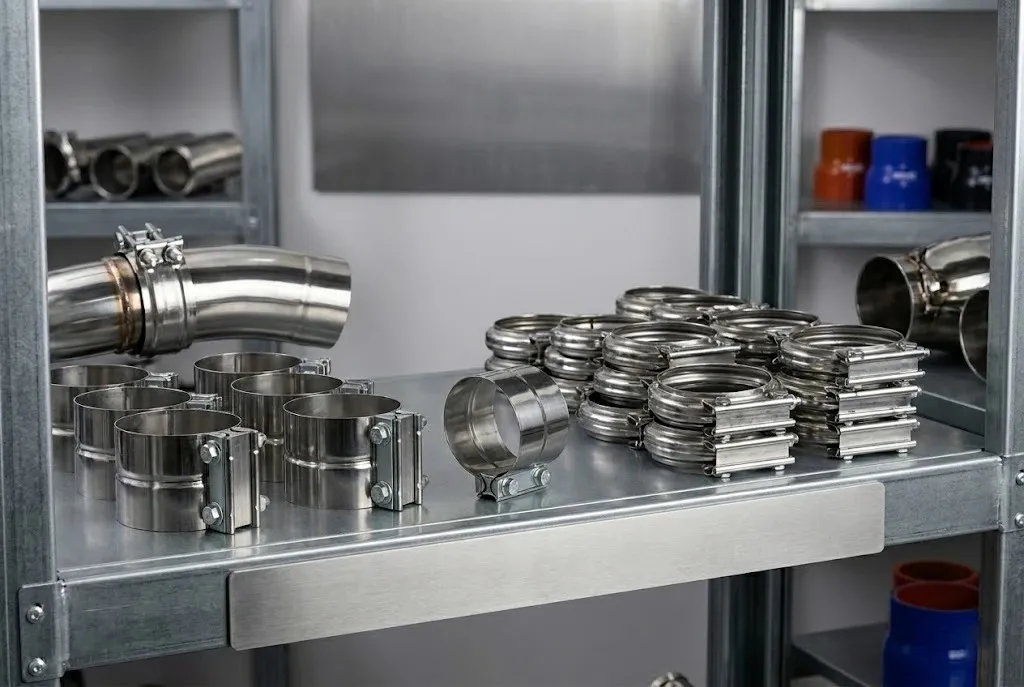
– Size range: 2.5 to 5 inches — covering the vast majority of passenger car and light truck exhaust applications
– Lap joint design — even 360° clamping force, reusable, adjustment-friendly
– Factory-direct pricing — we’re the manufacturer, not a distributor
– MOQ: 50 pieces — accessible for shops of all sizes, not just volume buyers
– Amazon ASIN: B082SBTBZG — proven market presence with verified customer feedback
Whether you’re outfitting a single bay or stocking for a multi-location operation, our SS304 exhaust band clamps are priced to make the business case obvious. The per-unit cost is higher than mild steel, yes. But when you factor in zero comebacks, no warranty inventory, and customers who actually recommend you to their friends, the total cost of ownership flips the equation entirely.
The Bottom Line
I’ve been in this business long enough to know that price is the easiest thing to compete on and the hardest thing to win with. The shops that survive and thrive aren’t the ones with the cheapest parts bin. They’re the ones whose customers never have a reason to call back. Pick the right band clamp for workshop installation once, and you pick it for good.
SS304 exhaust band clamps aren’t a luxury upgrade. They’re an insurance policy — against comebacks, against reputation damage, against the slow bleed of hidden costs that make a profitable job unprofitable.
If you’re still buying cheap clamps, I’m not here to judge. I used to sell them. But I’d ask you to do the math: add up your comeback labor, your warranty inventory, and the customers you’ve lost to preventable failures. Then look at the price difference between a $6 clamp and an SS304 exhaust band clamp.
The numbers will tell you what Tony already learned the hard way.