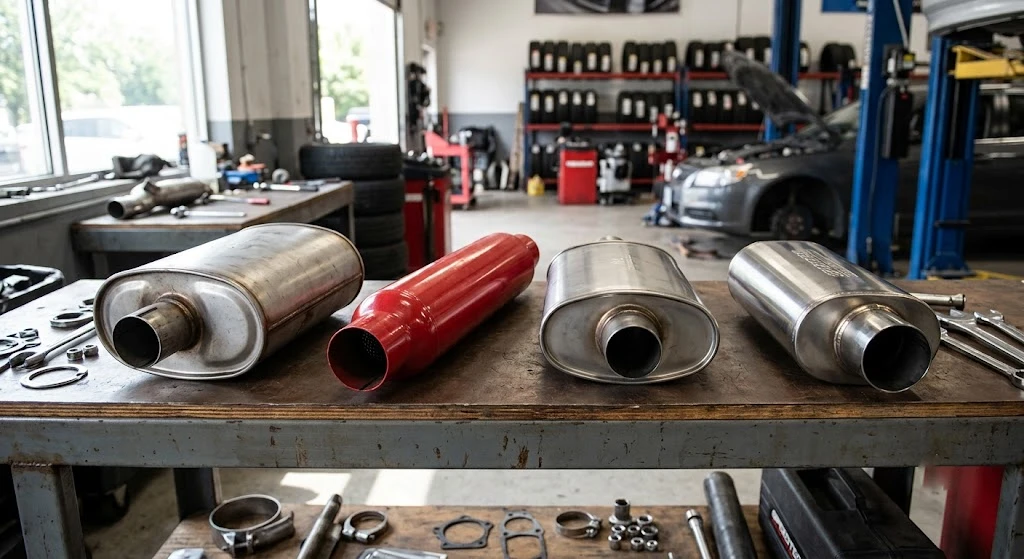
TL;DR: Picking the right muffler comes down to three things — getting your pipe size right, picking a design that matches your engine and sound goals, and choosing a material that fits your budget and climate. Measure first, buy second. Straight-through mufflers give strong flow for performance builds, while chambered or turbo styles keep things reasonable for daily drivers. Knowing how to choose a muffler is straightforward once you understand these three factors.
Thinking about swapping your muffler? Whether you want a deeper tone, better flow, or just need to replace a rusted-out unit, how to choose a muffler isn’t as complicated as the forums make it sound. LEDAUT has been manufacturing exhaust systems for over 20 years, and we’ve seen buyers overthink this more times than we can count. Let’s break it down into simple steps so you get the right part the first time.
Muffler Basics: How They Work
A muffler does two jobs: reduce noise and keep exhaust flowing. Most factory mufflers use a chambered design — internal walls that force exhaust gases to bounce through divided chambers before exiting. This cuts noise effectively, but also creates back pressure that can reduce engine output.
Performance mufflers work differently. A straight-through (also called absorptive or glasspack) design uses a perforated core wrapped in sound-absorbing material, usually fiberglass or steel wool, encased in the outer shell. Exhaust passes straight through the core while the surrounding material absorbs sound waves. This design flows significantly better than a chambered unit.
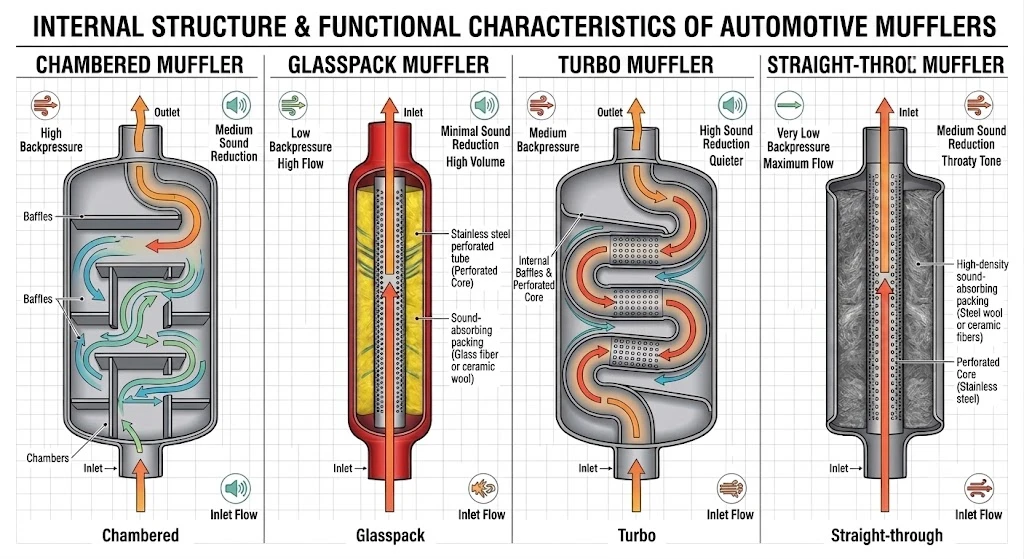
Industry sources (including SAE technical papers on exhaust acoustics) confirm that absorptive designs provide lower back pressure at the cost of reduced low-frequency attenuation — which explains why straight-through mufflers are louder but freer-flowing.
Most modern OEM systems combine both approaches: a chambered base structure with perforated tubes and localized sound-deadening material. This gives automakers the noise control they need while keeping flow acceptable for everyday driving.
> New to muffler types? Check our full muffler types guide for a side-by-side comparison of chambered, straight-through, turbo, and glasspack designs.
Step 1: Measure Pipe Size & Pick Your Configuration
Before buying anything, measure your exhaust pipe diameter. This is the single most common mistake — getting a muffler that doesn’t fit your existing piping.
How to Measure
Use a caliper or wrap a string around the pipe and divide by π (3.14). Measure the outer diameter of your existing exhaust pipe, not the inner. Most passenger vehicles use one of these sizes:
- 2″ (50.8mm) — Small engines, older 4-cylinder vehicles, some motorcycles
- 2.25″ (57.2mm) — Most modern 4-cylinder and smaller V6 engines
- 2.5″ (63.5mm) — V6 and small V8 engines, popular performance upgrade size
- 3″ (76.2mm) — Large V8s, diesel trucks, high-horsepower builds
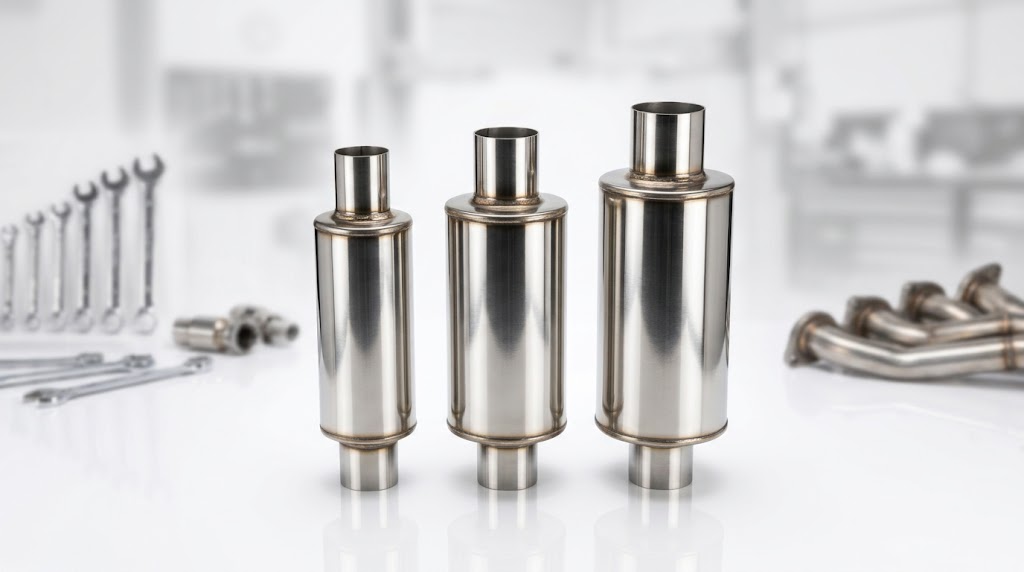
LEDAUT straight-through mufflers are available in all four inlet sizes: 2″, 2.25″, 2.5″, and 3″ — confirmed to fit the most common vehicle applications.
Muffler Inlet vs Outlet
Most mufflers use the same size inlet and outlet. If your build uses a step-up (e.g., 2.5″ pipe into a 3″ muffler), make sure you have the right adapter. Center-over-center and offset configurations also matter for fitment — check your existing setup before ordering.
Inlet and Outlet Configurations
Beyond diameter, the physical layout of the muffler matters. Most mufflers come in three inlet-to-outlet configurations:
- Center/Center: Both inlet and outlet are centered on the muffler body. Common on many OEM replacements.
- Offset/Offset: Both inlet and outlet are offset toward one side. Used when the exhaust path isn’t centered under the vehicle.
- Center/Offset: One side centered, the other offset. Useful for specific vehicle layouts where space is tight on one side.
Check your current muffler’s configuration before ordering. A visual check from under the vehicle takes two minutes and saves a return trip.
Step 2: Pick the Right Muffler Design
Each muffler type has a different sound profile and performance trade-off. Here’s how they compare in practice:
Chambered Mufflers
Chambered mufflers use internal walls and divided cavities to cancel sound waves through reflection and interference. This is the most common OEM design because it controls noise well across the RPM range. On the flip side, the baffle structure restricts exhaust flow more than straight-through designs.
Best for: Daily drivers who want moderate sound levels and don’t need maximum flow.
Sound: Mellow, deep tone. Some users report a noticeable drone around 1800-2200 RPM under highway cruising conditions — something to be aware of if you do a lot of highway driving.
Straight-Through (Absorptive) Mufflers
A perforated center tube surrounded by sound-absorbing material (typically fiberglass packing held in place by a wire mesh layer) inside a solid outer shell. Exhaust flows straight through with minimal restriction. The packing material absorbs sound energy as gases pass through the perforations.
Best for: Performance builds, track cars, anyone prioritizing flow over noise control.
Sound: Louder and more aggressive. The tone depends on the core diameter, packing density, and overall length.
Durability note: The fiberglass packing can degrade over time. Users report that budget glasspack mufflers may lose their packing within months of regular use. Higher-quality straight-through mufflers use denser packing with wire mesh retention — a design detail that extends effective life considerably by preventing the packing material from being blown out by exhaust pressure.
LEDAUT straight-through mufflers use a perforated core with fiberglass packing secured by stainless steel wire mesh. The muffler shell is welded shut — the internal packing is not user-serviceable. When the packing eventually degrades after extended use, the entire muffler is replaced rather than repacked.
Turbo Mufflers
A hybrid design that uses a combination of small chambers and a straight-through section. Turbo mufflers are quieter than open straight-through designs but freer-flowing than full chambered units. They’re popular among drivers who want a middle ground.
Best for: Daily drivers who want a sportier note without excessive cabin noise.
Sound: Moderate, with a smooth tone across the RPM range.
Glasspack Mufflers
The simplest design — a straight perforated tube surrounded by fiberglass packing inside a smaller-diameter shell. Glasspacks are essentially basic straight-through mufflers without the added structural features of modern designs. They’re inexpensive but typically louder and shorter-lived.
Best for: Budget builds, temporary setups, or users who don’t mind a loud exhaust.
Sound: Loud, raspy, especially on smaller engines.
What Affects Muffler Sound
Muffler sound isn’t just about type — several factors change the final note:
- Core diameter: A larger core flows more but reduces noise absorption. This is why straight-through mufflers with larger inlets are louder than small-diameter units of the same design.
- Muffler length: Longer bodies provide more surface area for sound absorption. Given the same internal design, a longer muffler is generally quieter than a short one.
- Packing material density: Denser packing absorbs more sound but can degrade faster under high heat. The wire mesh retention used in higher-quality mufflers addresses this by keeping the material in place.
- Engine configuration: V8s produce a deeper, more distinct note than 4-cylinder engines through the same muffler. The firing order and exhaust pulse spacing change the sound character significantly.
Step 3: Choose Your Material
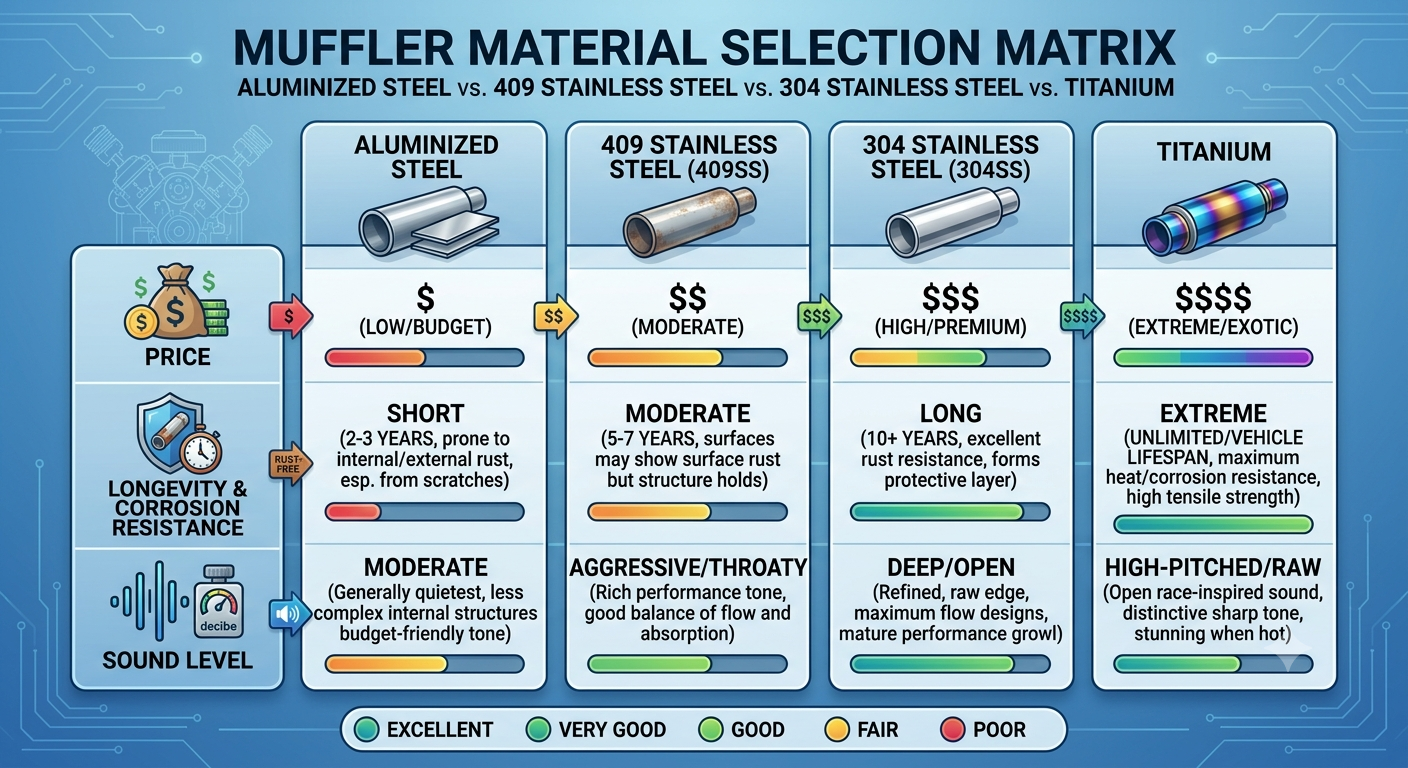
Muffler material determines longevity, especially in regions with road salt or humid climates. Listed in order of corrosion resistance (lowest to highest):
| Material | Corrosion Resistance | Typical Cost | Best For |
|---|---|---|---|
| Aluminized Steel | Budget-level | $ | Dry climates, budget replacements |
| 409 Stainless Steel | Good | $$ | Most vehicles, good balance of cost and durability |
| 201 Stainless Steel | Better | $$$ | Areas with occasional moisture, mild winters |
| 304 Stainless Steel | Best | $$$$ | Salt-belt states, coastal areas, long-term builds |
Performance enthusiasts generally prefer 409 or 304 stainless. Aluminized steel works for budget builds but won’t last as long in wet conditions. LEDAUT mufflers are available in both 409 and 304 stainless steel options.
Step 4: Consider Weight and Installation
Muffler weight matters if you’re minimizing overall vehicle weight for performance. A typical straight-through muffler weighs approximately 6-7 kg (about 12-14 lbs). Chambered mufflers tend to be heavier due to their internal baffle structure — sometimes 30-50% heavier than an equivalent straight-through unit.
Muffler Body Length and Clearance
Overall muffler length varies by design. Straight-through mufflers tend to be longer for a given noise reduction level because they rely on packing surface area rather than chamber volume. Typical lengths range from 14″ to 26″. Measure the available space between your existing hangers and any underbody components (spare tire well, fuel tank, crossmembers) to confirm fitment.
Some installers recommend leaving a small gap — roughly a finger’s width — between the muffler body and any surrounding components to prevent contact noise and allow for drivetrain movement. This is standard practice for most exhaust installations.
Installation considerations:
- Center vs offset inlet/outlet — match your existing piping layout
- Overall length — make sure the muffler fits in the available space under your vehicle
- Hanger placement — verify hanger locations line up with factory mounting points
- Some users recommend checking clearances before final tightening to avoid contact with the underbody or heat-sensitive components
Muffler Selection Quick Guide
| If You Drive… | And You Want… | Consider This Type |
|---|---|---|
| Daily commuter, 4-cylinder | Moderate sound, easy install | Chambered or turbo muffler |
| Performance build, V6/V8 | Maximum flow, aggressive sound | Straight-through muffler |
| Truck or SUV | Deep tone, not too loud | Turbo or chambered muffler |
| Budget project car | Minimum spend, entry-level upgrade | Glasspack |
| Track/weekend car | Weight savings, max performance | Straight-through, lightweight build |
Direct Fit vs Universal Mufflers
Mufflers fall into two categories based on how they install:
Direct-Fit Mufflers
Designed as a bolt-on replacement for specific vehicle makes and models. They come with the correct inlet/outlet configuration, hanger positions, and overall length. Installation typically requires basic hand tools — a jack and stands, wrenches or sockets, and penetrating oil for rusted fasteners. Most DIYers can complete a direct-fit swap in an hour or two.
Universal Mufflers
Universal mufflers require cutting and welding. You measure your existing piping, cut the old muffler out, and weld or clamp the new one in place. This gives more flexibility in positioning but requires welding equipment or a trip to a muffler shop. Clamp-on universal mufflers exist but may not seal as reliably as welded installations — some users report leaks developing over time at clamp joints on high-vibration vehicles.
LEDAUT mufflers are universal design and fit any vehicle where the pipe size and configuration match. Installation requires basic welding or exhaust clamps.
Common Questions About Choosing a Muffler
Does a bigger muffler always mean more power?
Not necessarily. Oversizing creates a mismatch that can actually hurt low-end torque. Match the muffler size to your pipe diameter and engine output. A 3″ muffler on a 2.25″ exhaust system won’t add power — it’ll just be unnecessarily large and potentially harder to fit.
Can I swap muffler types without changing the rest of my exhaust?
Usually yes, as long as the inlet/outlet sizes and configuration match your existing piping. A direct-fit replacement doesn’t require cutting or welding the rest of the system.
Straight-through vs chambered — which is better for turbo engines?
Turbocharged engines benefit from reduced exhaust restriction since the turbo relies on exhaust gas flow to spool. A straight-through muffler helps maintain flow. Naturally aspirated engines are less sensitive to exhaust restriction from the muffler alone — the difference will be more about sound than measurable power gains.
How do I know if a muffler will fit my vehicle?
Check three things: inlet/outlet size (measure your pipe), inlet/outlet configuration (center vs offset), and overall length (measure the available space). Most manufacturers provide dimension specs for each model.
Bottom line: Choosing the right muffler starts with measuring your pipe, then matching the design to your sound and performance goals, and selecting a material that fits your climate. LEDAUT offers straight-through mufflers in 2″, 2.25″, 2.5″, and 3″ sizes in both 409 and 304 stainless steel — built for durability with a wire-mesh-secured fiberglass packing design.
> Ready to choose? See our muffler types comparison for detailed specs, or browse available muffler options by size and material.