Vacuum hoses are easy to overlook until one cracks, splits, or collapses — and suddenly your car is idling rough, throwing check engine codes, or won’t start at all. Choosing the right hose from the start prevents these problems.
Here’s what to look for when selecting vacuum or coolant hose for your application.
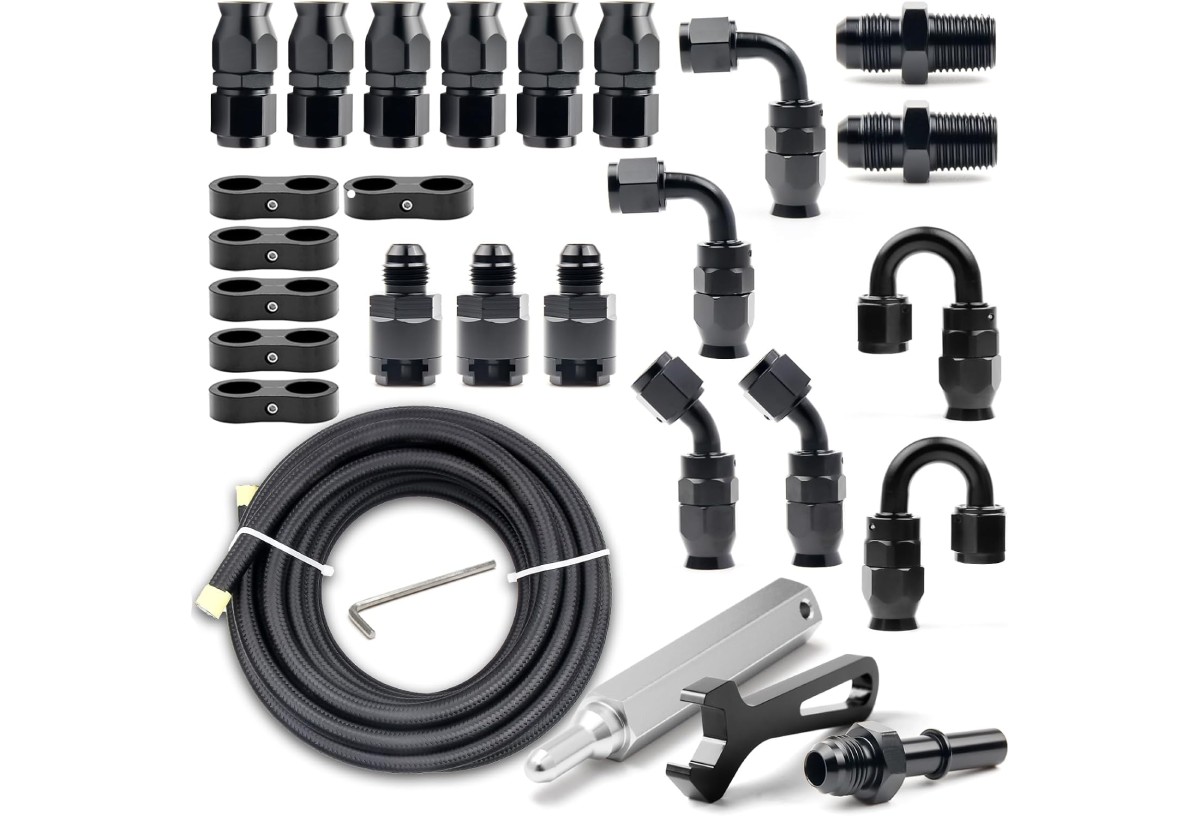
Vacuum Hose Materials: Three Options
Silicone Hose
Silicone is the premium choice for vacuum and coolant systems. It handles temperatures from -65°F to 500°F — far beyond what any engine bay vacuum line encounters. It stays flexible in extreme cold (important for winter-driven cars), resists ozone and UV damage, and doesn’t harden or crack over time. The main drawback is cost — silicone costs roughly twice as much as rubber.
Silicone hose is manufactured through an extrusion process, typically with a smooth inner surface that minimizes flow restriction. Wall thickness ranges from 2mm to 4mm depending on diameter and pressure rating. Most automotive silicone hoses are rated for 45-85 PSI working pressure, far exceeding the 20-30 inHg of vacuum that engine systems generate. The material is inherently flame-retardant — it won’t support combustion, an important safety feature near exhaust components.
Silicone’s tear resistance is lower than rubber, so it requires careful handling during installation. Avoid contact with sharp edges, and use proper hose clamps (constant-tension or lined worm-gear clamps) rather than standard worm-gear clamps that can cut into the silicone.
Where to use it: Turbo inlet hoses, PCV systems, coolant overflow lines, any connection near heat sources. Also ideal for show cars where appearance matters — silicone comes in multiple colors (black, blue, red, green, purple, orange, and custom colors on special order).
Where NOT to use it: Submerged in oil or fuel continuously — silicone absorbs hydrocarbons over time and swells, losing strength. For oil-breather systems, use nitrile or FKM.
EPDM Rubber Hose
EPDM (ethylene propylene diene monomer) is the standard for OEM vacuum systems. It offers good flexibility, decent heat resistance up to 250°F, and excellent resistance to coolant and water. It’s the most cost-effective choice for general purpose vacuum lines.
EPDM is a synthetic rubber compound that excels in several areas where silicone falls short. It has superior abrasion resistance — important where hoses rub against engine components or brackets. It handles continuous contact with coolant and water-based fluids without degradation, unlike silicone which can experience hydrolysis under certain conditions at sustained high temperatures. EPDM also resists steam and brake fluid better than silicone.
The service life of a quality EPDM hose in normal engine bay conditions is 5-8 years. Installation is straightforward — EPDM has good tear resistance, so standard worm-gear clamps work fine. The material grips barbed fittings well without needing constant-tension clamps in most applications.
Where to use it: Standard vacuum lines, emissions system hoses, coolant bypass hoses, general engine bay connections away from direct heat sources, heater hoses (with appropriate wall thickness), water pump bypass lines.
Where NOT to use it: Near exhaust manifolds or turbochargers where radiant heat exceeds 250°F. Not suitable for fuel or oil contact — EPDM swells and degrades rapidly when exposed to petroleum products.
Nitrile (Buna-N) Hose
Nitrile rubber offers excellent oil and fuel resistance. It’s the standard choice for fuel system vent lines, oil breather hoses, and any application where the hose contacts petroleum products.
Nitrile is formulated specifically for hydrocarbon resistance. The material’s nitrile content determines its oil resistance level — standard automotive nitrile hose (Buna-N, NBR) has a nitrile content around 33%, providing good resistance to gasoline, diesel, oils, and hydraulic fluids. Temperature range is -40°F to 250°F, similar to EPDM.
Nitrile hose has excellent mechanical properties — high tensile strength (typically 1000-1500 PSI) and good tear resistance. It’s available in smooth bore (for fuel and oil lines) or with a fabric reinforcement layer (for higher-pressure applications). Wall thickness on standard nitrile vacuum hose is 3-4mm.
Where to use it: Fuel vapor lines, oil breather system, diesel applications, any hose that may contact oil or fuel, transmission cooler lines (with appropriate pressure rating), power steering return hoses.
Where NOT to use it: Coolant or water systems — nitrile degrades in continuous contact with coolant. Avoid prolonged exposure to ozone (sunlight) — nitrile is less UV-resistant than EPDM or silicone.
FKM (Viton) Hose — The Specialty Option
For applications requiring the highest chemical resistance, FKM (fluoroelastomer, commonly known as Viton) is the premium choice. It handles temperatures up to 400°F continuous and resists virtually every automotive fluid — gasoline, diesel, ethanol blends (E85), biodiesel, synthetic oils, transmission fluid, and coolant.
FKM is significantly more expensive than silicone, EPDM, or nitrile — typically 3-5 times the cost of standard rubber hose. It’s used in high-performance, racing, and industrial applications where failure is not an option. Common uses include fuel injection return lines on boosted applications, E85 fuel system vent lines, and diesel fuel return lines.
When to use FKM: Racing fuel systems, E85-compatible lines, high-temperature diesel applications, any system where standard rubber hose failure would cause a safety hazard.
Size Selection Guide
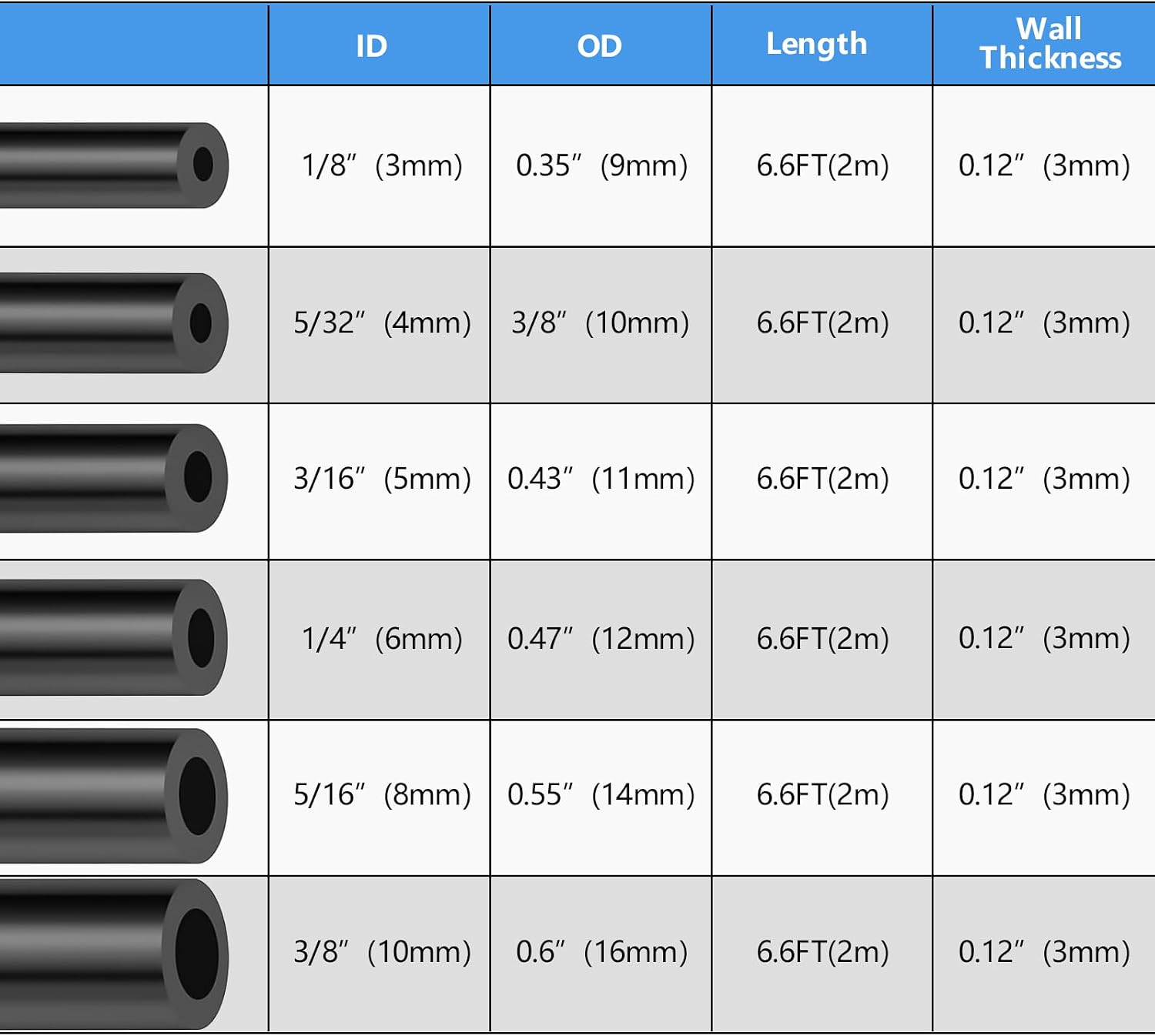
Vacuum hose sizes are measured by inside diameter (ID). The most common automotive sizes:
- 1/8″ (3mm): Small vacuum lines, boost reference lines, map sensor connections
- 3/16″ (5mm): General vacuum connections on older vehicles, vacuum advance lines
- 1/4″ (6mm): Most common size for modern vacuum systems — fuel pressure regulators, evaporative emissions, HVAC controls
- 5/16″ (8mm): PCV system hoses, larger vacuum lines, EGR system connections
- 3/8″ (10mm): Coolant bypass hoses, large vacuum actuators, booster circuits
Outside diameter (OD) matters for clamps: When selecting clamps, measure both the hose OD and the fitting OD. A properly sized clamp should tighten 1/4″ to 3/8″ beyond the hose OD. For silicone hose with its larger wall thickness (and therefore larger OD at the same ID), you’ll typically need a clamp one size larger than you’d use for rubber.
Metric vs. imperial: Many Japanese and European vehicles use metric hose sizes. Common metric sizes include 4mm, 6mm, 8mm, 10mm, and 12mm ID. When replacing metric hoses with imperial sizes, go one size larger — 6mm is close to 1/4″ (6.35mm), and the slight difference usually works with a quality clamp. For exact fitment, measure the original hose ID with a drill bit or caliper before ordering.
Temperature Considerations by Location
Engine bay temperatures vary dramatically by location. Choosing the wrong material for the location is the most common cause of premature hose failure.
- Near exhaust manifold: 400-600°F — silicone only. Even silicone’s 500°F rating is near its limit here; consider heat shielding (aluminized sleeve or fiberglass wrap) if the hose runs within 2″ of the manifold surface.
- Near turbo/header: 300-500°F — silicone recommended. Use heat-reflective sleeving for direct contact areas. FKM hose works here too, though at higher cost.
- Engine front (away from exhaust): 180-250°F — EPDM works fine for nearly all applications in this zone. This is where most OEM vacuum hoses live.
- Intake area/cold side: 100-180°F — any material works. Cost-savings tip: use EPDM here and reserve silicone for the hot zones.
- Inside intake manifold: 80-120°F (post intercooler) — any material works. Note that PCV and evaporative emissions hoses here may carry oil vapor, so nitrile or EPDM are better choices than standard rubber.
When routing new vacuum lines, keep them as far from exhaust heat as possible. Every inch of distance adds lifespan to the hose. Where routing near heat sources is unavoidable (turbocharged engines are especially tight), use two layers: a heat-resistant hose (silicone) plus a reflective heat sleeve for maximum protection.
Signs of Vacuum Hose Failure
Knowing what to look for prevents breakdowns and rough-running issues:
- Cracking: Surface cracks at bends or near connections — indicates age or ozone damage. Replace immediately. Common on hoses over 5 years old.
- Soft or spongy feel: Hose collapses when squeezed — internal degradation from oil or fuel exposure. The hose has absorbed hydrocarbons and lost structural integrity.
- Hard and brittle: Hose won’t bend without cracking — heat-aging and material oxidation. This is the most common failure mode on older vehicles.
- Collapsed hose: The hose flattens under vacuum — internal delamination or wrong wall thickness. This causes restriction even when the hose hasn’t physically leaked.
- Oil residue at connections: Evidence of oil mist migration through the hose wall — occurs when the wrong material is used in PCV or crankcase vent systems.
- Sooting or black deposits: Small exhaust leaks near the connection point indicate the hose isn’t sealing properly at the fitting.
How to Measure and Cut Vacuum Hose
Getting the right length and a clean cut matters for proper sealing:
- Measure with the hose routed: Run a piece of string along the exact path the hose will follow, including bends. Add 10% to account for straight-line tension and connection depth.
- Cut with a sharp blade: Use a sharp utility knife or hose cutter (not side cutters or scissors, which pinch the hose). For silicone hose, a single smooth cut with a razor blade gives the cleanest end.
- Cut straight: Use a hose cutting guide or wrap masking tape around the hose as a cutting guide to ensure a 90-degree cut. An angled cut reduces the sealing surface at the fitting.
- Deburr after cutting: Run a small file or sandpaper around the cut end to remove any rough edges that could leak or restrict flow.
- Push fully onto fittings: Standard barbed fittings require the hose to be pushed on until it bottoms out — usually 5/8″ to 1″ of engagement. Silicone hose may need a small amount of dish soap or silicone lubricant to slide onto tight fittings.
Quick Reference: Which Hose for Which Job
| Application | Recommended Hose | Why |
|---|---|---|
| General vacuum lines | EPDM rubber | Cost-effective, good performance |
| Turbo inlet / hot areas | Silicone | High temperature resistance |
| PCV system | Silicone or EPDM | Oil mist resistance |
| Fuel vapor lines | Nitrile or FKM | Fuel resistance |
| Brake booster | EPDM or silicone | Must hold vacuum reliably |
| Coolant overflow | Silicone | Heat + appearance |
| E85 fuel system | FKM (Viton) | Ethanol resistance |
| Oil breather / catch can | Nitrile rubber | Oil resistance |
| Diesel fuel return | FKM or nitrile | Diesel fuel resistance |
| Heater hose | EPDM with 4mm+ wall | Coolant + pressure |
Installation Tips for Long Hose Life
The best hose in the world fails early if installed incorrectly. Follow these practices for maximum service life:
- Use constant-tension clamps for silicone: Standard worm-gear clamps can cut into silicone hose as it expands and contracts with temperature cycles. Constant-tension (spring-style) clamps maintain consistent pressure across temperature changes. For EPDM and nitrile, quality worm-gear clamps work fine.
- Don’t overtighten: Tighten clamps to the point where the hose material slightly deforms around the barb. Over-tightening cuts the hose reinforcement and creates a leak path. As a rule of thumb, 1/4 turn past hand-tight is sufficient.
- Leave slack at bends: A straight, taut hose puts unnecessary stress on connections. Leave a slight curve — the hose should have visible slack, not be stretched tight between fittings.
- Use 45° or 90° fittings at tight corners: Sharp bends collapse vacuum lines and restrict flow. If a right-angle bend is needed within 1″ of a fitting, use a pre-formed elbow fitting rather than forcing the hose into a bend.
- Wire-tie or bracket-mount: Securely fasten hoses every 12-18 inches to prevent vibration-induced wear at connection points. Use cushioned P-clamps or zip ties with a mounting tab.
- Add heat shielding where needed: For hoses within 6″ of exhaust components, use aluminized fiberglass sleeving. This adds 200-300°F of protection for less than the cost of upgrading to a higher-temperature hose material.
Frequently Asked Questions
Can I use standard rubber vacuum hose for coolant?
Standard rubber vacuum hose is not rated for coolant temperatures or pressure. Coolant hoses require a thicker wall (4-5mm) and specific rubber compounds that resist ethylene glycol. Using vacuum hose for coolant will result in softening, swelling, and eventual rupture within weeks.
How often should I replace vacuum hoses?
As a preventive maintenance schedule: inspect annually, replace every 5 years for EPDM/nitrile, every 8-10 years for silicone. For high-performance or track vehicles, replace silicone hoses every 5 years as a precaution, especially turbo inlet and hot-side hoses.
Does hose color affect performance?
No — color is purely cosmetic in silicone hoses. The same silicone compound is used regardless of color. However, dark-colored hoses (black, dark blue) absorb more radiant heat from nearby exhaust components than light-colored ones (white, silver). The difference is negligible in most applications — less than 10°F internal temperature change.
What’s the difference between vacuum hose and heater hose?
Heater hose has a thicker wall (typically 4-5mm vs. 3-4mm for vacuum hose) and is reinforced for the higher pressures in coolant systems (15-20 PSI vs. vacuum-only). Vacuum hose is designed for suction-side applications only. Never substitute vacuum hose for heater hose, but heater hose can often work for vacuum applications if diameter matches.
Should I use hose clamps on vacuum lines?
Yes — especially on modern vehicles with boosted PCV systems and fuel injection. While older naturally aspirated engines often used simple push-on connections without clamps, modern systems operate under higher vacuum and sometimes positive crankcase pressure. A properly installed clamp on every connection prevents leaks and ensures consistent engine operation. Use small-diameter clamps (micro clamps or Oetiker ear clamps) for vacuum lines under 1/4″.
Can I repair a cracked vacuum hose or should I replace it?
Replace, don’t repair. Electrical tape or hose repair compound is a temporary field fix at best — the repair will fail within weeks, usually at the worst possible moment. Vacuum hoses are inexpensive, and the labor to access and replace a hose is identical whether you repair or replace. Cut out the damaged section and install a new piece with proper fittings.
Browse our full range of silicone, EPDM, nitrile, and FKM hoses at LEDAUT. We stock all common automotive sizes and can custom-cut lengths for bulk orders. Contact our team for help selecting the right hose for your application.