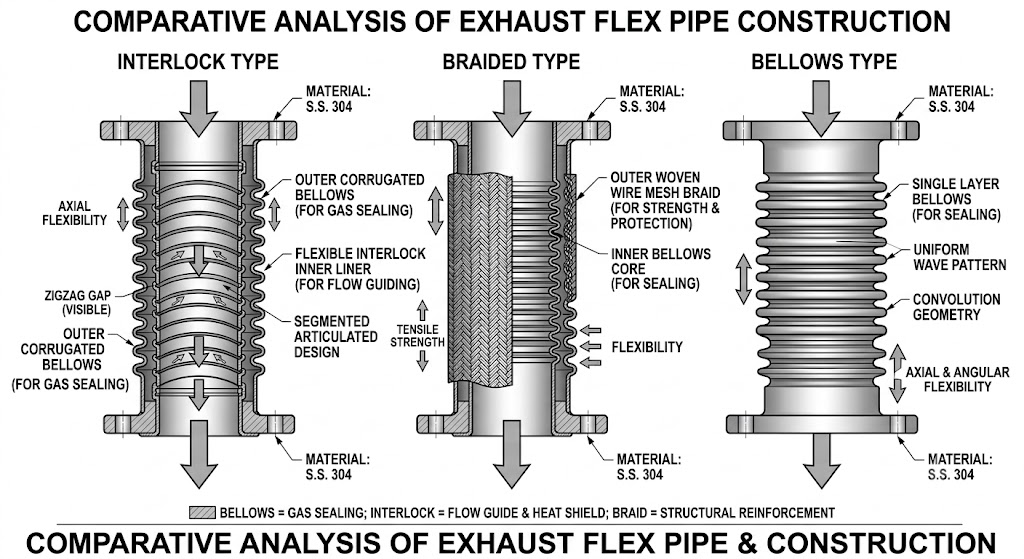
Three flex pipe types, three different jobs. Interlock is the most rigid and the most durable under vibration — the common OEM choice. Braided flexes further and handles more misalignment, which suits custom builds. Bellows absorbs the most movement and is the pick where the pipe has to take real thermal expansion. This guide compares the three by type, flexibility, and where each one belongs.
This guide breaks down the three types so you can choose the right one for your application the first time.
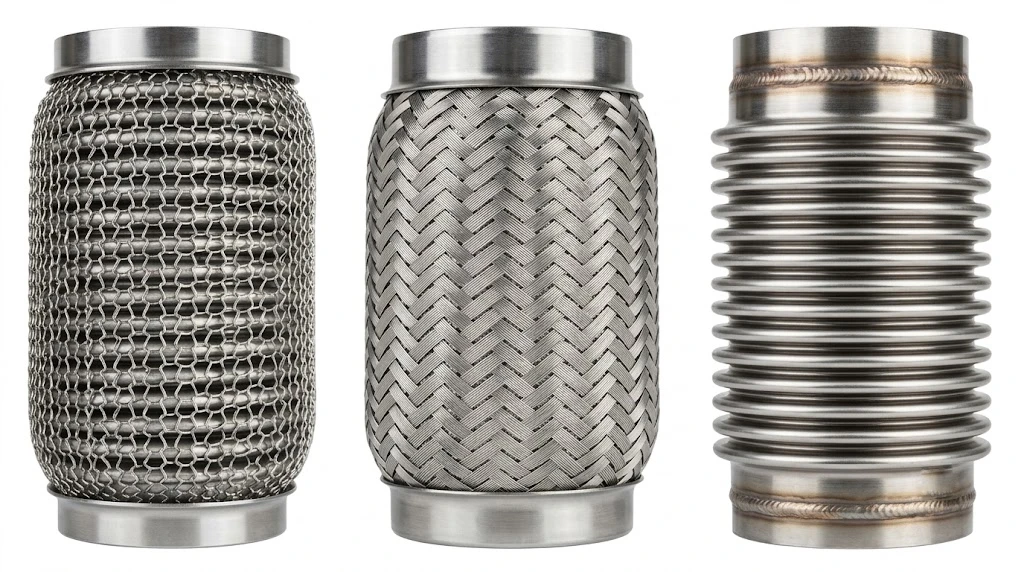
Quick Flex Pipe Comparison:
- Interlock Flex Pipe: Best for extreme performance, off-road (4×4), and custom builds. Highest multi-directional flexibility and structural strength.
- Braided Flex Pipe: Best for daily drivers and OEM replacement. Perfect balance of durability, heat shielding, and cost.
- Bellows Flex Pipe: Best for tight budget repairs and predictable, low-vibration OEM street applications.
- Golden Rule: Upgrade to SS304 stainless steel if your vehicle faces road salt, marine environments, or extreme heat.
What Is an Exhaust Flex Pipe and Why Do You Need One?
An exhaust flex pipe is a flexible section installed in the exhaust system to absorb three main forces. First, engine movement as the engine rocks on its mounts during acceleration and deceleration. Second, thermal expansion as exhaust pipes heat up to several hundred degrees during operation and cool down when parked. Third, vibration from road conditions and the engine itself that would otherwise transfer through the entire exhaust system.
Without a flex pipe, these forces concentrate at rigid joints, causing cracks, leaks, and premature failure of exhaust components. Every modern vehicle comes with at least one flex pipe from the factory, typically positioned between the exhaust manifold and the catalytic converter where movement is greatest. If you are replacing an exhaust system or building a custom setup, including a flex pipe in the same location is essential for long-term reliability.
The 3 Exhaust Flex Pipe Types
1. Interlock Flex Pipe
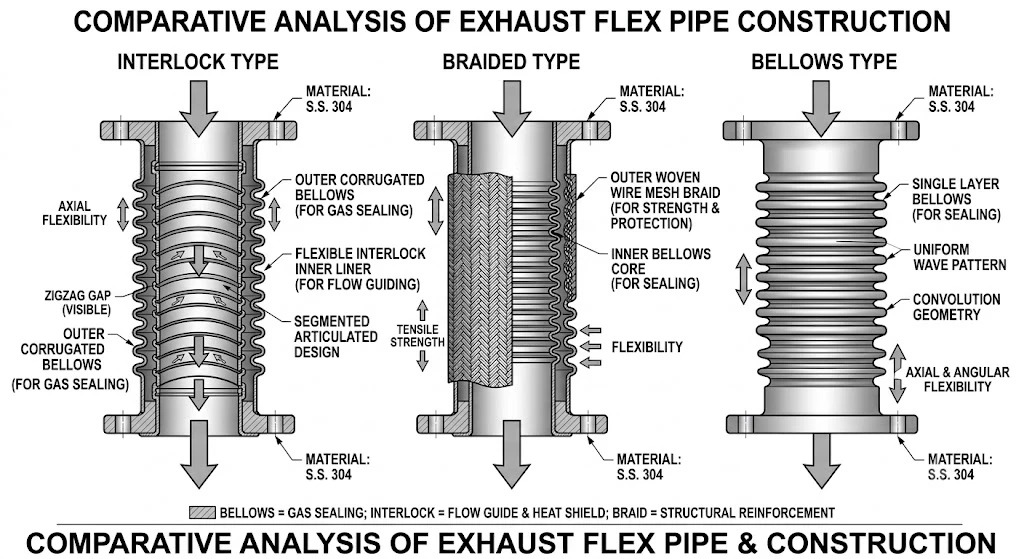
Construction: Interlock flex pipes are made from tightly wound, interlocking metal rings that form a flexible tube. A separate inner liner guides exhaust flow and acts as a heat shield. The interlocking design allows the pipe to bend and flex while maintaining a continuous gas seal through the outer corrugated bellows. This is the most mechanically complex flex pipe design, with multiple layers working together to provide maximum flexibility.
Key features: Outer corrugated bellows for gas sealing, flexible interlock inner liner for flow guiding, segmented articulated design with visible zigzag gaps between rings that allow multi-directional movement, high tensile strength that resists pull-apart forces even under extreme conditions.
Pros: Excellent multi-directional flexibility — the most flexible type available on the market. Strong structural integrity with high resistance to tensile forces. Good gas sealing through the dual-layer design that provides redundancy.
Cons: More expensive than braided or bellows types. Heavier due to the dual-layer construction with both interlock and bellows layers. The interlock gaps can collect debris in harsh off-road environments like mud and snow.
Best for: Performance builds, off-road vehicles, and applications where maximum flexibility and durability are required. The interlock design handles both axial movement along the pipe length and angular misalignment at connection points, making it ideal for custom exhaust systems with tight routing.
2. Braided Flex Pipe
Construction: Braided flex pipes feature a woven stainless steel wire mesh outer layer surrounding an inner bellows core. The braided mesh provides structural reinforcement while allowing flexibility, and the inner bellows maintains the gas seal. This is the most common design found on OEM vehicles from most manufacturers because it offers the best balance of cost, durability, and performance.
Key features: Outer woven wire mesh braid for structural strength and abrasion protection from road debris. Inner bellows core for gas sealing. Multi-directional flexibility that handles most real-world installation angles and movement requirements. The braided layer also provides a degree of heat shielding.
Pros: Excellent durability — the outer braid protects the inner bellows from impact and abrasion better than any other design. Good flexibility while maintaining structural integrity. Widely available and well-tested design trusted by major automotive manufacturers worldwide. Easy to source in any size.
Cons: Slightly less flexible than interlock designs in extreme angles. The braided layer can fray if improperly installed or if clamps are over-tightened during installation. Heavier than bellows-only designs.
Best for: Street vehicles, daily drivers, and applications where a proven balance of flexibility and durability is needed. The braided design is the standard recommendation for most replacement applications and is suitable for the vast majority of vehicles on the road.
3. Bellows Flex Pipe
Construction: Bellows flex pipes use a single-layer corrugated metal tube that flexes through its accordion-like convolutions. This is the simplest and most affordable flex pipe design, widely used in OEM applications where cost sensitivity is high and movement requirements are predictable.
Key features: Single-layer bellows with uniform wave pattern. Convolution geometry that provides both axial and angular flexibility. Lightweight and compact design that fits in tight installation spaces where larger multi-layer flex pipes will not fit.
Pros: Lightest and most affordable option by a significant margin. Simple construction means fewer potential failure points compared to multi-layer designs. Easy to install even in tight spaces where larger flex pipes cannot be positioned.
Cons: Less angular flexibility than interlock designs. Single-layer construction means no backup seal if the bellows cracks or develops a pinhole leak. More prone to fatigue failure under extreme or repeated vibration cycles. Limited tensile strength compared to braided and interlock types — can pull apart under tension.
Best for: OEM replacement on standard vehicles, budget builds where cost is the primary concern, and applications with limited installation space and predictable loads that will not exceed the bellows design limits.
Material Comparison: SS304 vs SS409 vs Aluminized Steel
The material your flex pipe is made from determines how long it lasts — especially in salt-belt states or marine environments where corrosion is accelerated. Choosing the right material is just as important as choosing the right construction type.
| Material | Corrosion Resistance | Max Temperature | Cost | Best Application |
|---|---|---|---|---|
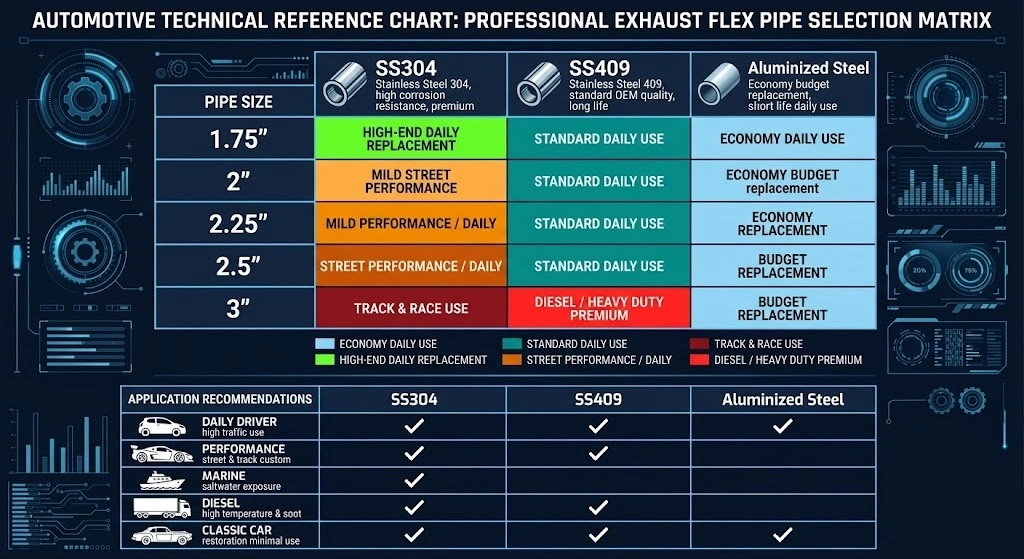
| SS304 | Excellent | 1,800°F | $$$ | Marine, coastal, performance builds |
| SS409 | Good | 1,600°F | $$ | OEM replacement, standard street use |
| Aluminized Steel | Fair | 1,400°F | $ | Budget builds, dry climates |
SS304 is the premium choice offering maximum corrosion resistance. It is ideal for marine applications, coastal vehicles, and any build where longevity is the top priority. SS304 flex pipes can last 5-10 years even in harsh environments.
SS409 is the standard OEM material that offers good corrosion resistance at a reasonable price point. It is suitable for most street-driven vehicles in moderate climates and represents the best value for standard replacement applications.
Aluminized steel is the budget option that works well for short-term use or dry climates but will corrode faster in wet or salty conditions. It is suitable for vehicles that will not be kept long-term or in arid regions.
Size Guide
| Diameter | Typical Application |
|---|---|
| 1.75″ | Small engines, motorcycles |
| 2.0″ | Compact cars, 4-cylinder engines |
| 2.25″ | Mid-size cars, V6 engines |
| 2.5″ | Full-size cars, small V8 engines |
| 3.0″ | Performance V8, diesel trucks |
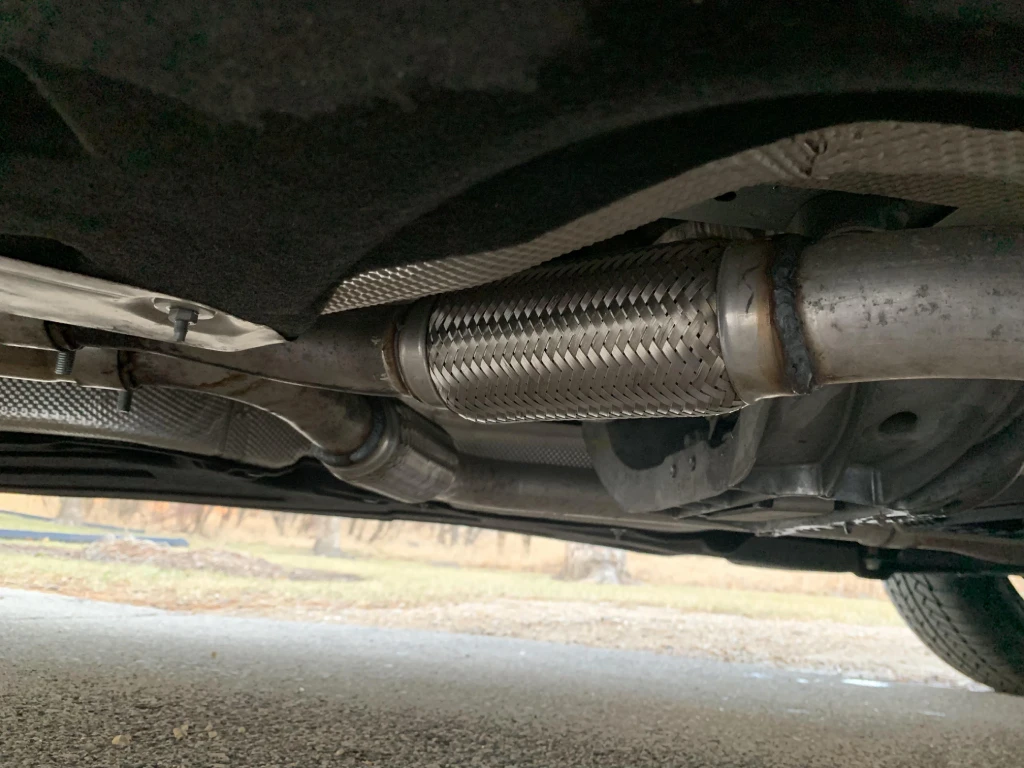
Installation tip: Position the flex pipe as close to the engine as possible, typically between the exhaust manifold and the catalytic converter. This is where the most movement and heat occur, and the flex pipe absorbs these forces before they reach the rest of the exhaust system. Use the shortest length that provides adequate flexibility — an overly long flex pipe can sag under its own weight and create a low point where moisture collects, accelerating corrosion from the inside out. If you’re swapping out a damaged pipe or dealing with cabin rattling, consult our guide on how to measure and know when to replace your exhaust flex pipe to get the exact ID, OD, and overlap dimensions before cutting.
How to Choose the Right Flex Pipe
| Application | Recommended Type | Recommended Material |
|---|---|---|
| Daily driver street car | Braided | SS409 |
| Performance / track build | Interlock | SS304 |
| Off-road / 4×4 | Interlock | SS304 |
| Marine | Braided or Interlock | SS304 |
| Diesel truck | Interlock or Braided | SS304 |
| Budget replacement | Bellows | Aluminized or SS409 |
| Classic car restoration | Braided | SS409 |
Frequently Asked Questions
How long does an exhaust flex pipe last? With proper installation, SS304 braided or interlock flex pipes can last 5-10 years. Budget bellows pipes in aluminized steel may need replacement every 2-3 years depending on climate and driving conditions.
Can a flex pipe be too long? Yes. An overly long flex pipe can sag under its own weight and create a low point where moisture collects, accelerating corrosion from the inside out. Use the shortest length that provides adequate flexibility for your application.
Do I need a flex pipe on every exhaust system? Every modern vehicle comes with at least one flex pipe from the factory. If you are replacing an exhaust system or building a custom setup, always include a flex pipe in the same location as the original to prevent stress fractures at welded joints.
What is the difference between flex pipe and regular exhaust pipe? Regular exhaust pipe is rigid and simply carries exhaust gases from one point to another. Flex pipe is designed to flex and absorb movement, vibration, and thermal expansion, connecting rigid sections without transferring stress between them.
Conclusion
Choosing the right exhaust flex pipe comes down to your application. For daily drivers and street builds, braided flex pipes offer the best balance of durability, flexibility, and cost. For performance and off-road builds where maximum movement is needed, interlock designs are the right choice. For simple, budget-friendly OEM replacement, bellows flex pipes get the job done.
Match your flex pipe type with the right material — SS304 for marine or performance applications, SS409 for standard street use — and your LEDAUT exhaust components will stay leak-free and trouble-free for years.