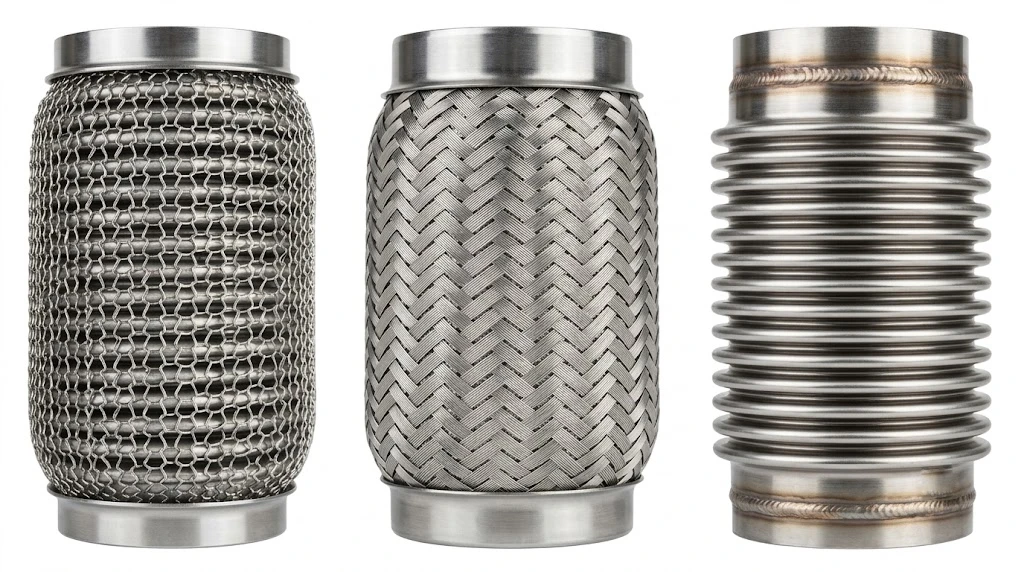
TL;DR —Five signs say it is time to replace a flex pipe: a hiss that grows with rpm, a rattle over bumps, a burning smell in the cabin, visible fraying at the braid, and a check-engine light from a lean code upstream. Any one of them is worth a look. Left alone, a failing flex pipe leaks exhaust into the cabin and can crack the flange it bolts to, turning a cheap part into an expensive repair. This guide covers when to replace it and how.
—
What Is a Flex Pipe and Why It Fails
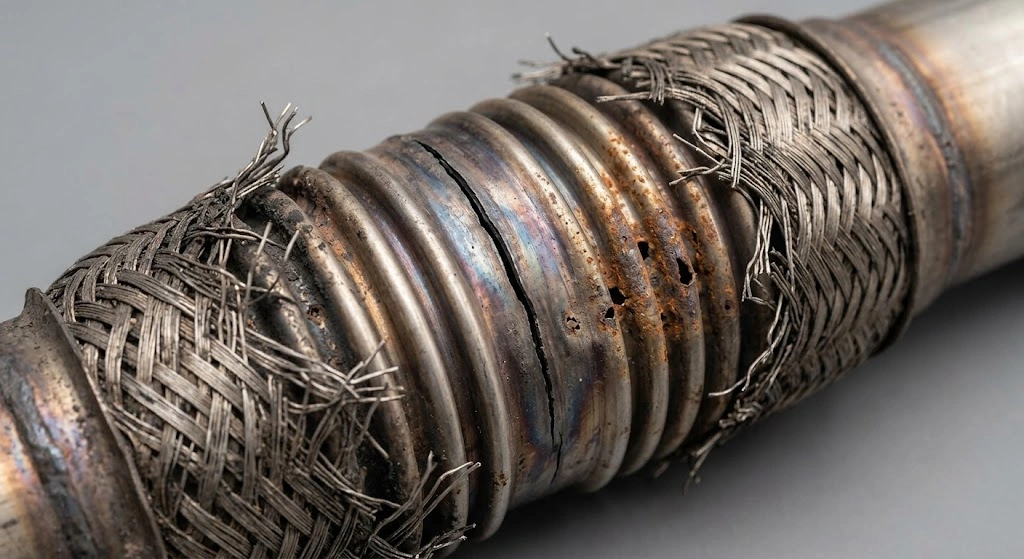
The flexible section of the exhaust sits between the manifold and the catalytic converter. Its job sounds simple but is brutal in practice: absorb engine vibration, soak up thermal expansion, and compensate for the torque-rocking motion of transverse-mounted front-wheel-drive powertrains. Without it, every engine shudder transmits straight into the manifold flanges and hangers, cracking castings and rattling brackets loose in a few thousand miles.
Over two decades of supplying flexible exhaust components to exhaust shops and distributors, we’ve seen every failure mode there is. The most common is metal fatigue — the stainless braid or inner bellows gets cycled through enough heat-cold rounds that the grain structure work-hardens and cracks. Then comes corrosion, especially in regions where roads get salted in winter. Road salt and condensed exhaust moisture create a pinhole-starting environment that eats thin-wall stainless over time. And vibration, while the component is designed to absorb it, can still finish a unit early if the exhaust hangers are worn or the engine mount is shot — the flexible section becomes the weak link that takes all the extra beating.
We’ve also noticed a clear pattern in failure rates that tracks directly to material choice. Lower-grade stainless simply doesn’t survive as many thermal cycles, which is one reason we carry our line in 304, 321, and 409 stainless steel — each matched to a different operating condition. After 20+ years in this industry, we’ve learned that the material decision is the single biggest factor in how long the replacement lasts.
—
5 Warning Signs You Need a New Flex Pipe
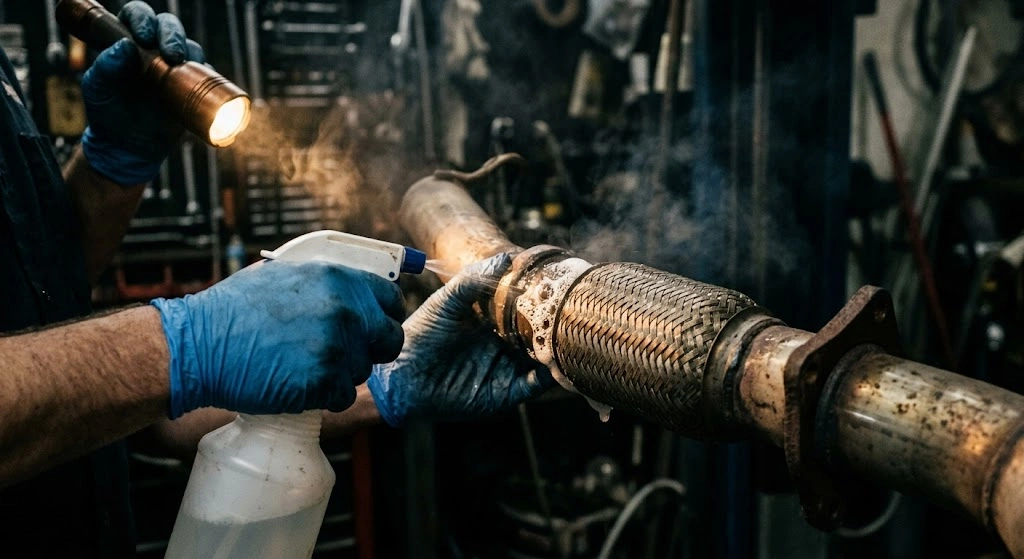
Some exhaust problems are subtle. A failed flexible joint is not one of them. Here’s what to listen and feel for.
Sign 1: Hissing Sound on Startup
When a cold engine fires up, the exhaust system is at its most pressurized before everything warms and expands. If the braided core has a hairline crack, you’ll hear a sharp hissing noise — almost like air escaping a tire — from under the vehicle. The sound often fades once the metal warms and the gap closes slightly, but that doesn’t mean the problem went away. That crack will reopen and worsen with every cold start.
Sign 2: Metallic Rattling Under Acceleration
A rattling noise when you step on the gas is a textbook symptom of a broken inner bellows or a separated braid layer. The loose metal fragments vibrate against the pipe interior or get pushed by the exhaust flow, creating a distinct tinny rattle. This is the most common complaint we hear from shops diagnosing bad flex pipe symptoms — and it’s almost never anything else.
Sign 3: Abnormal Cabin Vibration at Idle
If the flexible section has collapsed or torn internally, the exhaust system starts transmitting engine vibration directly into the chassis. You’ll feel it in the floorboard, the seat frame, even the steering wheel when sitting at a stoplight. Many drivers mistake this for a bad motor mount, but if the mounts check out fine, the exhaust flex pipe is the next thing to inspect.
Sign 4: Burning Smell from the Exhaust Area
A failed flexible joint can leak hot exhaust gas into areas it shouldn’t reach — underhood wiring, plastic underbody panels, or rubber hangers. The result is a burning odor that gets stronger after a long drive. If you smell something burning and the coolant temperature is normal, get under the car and inspect the corrugated section. The leak might be small now, but it won’t stay that way.
Sign 5: Visual Cracks or Rust-Through
Sometimes you don’t need to start the engine to know the component is done. Get the vehicle on a lift or ramps and visually inspect the braided portion. Look for:
- Burst braid strands — the outer mesh should be uniform. Any popped wires mean the inner bellows is already exposed.
- White or orange rust scale — heavy corrosion that has pitted through the stainless.
- Separation at the weld joints — the flexible section pulled away from the solid pipe ends.
If you see any of these, plan for an exhaust flex pipe replacement immediately. It’s not a “next oil change” kind of job.
Not sure which replacement design best handles extreme heat or off-road vibration? Learn how internal liners and outer mesh function in our comprehensive breakdown of the 3 exhaust flex pipe types (Interlock, Braided, and Bellows).
—
How to Measure Your Flex Pipe
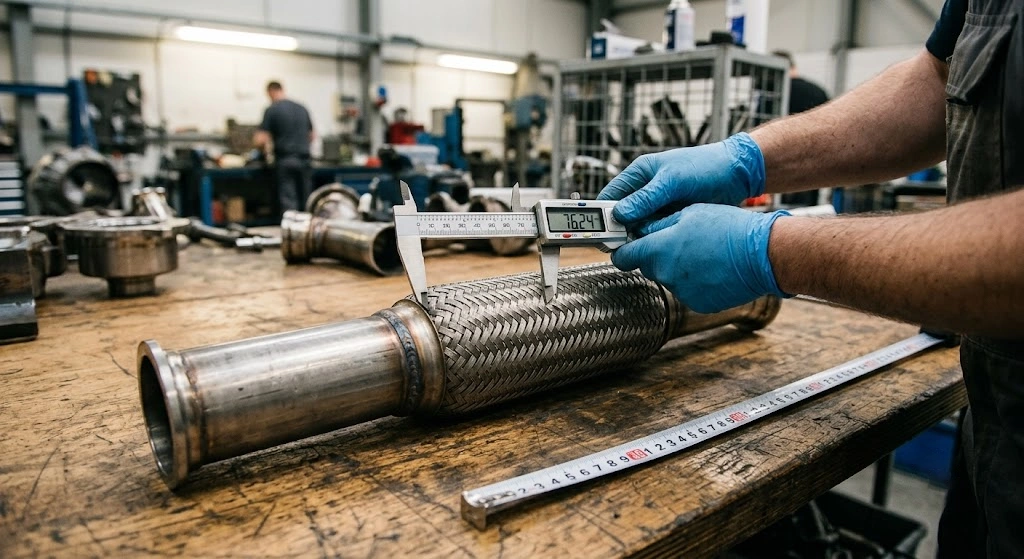
Getting the measurement right is the difference between a 30-minute replacement and a return trip because the part doesn’t fit. Here’s what to check.
Inside and Outside Diameter
Measure the ID of the solid pipe stubs on either end of the flexible assembly — this is what will connect to your exhaust tubing. Common sizes are 1.5″, 2″, 2.5″, 3″, and 5″ (all of which we carry in our standard lineup). The OD matters too, especially if you plan to use a sleeve or band clamp — make sure the pipe end slides in without forcing.
Center-to-Center Length
This is the total length from one end face to the other. Measure it while the old unit is still in the vehicle so the exhaust system is in its natural position. A difference of more than 0.5″ on either side means you’re fighting the exhaust hangers to line things up, which introduces new stress.
Overlap
Most flexible pipe connections use 2″ to 3″ of overlap where the component slides into the adjoining pipe. If you’re replacing with a new unit, verify that the overlap zone is at least 2″ deep. Less than that and the joint will be weak — more prone to leaking and vibration cracking.
Connection Type
Is the original unit welded-in, or was it clamped? Are the ends flared or straight? These details determine whether you need a weld-on replacement or one with pre-attached flanges. Not all exhaust flex pipe replacements are drop-in — know what you’re working with before you order.
—
How to Choose the Right Replacement
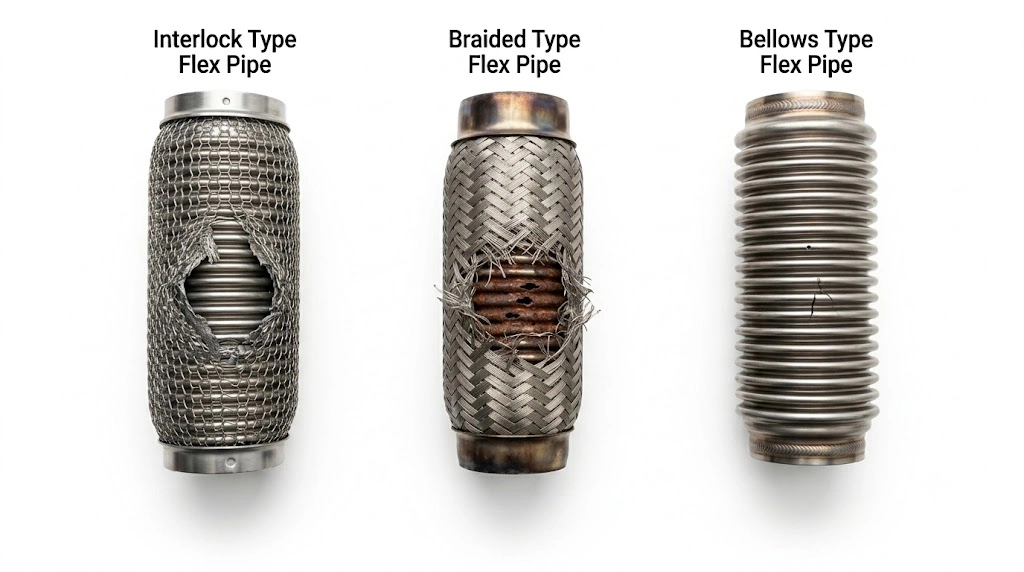
Picking a replacement isn’t just about matching the length. The environment the joint will live in — engine type, operating temperature, road conditions — should drive the choice.
Material (304 vs 321 vs 409)
The stainless grade is the first decision because it determines thermal tolerance and corrosion resistance.
304 stainless is the workhorse. It handles standard gasoline engine temperatures, resists salt corrosion well, and balances durability with cost. For most passenger vehicles and light trucks, 304 is the right call.
321 stainless is stabilized with titanium, which makes it hold its strength at much higher temperatures — above 800°C (1472°F). That’s turbocharger territory, where the flexible joint sits right after a hot-side turbine. If you’re building or repairing a turbo setup, or working on a high-performance diesel, 321 is the safer pick.
409 stainless is a ferritic grade that costs less but also has lower corrosion resistance and less long-term thermal cycle durability. It works for low-cost replacements on older vehicles where the rest of the exhaust is already near end of life.
We offer all three grades precisely because we don’t think one material fits every job. The right one depends on the application.
| Stainless Grade | Best For | Key Advantage | Temperature Rating |
|---|---|---|---|
| 304 | Passenger cars, Light trucks | Excellent corrosion resistance | Standard exhaust heat |
| 321 | Turbos, High-performance | Extreme thermal stability | Up to 800°C (1472°F) |
| 409 | Budget repairs, Older vehicles | Lowest cost | Low/Moderate |
Type (Braided vs Interlock vs Bellows)
Braided — the most common type for gasoline passenger cars. The inner bellows is wrapped in a stainless braid that adds structural reinforcement and some abrasion resistance. It’s what you’ll see on most OEM replacements.
Interlock — a heavier construction where interlocking metal rings form the flexible core. This is the preferred choice for diesel engines and heavy trucks because it withstands the higher exhaust mass flow and deeper vibration cycles that come with larger displacement engines.
Bellows — a bare corrugated tube, usually with no outer braid. It’s more flexible than braided types but also less resistant to mechanical damage. For turbocharged applications, bellows or interlock are recommended over standard braided because the thermal expansion cycles are more extreme.
| Flex Type | Construction | Best Application |
|---|---|---|
| Braided | Outer stainless mesh | Standard gasoline engines |
| Interlock | Inner interlocking metal rings | Diesel, heavy-duty trucks |
| Bellows | Bare corrugated tube | High thermal expansion setups |
Each design handles vibration, backpressure, and thermal expansion differently. For a full breakdown of internal corrugations, multilayer construction, and application matching, read our exhaustive comparison of interlock vs. braided vs. bellows flex pipes.
Specs to Match
- Inlet and outlet diameters must match the connecting pipe. A 2.25″ unit won’t seat properly on 2.5″ tubing regardless of how tight the clamp is.
- Overall length within ±0.5″ of the original, measured center-to-center.
- Overlap zone at least 2″ on each side for weld-on installations, more for clamp-fit connections.
When in doubt, pull the old unit and measure it on the bench before ordering. One measured inch beats three guessed ones. If the specs you need fall outside the standard range, contact us for custom sizing.
—
Installation Options: DIY vs Shop
Replacing an exhaust flex pipe is not a beginner-level job, but it’s also not a job that always needs a muffler shop.
DIY approach — If you have a welder (MIG or TIG) and a cutoff tool, you can cut out the old section and weld in the new one. The key is a clean, square cut and a full 360° weld bead with no pinholes. Some exhausts use mechanical clamp fittings instead of welded joints — these are simpler but require the pipe ends to be straight and round, which they often aren’t after years of service.
Shop installation — A dedicated exhaust shop can get it done faster and will also inspect the rest of the system (hangers, flanges, O2 sensor bungs) while the vehicle is on the lift. Expect them to budget roughly an hour for a straightforward exhaust flex pipe replacement and a bit more if rusted bolts need cutting or if the replacement requires welding to existing pipe.
The risk of getting it wrong is real. An improperly installed replacement — one that’s too short, too long, or welded in crooked — will leak, vibrate, or fail prematurely. A leak before the catalytic converter can also lean out the O2 sensor readings, tricking the ECU into a rich mixture that kills fuel economy. So if you’re not confident in the weld and the measure, send it to someone who does exhaust work every day.
Learn more about the full replacement process in our flex pipe installation guide. Whether you’re a shop stocking inventory or a fleet managing replacements, let us know what you need and we’ll point you to the right part.
—
FAQ
Q1: Does the replacement have to match OEM specs exactly?
Not necessarily, but the critical dimensions — ID, OD, and center-to-center length — should match closely. The material grade and construction type (braided vs. interlock) can be upgraded as long as the fitment is right. Many shops upgrade OEM 409 flexible sections to 304 for better longevity.
Q2: Can I keep driving with a leaking flexible joint?
Technically yes, but it’s a bad idea. An exhaust leak before the catalytic converter messes with oxygen sensor readings, which throws off the air-fuel ratio. Over time, that hurts fuel economy, and the hot leaking gases can damage nearby components. We’ve seen wiring harnesses melted by nothing more than a small crack in the corrugated section.
Q3: How much longer does a 304 unit last compared to 409?
In typical driving conditions, a 304 unit can outlast a 409 by a significant margin — the 409 will rust from the inside out faster due to its lower chromium content. Service life varies significantly depending on climate, driving habits, and material quality, and 304 consistently lands closer to the top end of that window.
Q4: Is welding better than clamping?
Welding gives a stronger, more permanent seal — no chance of the clamp loosening from vibration. Clamps are faster and don’t require welding skill, but they add bulk to the joint and can slip if not torqued properly. For a daily driver you plan to keep, welding is the better long-term choice.
—
Conclusion
A worn-out flexible joint isn’t something that gets better on its own. The hiss, the rattle, the vibration — those are the exhaust system telling you it has failed. A prompt replacement, matched to the right specs and material, keeps the rest of the system healthy and the vehicle running right.
With nearly 20 years of experience in the flexible exhaust business — across 304, 321, 409 stainless, in braided, interlock, and bellows constructions — across standard diameters from 1.5″ to 5″. If you’re sourcing replacements for a shop, a fleet, or a production line, we can help you pick the right unit. Get in touch with our team to discuss your requirements.