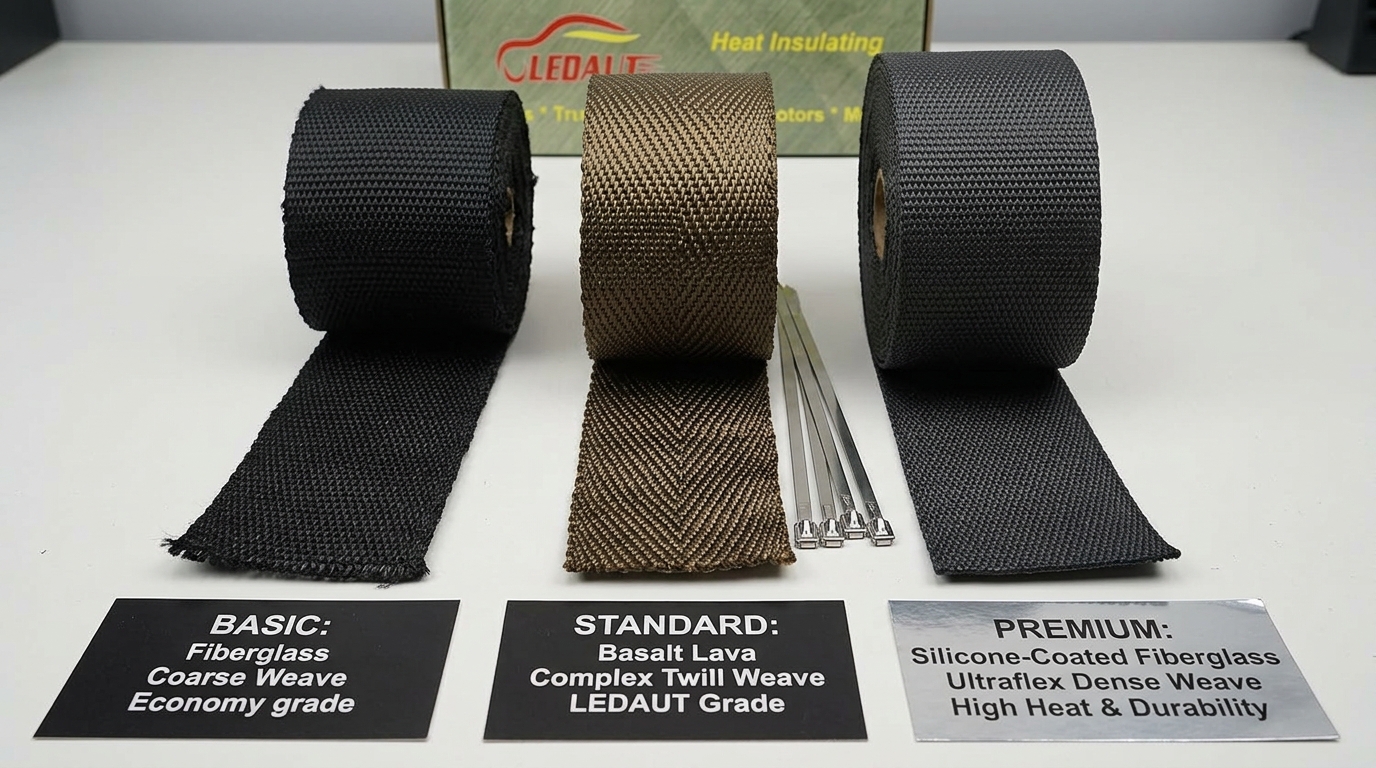
Ten years of supplying wrap to shops has narrowed this down to two weaves that matter: fiberglass and basalt. Fiberglass is the budget option and handles normally aspirated street use fine. Basalt — often sold under the “titanium” label — costs more and takes the sustained heat of manifolds, turbos, and track use. This comparison lays out where each one wins, so you can pick for the pipe in front of you instead of the one on the poster.
Where these numbers come from: we manufacture exhaust wrap. We weave the fabric and supply it to performance brands, motorcycle builders and marine shops, so what follows is what we have to stand behind on a spec sheet rather than brochure copy. Where a material is not one we make, we say so and tell you what to buy instead.
Which Wrap Should You Stock?
If you are a shop owner, distributor or private-label brand adding exhaust wrap to your line, here is the 30-second version:
- Fiberglass (Basic) — typical US retail $8–15 per roll. 1,000°F (538°C) continuous, 1,200°F (649°C) spike. Fine for daily drivers, mild hot rods and budget builds. Expect a re-wrap every 1–2 years, and expect to wet the roll before you install it so the glass dust stays out of the air.
- Basalt, sold as “titanium” wrap (Standard) — typical US retail $20–35 per roll. 1,800°F (982°C) continuous, 2,500°F (1,371°C) spike on our own spec sheet. This is the sweet spot for roughly nine out of ten performance and off-road jobs. 3–5 years of service with a correct install, and it goes on pliable and dry.
- Ceramic (Premium) — typical US retail $40–65 per roll. 2,200°F (1,200°C) continuous. Race and extreme-duty only. Properly installed, it does not degrade over the life of the vehicle. It is also the one we do not weave — more on that below.
Our recommendation for most shops: make basalt your primary offering, keep ceramic for the customers whose exhaust glows in the dark, and stock fiberglass only for price-shoppers who understand they are buying a re-do. The material itself is not where the money goes — see the cost-per-year row in the table below, where all three land within a couple of dollars of each other.
Fiberglass vs Basalt vs Ceramic: The Full Comparison
Heat limits and lifespan figures follow our published material specifications; retail prices are typical US market ranges for a 2″ × 50′ roll, not our pricing. Where a figure is a supplier or industry claim rather than something we measure, it is marked as such.
| Specification | Fiberglass Basic |
Basalt / “Titanium” Standard |
Ceramic Premium |
|---|---|---|---|
| Material Type | E-glass fiber | Volcanic basalt rock fiber | Alumina-silica ceramic fiber |
| Continuous Heat Limit | 1,000°F (538°C) | 1,800°F (982°C) | 2,200°F (1,200°C) |
| Short-Term Spike | 1,200°F (649°C) | 2,500°F (1,371°C) | 2,600°F (1,430°C) |
| Pre-Wetting Before Install | Yes — wet the roll to control glass dust | No — pliable as supplied | Recommended — helps it follow tight bends |
| Installed Lifespan | 1–2 years | 3–5 years | 8–10+ years |
| Typical Retail (2″×50′) | $8–15 | $20–35 | $40–65 |
| Material Cost per Year | About $5–10/yr | About $5–9/yr | About $4–7/yr |
| Roll Weight (2″×50′) | About 1 lb | About 1.5–2 lb | About 2–2.5 lb |
| Water Resistance | Poor — absorbs and holds moisture | Good — naturally hydrophobic | Good — sealed fibers |
| Resists Oil / Fuel | Poor — degrades | Good — stable | Excellent — chemically inert |
| Fiber Dust / Skin Irritation | High — gloves and sleeves essential | Moderate — gloves advised | Low — fibers are coarser |
| Install Difficulty | Easy — beginner friendly | Moderate — some experience helps | Hard — needs patience on tight bends |
| End of Life | Non-recyclable; dusty to strip | No chemical additives; recyclable in some streams | Inert and non-recyclable |
Two things the table will not tell you. First, the cost-per-year row looks almost flat because material cost is not what separates these tiers — the second install and the second labor charge is. Fiberglass is only cheaper if your own time is free. Second, “green” is not a clean win for any of them: basalt needs no chemical additives, but melting rock at roughly 1,500°C takes real energy, so it is a sourcing story rather than a carbon story. We would rather you repeat the accurate version than the marketing one.
In-Depth: Fiberglass Exhaust Wrap (Basic Tier)
Fiberglass is the entry-level workhorse and the one your customers will have heard of. It is cheap, it is on the shelf at every parts store, and it conforms easily to bends. Those advantages come with a service life you have to plan for.
Where fiberglass performs
- Lowest material cost. At $8–15 per roll there is nothing cheaper to quote.
- Easiest to install. Softer fibers take curves without a fight, which matters on a first-timer’s job.
- Widely available. 1″ to 3″ widths are stocked almost everywhere.
- Adequate on low-heat street engines. Below roughly 1,000°F at the pipe it does the job.
Where fiberglass falls short
- Moisture kills it. Glass fiber absorbs water and then holds it against the pipe, which is why wrapped mild-steel headers rust from the outside in. On a car that sees road salt or a wet climate, plan on 12–18 months rather than two years.
- It sheds. As heat cycling breaks the fibers down, the wrap releases airborne glass dust every time someone works near the exhaust. That is a genuine hazard for whoever does the next job.
- Short service life. Once it goes, your shop eats a second labor charge to redo work it already billed.
- Not for forced induction. Sustained high EGTs turn fiberglass brittle inside a season.
Best for: budget daily-driver headers, mild V8 projects, stationary engines. Avoid for: turbo builds, marine use, road-salt states, high-horsepower applications.
In-Depth: Basalt Wrap — Sold as “Titanium” (Standard Tier)
This is the tier most professional work gravitates to. Basalt fiber is drawn from melted volcanic rock, which is also why the same product is sold across the industry as “titanium wrap” or “lava rock wrap” — the deal is the fiber, not the metal. If you only stock one grade, this is the one. We weave it; our titanium exhaust heat shield wrap is this material.
Where basalt performs
- Heat headroom. 1,800°F continuous covers every street and track application short of full race.
- It does not hold water. Basalt fibers are naturally hydrophobic. This is the single biggest practical difference from fiberglass: no wicking, no trapped moisture, no rust line under the wrap.
- It goes on dry. No pre-wetting, no bucket, no waiting. On a flat-rate job that is real minutes saved per header.
- Better long-run cost. Three to five years with minimal degradation means one install instead of two.
- Low thermal conductivity. It holds more heat inside the pipe than an equivalent thickness of glass wrap.
Where basalt has limits
- Some skin irritation. Less than fiberglass, but gloves are still the right call.
- Colour is basically one option. Natural charcoal-grey. Coloured wraps are almost always fiberglass.
- Not a race material. Sustained pipe temperatures above 1,800°F will eventually degrade it. Nitrous and high-boost turbo builds belong in the ceramic column.
Best for: street performance, off-road and overland, fleet and work trucks, short-track racing, marine (the water resistance makes it viable), most turbo applications under 15 PSI. Our default recommendation for the large majority of jobs.
In-Depth: Ceramic Exhaust Wrap (Premium Tier)
Ceramic wrap sits at the top of the market: high-purity alumina-silica fiber, the same family used in kiln linings and turbine insulation. It is what you install when temperature and longevity justify the price. It is also the one grade we do not manufacture, and we would rather tell you that than pretend otherwise — if your customer genuinely needs it, buy it, from us or anyone else.
Where ceramic performs
- Extreme heat. 2,200°F continuous. No street or track car reaches its limit.
- Longest life. Correctly installed, it outlasts the vehicle — no degradation from heat cycling, no cracking from thermal shock.
- Chemically inert. Oil, fuel, coolant and road salt do nothing to it. If it gets dirty, hose it off.
- Less dust. Ceramic fibers are coarser than glass, so there is far less airborne material during installation.
Where ceramic is the wrong answer
- Cost. Three to five times fiberglass. A long-tube V8 set takes three or four rolls, so $120–260 in material alone before labor.
- It fights you. Stiff fibers, tight-radius bends that need patience and pre-wetting, and stainless ties rather than anything cheaper. Not a job for a first-timer.
- Wasted on mild builds. On a stock manifold or a naturally aspirated 350, basalt does the same job for half the money.
Best for: turbo race cars, high-boost builds above 20 PSI, endurance racing, nitrous, competition marine, extreme off-road, anything with sustained pipe temperatures past 1,600°F. Buy it as a permanent installation and never touch it again.

Which Grade for Which Build
Match the material to the actual use case and the conversation with the customer gets short.
Street / daily driver
Grade: Fiberglass or basalt
Why: Moderate heat cycles, no track use. Fiberglass will hold if the customer is strictly price-driven, but ask how long they plan to keep the car. Past three years, basalt wins on the math — the second install costs more than the material upgrade does.
Track / road course
Grade: Basalt or ceramic
Why: Sustained rpm means sustained exhaust temperature. Basalt handles weekend track days comfortably. For competitive sessions of 30 minutes or more, ceramic. The better heat containment also keeps the cabin cooler, which drivers notice.
Off-road / overland
Grade: Basalt
Why: Water crossings and mud rule fiberglass out — it will hold moisture against the pipes and accelerate corrosion. Basalt’s hydrophobic fiber is the right fit, and the slight weight penalty is irrelevant on a truck.
Fleet / work trucks
Grade: Basalt
Why: Fleet maintenance buys on total cost of ownership and downtime, not material price. Three to five years from one install is the cheapest outcome on the board — one purchase order, one labor charge, back on the road.
Extreme / competition
Grade: Ceramic
Why: Drag cars, professional drift, endurance racing — if the exhaust glows at night, ceramic is the only material that survives the season. Expensive per roll, still trivial next to the engine build.
Installation Rules That Apply to All Three
Material choice decides the lifespan. Installation decides whether the wrap ever works at all. The four rules below are the ones we see broken most often; the full walk-through with the 50% overlap technique lives in our step-by-step exhaust wrap install guide.
- Wet only what needs wetting. Fiberglass gets wetted to keep glass dust out of the air; basalt goes on dry and pliable. Soaking a basalt roll does nothing useful and slows the job down.
- Overlap properly. The 50% overlap rule is what guarantees full coverage. Exposed pipe is a heat leak, and a heat leak defeats the point.
- Use stainless ties only. Ordinary ties rust through and let the wrap unwind. 304-grade stainless, sized to the wrap width.
- Heat-cycle before the customer drives it hard. Bring the engine to temperature, let it cool completely, repeat two or three times. That sets the wrap and drives off any residual moisture.
One more, because it costs people jobs: wrap the headers after they are mounted, not on the bench. Wrapping first and wrestling the header in afterwards tears the material and leaves gaps you cannot see.
Frequently Asked Questions
Sourcing Wrap for Your Business
Whether you are a shop adding a service line, a distributor filling a catalogue or a brand building its own range, the grade decision has a bottom line attached. Stock the wrong tier and you either lose the quote on price or eat the labor when it comes back.
For wholesale and shop buyers: lead with basalt as the core SKU, keep ceramic available for extreme builds, and hold fiberglass for walk-in price-shoppers. That covers essentially the whole market while protecting your margin and your callbacks.
Buying wrap by the roll or the pallet?
We manufacture titanium (lava rock) exhaust wrap and fiberglass wrap in 1″, 1.5″, 2″ and 3″ widths, supplied direct from our own mill to performance brands, motorcycle builders and marine shops. That means custom widths, your own labelling, and volume pricing rather than a distributor’s margin on top of ours. Tell us the widths, the roll lengths and the annual volume, and we will quote the lot.
Request a wholesale quoteWe manufacture exhaust wrap — the fabric, not a resold import — and supply it to performance, motorcycle and marine brands worldwide. That is the vantage point this comparison comes from: the numbers we have to put on a spec sheet and defend when a customer tests them. If you are choosing material for a specific build or stocking a range, send us the details and we will tell you which grade fits, including when the answer is a material we do not make.