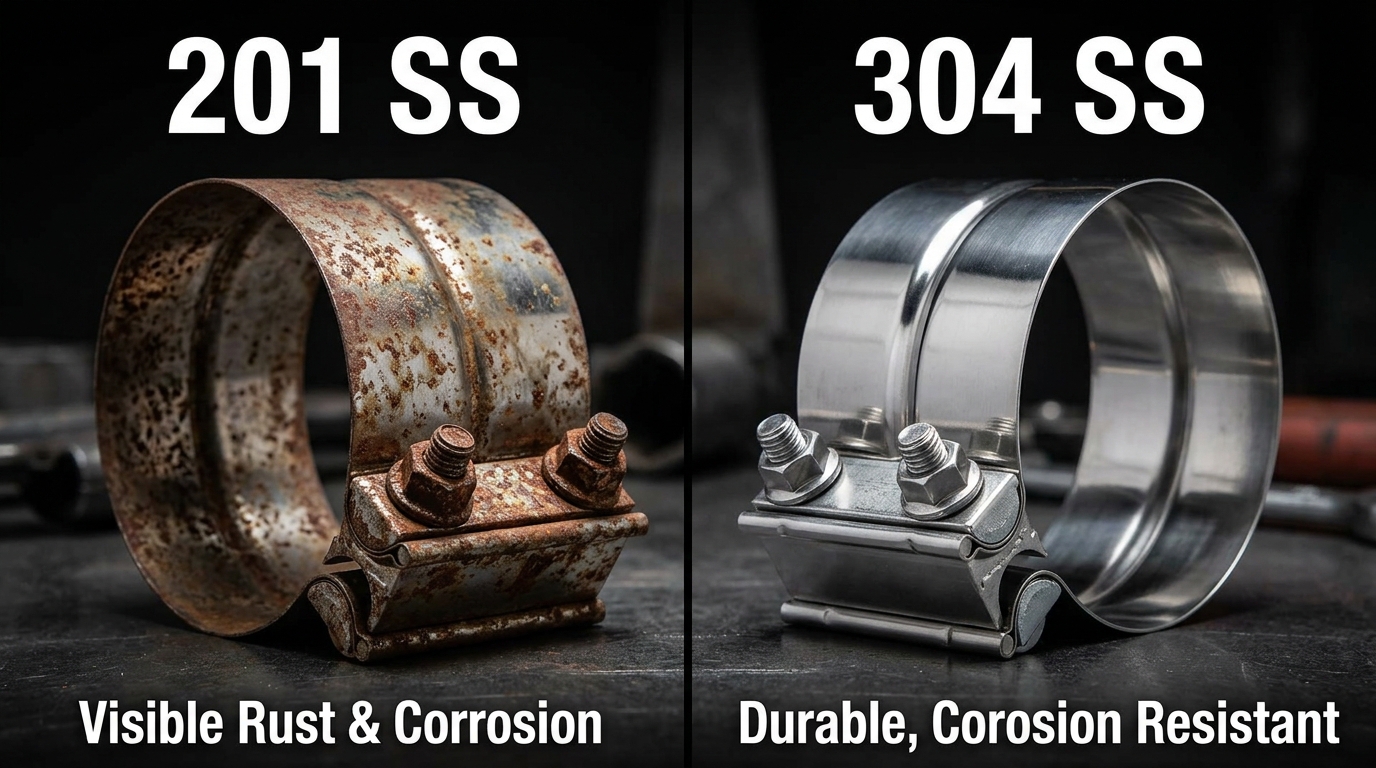
Muffler material decides how long the part lasts far more than how it sounds. In a wet climate, aluminized steel will rot through in a few winters while 304 stainless is still going strong. Inland and dry, aluminized can last a decade. This guide compares aluminized steel, 304 and 409 stainless, and titanium by rust resistance, lifespan, sound, and cost — and tells you which one matches your climate and budget.
This muffler material comparison covers what each option is made of, how they perform in real road conditions, where they fall short, and how to pick the right one for your specific vehicle and climate. We have been manufacturing straight-through mufflers at LEDAUT for over twenty years, and we have seen every material cycle through popularity. Here is what actually holds up on the road.
—
Why Material Matters
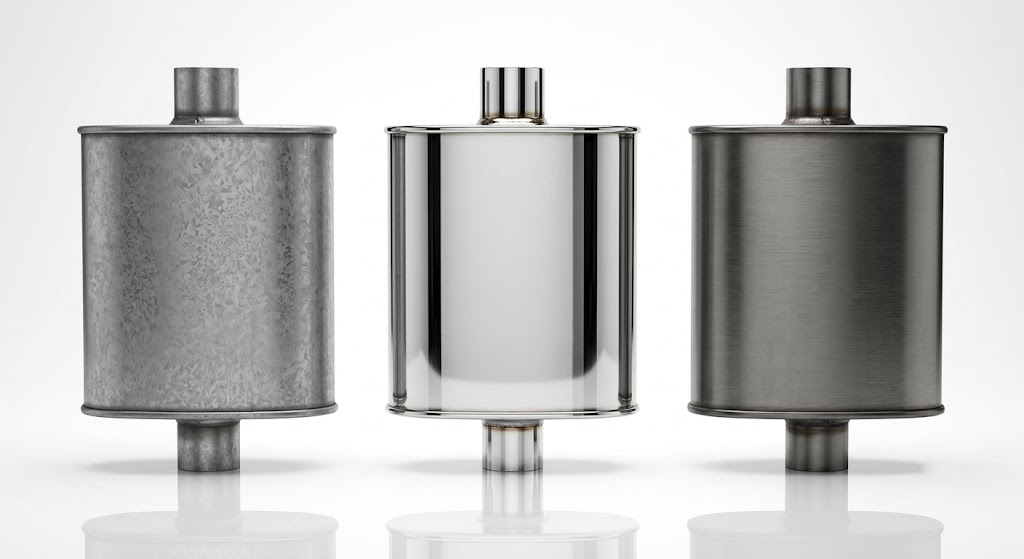
The muffler material you choose determines three things in the real world: how long the part lasts, how well it handles exhaust heat, and how it looks under the car.
- Longevity: A muffler lives inches off the pavement. It takes salt spray in winter, acid rain in summer, and gravel year-round. Pick the wrong material and you will see rust-through from the inside in as little as two winters in northern states. Pick the right one and the muffler outlasts the car itself. Inside the muffler, condensation is just as destructive as external salt. Every cold start produces water vapour inside the exhaust. That water sits in the lowest point of the muffler shell and, if the material is not corrosion-resistant, slowly eats through from the inside out.
- Heat resistance: Exhaust gases hit 600°C and beyond near the engine outlet. A material that cannot handle sustained high temperatures will scale, crack, or discolour. This is even more critical on turbocharged or high-performance builds where gas temperatures run higher for longer.
- Appearance: Some owners care about what shows behind the rear valance. Stainless and titanium hold their finish for years. Aluminized steel turns brown and eventually rusty. If you are building a car where the exhaust is visible, that difference matters.
Regional climate is often the deciding factor. Northern US, Canada, anywhere crews dump calcium chloride and rock salt in winter—you need a stainless-steel muffler, full stop. Salt eats through an aluminised coating in one or two seasons. Once that coating is gone, the base metal underneath rots fast, often from both sides at once.
We position our muffler lineup at the mid-to-value range because we believe a long-lasting exhaust should not require a premium budget. You do not need to spend heavily to get a muffler that handles season after season—you just need the right muffler material for your climate and driving pattern.
—
Material Comparison Table
Here is the same data we reference on our own production floor. These numbers come from two decades of manufacturing experience, not marketing materials.
| Muffler Material | Max Continuous Temp | Corrosion Resistance | Expected Lifespan | Weight vs Mild Steel | Relative Cost |
|---|---|---|---|---|---|
| Aluminized Steel | ~650°C | Good while coating stays intact | 3–5 years (rust belt) | ~1× (baseline) | Low |
| 409 Stainless | ~750°C | Good | 7–10 years | ~1× | Medium |
| 304 Stainless | ~850°C | Excellent | 15–20 years | ~1× | High |
| Titanium (Grade 2) | ~600°C | Excellent | Lifetime of the car | ~40% lighter | Very High |
A few notes from our shop floor. The 7–10 year range for 409 and the 15–20 year span for 304 are based on real-world returns across multiple climate zones—not lab spray tests that run around the clock. Field return data across multiple manufacturers supports these ranges for temperate climates. In coastal or heavy-salt environments, expect both numbers to drop significantly, but 304 always outlasts 409 by a wide margin—generally at least double the service life.
Titanium is the only material here that is genuinely lighter—roughly 40% less than any steel option. A titanium muffler saves 2–4 kg versus its steel counterpart. On a race car that matters for handling and balance. On a daily driver you will not feel it.
Cost follows the same curve. Aluminized is the least expensive option to produce. 409 stainless costs roughly 1.5 to 2 times more than aluminized. 304 stainless climbs further from there. Titanium is in a separate category—raw material alone costs several times what a finished 304 muffler does.
—
Aluminized Steel: The Budget Choice
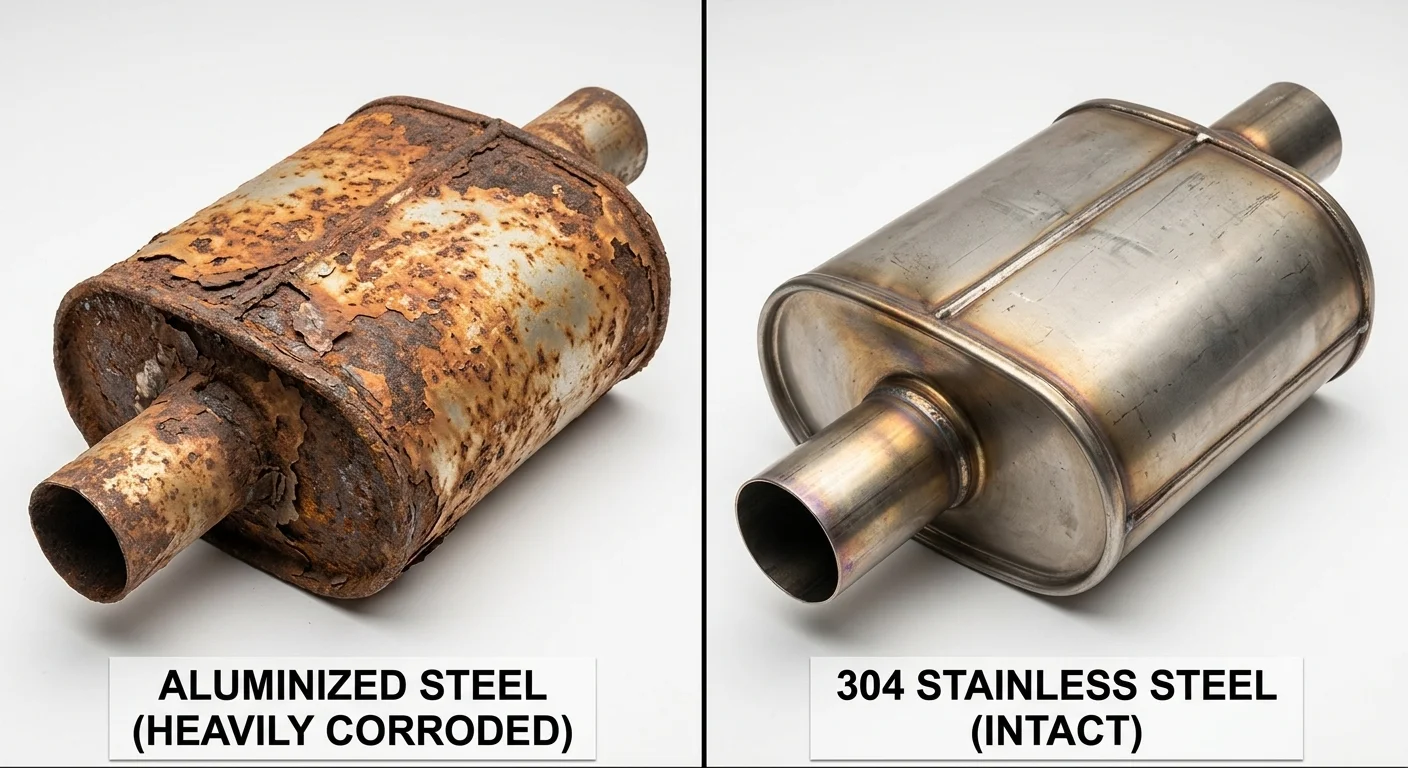
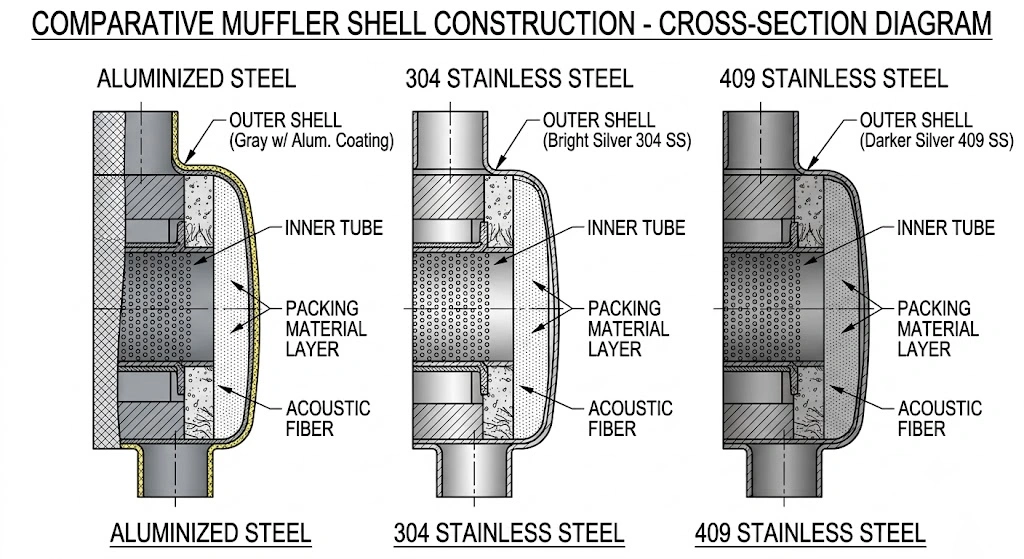
Aluminized steel starts as standard cold-rolled steel, then gets a hot-dip coating of aluminium-silicon alloy—roughly 90% aluminium, 10% silicon. That coating acts as a sacrificial layer: oxygen and moisture attack the aluminium first, leaving the underlying steel protected until the coating wears through.
- Where it works: This is the default material for OEM replacements and budget aftermarket units. It is affordable, welds easily, and performs acceptably in dry climates. If you live in the desert southwest and plan to keep your car for three to five years, an aluminized steel muffler is a perfectly solid pick.
- Where it fails: The coating is thin—typically one to two millimetres. Once it gets scratched, chipped, or burned off (common at weld joints and near the inlet where exhaust heat is highest), bare steel is exposed. In wet or salted conditions, corrosion starts at those weak points and spreads fast. We have seen aluminized mufflers fail in two winters on daily drivers in the snow belt. Internal flaking is another issue; thermal cycling weakens the bond, causing the coating to delaminate and leaving the inside completely unprotected.
- Bottom line: Use it for short-term ownership or mild, dry climates. Do not count on it past year five, especially if you drive where roads get salted in winter.
—
304 Stainless Steel: The Sweet Spot
304 contains roughly 18% chromium and 8% nickel. The chromium forms a passive oxide layer that self-heals when scratched. The nickel stabilises the austenitic structure, which improves weldability and formability over ferritic grades.
- Why we use it: After twenty-plus years of straight-through muffler manufacturing, we have learned one thing: when durability is the priority, 304 is the material to pick. It handles sustained exhaust heat without losing corrosion resistance. It welds clean with TIG. It polishes to a mirror finish that stays that way for years.
- The trade-off: 304 is genuinely expensive. The nickel content alone drives the price up substantially. For a budget-conscious build, 304 might push the total system cost higher than the project justifies.
- Ideal use cases: Long-term daily drivers, vehicles in coastal or snowy regions, show cars where appearance counts, and any build where the philosophy is to fit it once and forget it. If you plan to keep your car for more than five years and it sees winter roads, this is the pick.
Looking for an exhaust that outlasts your car? Browse our direct-fit 304 Stainless Steel Mufflers here.
—
409 Stainless Steel: Cost-Effective Option
409 is the ferritic alternative to 304, with roughly 11% chromium and titanium added as a stabiliser to prevent carbide precipitation during welding. No nickel—that is what keeps the cost closer to aluminized than to 304.
- The appeal: 409 offers noticeably better corrosion resistance than aluminized at a price much closer to aluminized. Automakers have relied on it for decades on factory exhaust systems. It is a proven, workable material.
- The catch: Without nickel, 409 does not form as robust a protective layer as 304. It can develop light surface rust—a fine brown dust that looks alarming but is actually the chromium oxide layer stabilising. This surface discolouration is cosmetic, not structural, but it means the muffler will never stay shiny or polished. It also has lower ductility than 304, meaning it can crack under repeated high-stress vibration if not properly supported with hangers.
- Well suited for: Mild climates (southern and western US), budget-conscious builds that want the benefit of a stainless build without the 304 price tag, and applications where the muffler is hidden under the car so appearance does not matter.
—
Titanium: The Premium Choice
Titanium sits in a completely different category. Grade 2 commercially pure titanium weighs roughly 40% less than steel. It forms an exceptionally stable oxide layer that makes it effectively immune to exhaust-system corrosion—salt, water, heat, nothing touches it. And when heated, that oxide layer thickens and shifts colour, producing the blue-to-purple gradient that dedicated enthusiasts pay a premium for.
- What it does well: Weight reduction is the headline number. Dropping 2 to 4 kg from the rear of a track car matters for rotational mass and chassis balance. The heat-colouring effect is completely unique and unreproducible with any other material.
- The reality check: Titanium is extraordinarily expensive relative to any steel option. Fabrication requires specialised welding techniques, different filler metals, and strict contamination control. A titanium muffler costs many times what a 304 stainless unit costs. It also resonates differently, producing a crisper, higher-frequency note that some love and others find harsh.
- When it makes sense: Dedicated race cars, high-end builds where cost is secondary, and show cars where the titanium appearance is part of the package.
—
How to Choose: Decision Tree
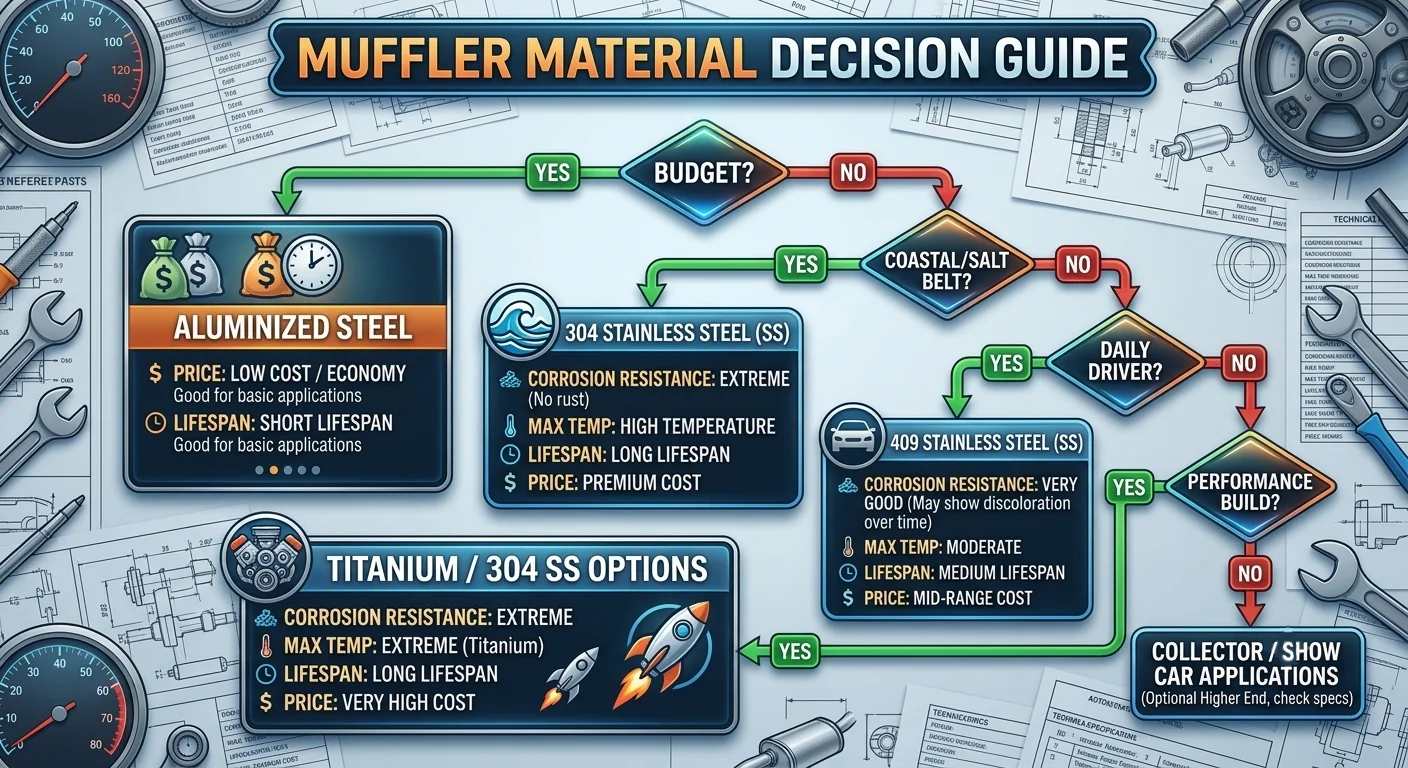
Three questions. One clear answer.
Step 1: What is your budget?
- Need the lowest possible cost → Aluminized Steel
- Reasonable budget or cost is not a constraint → move to Step 2
Step 2: Where do you live and drive?
- Snow belt, coast, or year-round humidity → 304 Stainless
- Dry inland climate (southwest, interior west) → 409 Stainless
- Car driven three months a year on dry roads → Aluminized Steel
Step 3: What kind of build is this?
- Track-only or serious performance build → Titanium (if budget allows) or 304 Stainless
- Daily driver that needs to last through winters → 304 Stainless
- Weekend cruiser in mild weather → 409 Stainless
- Utility vehicle or beater with a short expected life → Aluminized Steel
Most people land on either 304 or 409 grade, and for good reason—they deliver years of service without going into race-car pricing.
—
FAQ
Q1: 409 vs 304—how do I choose?
Look at your local climate first. If you drive in the salt belt, along the coast, or anywhere with regular wet conditions, go with 304. The extra nickel content makes a real, measurable difference in corrosion resistance. You will see it in the lifespan numbers. If you live in a dry climate—Arizona, Texas, inland California—and want a stainless exhaust without the 304 price, 409 will serve you well for years.
Q2: How long does an aluminized muffler last?
In a dry climate, four to five years. In a salt-belt winter climate, expect two to three years before the coating fails and corrosion takes over. The thin aluminium-silicon layer is the limiting factor—once it is gone, the underlying steel rusts quickly. Internal condensation accelerates the process from the inside, which is why aluminized mufflers often fail from within.
Q3: Is titanium worth the cost?
Only for specific use cases. If you are building a track car, chasing every kilogram, or want the blue-purple heat markings for a show build, titanium is unmatched. For a daily driver used on public roads, the weight savings are unnoticeable and the cost is prohibitive. Stick with 304 stainless steel.
Q4: How can I tell what material my factory muffler is?
Use a common magnet. Aluminized steel is strongly magnetic (it is steel under the coating). 409 stainless is also magnetic (ferritic crystal structure). 304 stainless is non-magnetic or only weakly magnetic (austenitic structure). Titanium is non-magnetic and noticeably lighter than it looks—pick it up and you will feel the difference. If a muffler has light surface rust but is not structurally failing, it is likely 409 stainless; that surface rust is cosmetic and does not affect function.
—
Conclusion
Every muffler material has a job it does well. Aluminized steel keeps the upfront cost low for short-term or mild-climate use. 409 stainless steel bridges the gap between budget and durability. 304 stainless steel is the all-round pick for anyone who wants a muffler that lasts as long as the car. And titanium is for the builds where weight and appearance justify the price.
Match the muffler material to your climate and ownership timeline—not to what looks good on paper. That is the honest way to choose.
If you are still exploring options, start with our guide on muffler types to understand the internal construction differences, then read how to choose a muffler for the full decision framework.
Need help deciding? Contact our team with your vehicle model and climate info—we can recommend the right material for your build.