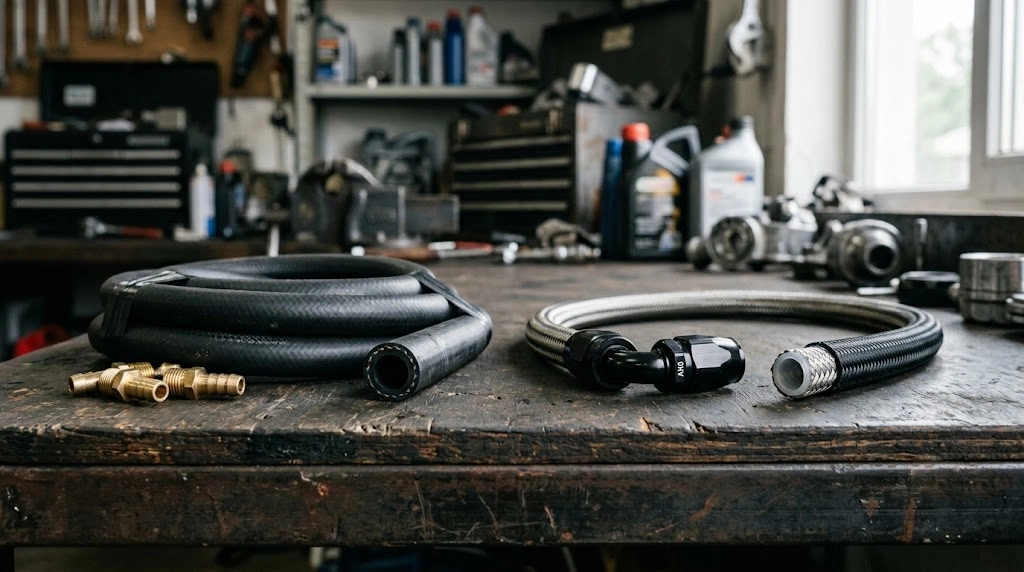
Walk into any small engine shop in late spring and you’ll hear the same story. A mower quit mid-cut. The tank is full, the plug is fresh, the carburetor was cleaned last season. Then someone pulls the fuel line off the tank nipple, bends it, and a hairline crack opens right at the fitting. That line was NBR rubber, and it had been on the machine for years of heat cycles and ethanol-blended gas.
We supply fuel line to rebuilders, repair shops, and backyard mechanics. Most of what we ship is rubber hose for small engines. Some of what we ship is PTFE line for fuel injection systems. Those are not competing products fighting for the same job. They match different applications, different pressures, and different fuels.
So here is the short version before the details. If you are working on a lawn mower, a generator, a snowblower, or a similar carbureted small engine, rubber fuel hose is the right call. If you are plumbing an EFI system, running high-ethanol fuel, or building something that sees higher pressure and heat, PTFE fuel line belongs in that conversation. Pick the material that matches the job, not the one that sounds more advanced.
What This Comparison Covers
This comparison is written for people doing real work on small engines and light equipment:
– Homeowners keeping a mower, trimmer, or generator running
– Small repair shops doing tune-ups and fuel system replacements
– Anyone buying replacement fuel line for general-purpose machinery
It is not written for race teams, high-pressure EFI plumbing specialists, or industrial fuel transfer. Those are different builds with different specs, and we cover them elsewhere.
Here is the core idea behind everything below. Rubber is the default. PTFE is the special-case solution. That single sentence settles most of the decisions people email us about.
Rubber Fuel Line: The Standard for Small Engines
Rubber is the default for a simple reason: it does the job, it is easy to work with, and it is everywhere. Walk into any parts counter and you can buy rubber fuel hose by the foot in five common inside diameters.
What it is made of
Our rubber fuel line is NBR nitrile rubber with a reinforcement layer. The rubber handles the fuel contact. The reinforcement layer keeps the hose from ballooning or collapsing under vacuum and pressure. That construction is what lets the line hold its shape when it bends around a tank, a filter, and a carburetor inlet without kinking.
Sizes and pressure
The hose comes in five inside diameters: 3/16 inch, 1/4 inch, 5/16 inch, 3/8 inch, and 1/2 inch. The 1/4 inch size is the workhorse. It fits most small engine fuel systems, and it is the size we ship most often. The 5/16 inch size is a different animal. It shows up on fuel-injected models, where it is marked EFI Only, and it is not the default for a general-purpose small engine. If you own a carbureted mower or generator, 1/4 inch is almost always the size you want, and reaching for 5/16 inch without checking the machine just adds a loose fit and a leak. The 3/16 inch size covers the smallest trimmers and handheld equipment, while 3/8 inch and 1/2 inch turn up on larger feed lines and gravity tanks. Match the inside diameter to the nipple on your machine rather than to the nearest size on the shelf, because a hose that is one step too large will slip and one step too small will not seal.
Working pressure is 300 PSI. On a carbureted small engine you are nowhere near that number, but the rating tells you the hose has real margin for the low-pressure feed it actually sees. Vacuum is the other half of the story. A gravity feed pulls a light vacuum on the line, and the reinforcement layer is what keeps the hose from collapsing inward and pinching off the flow.
Fittings and standards
The hose uses Push Lock connections. You push the hose onto the barbed fitting and the seal is made without a hose clamp. For a mower or a generator, that is a genuine convenience. Fewer clamps means fewer spots to leak and fewer tools in your hand.
The hose is built to SAE J30 R6 and R7. Those standards describe low-pressure fuel hose intended for carburetor and low-pressure feed applications, which is exactly what small engines run.
The ethanol caveat
Here is where we stay honest instead of selling. We have not tested this hose in ethanol. Our manufacturer’s guidance is direct: service life shortens when the hose is used in ethanol. That does not make the hose wrong for a mower. It means if you are running fuel with a meaningful ethanol content and you want a long service interval, you should know that rubber is not the material chosen for that job.
[IMG-02: Rubber fuel line product photo, coiled hose with Push Lock fitting and size callouts]
If you want the full walkthrough on replacing a line on a mower, our lawn mower fuel line guide covers the removal and install step by step.
PTFE Fuel Line: Where It Belongs
PTFE is a different tool. It shows up when the fuel system is more demanding than a gravity-fed carburetor.
The applications
PTFE line is the norm in EFI and fuel injection systems, LS swaps, turbo oil feed, transmission oil cooling, carburetor setups that need chemical resistance, and vapor return lines. In plain terms: higher pressure, tighter tolerances, and fuels that rubber was never designed to sit in.
Structure
The line is a PTFE inner core wrapped in a stainless steel and nylon braided jacket. The PTFE core is what touches the fuel. The braid adds abrasion resistance and pressure capability on the outside.
Fittings
PTFE line uses aluminum AN fittings, sold separately. You will see them in 4AN, 6AN, 8AN, and 10AN, with AN, PTFE, and NPT threads depending on what the system needs. Budget for the fittings. They are not included, and they are not an afterthought.
Assembly habits matter as much as the parts. In our experience, the most common cause of a weeping AN joint is a cut that is not square. A PTFE line wants a clean, perpendicular cut so the tube seats flat against the fitting shoulder. An angled cut leaves a gap, and that gap becomes a drip the first time the system sees pressure. Use a proper hose cutter or a sharp blade on a mandrel, not a hacksaw that leaves a ragged edge and stray braid. After the cut, blow the line out and check the bore for burrs, because a shaving left inside will travel and clog an injector or a filter down the line. Torque is the second habit. Over-tightening does not make a better seal; it distorts the flare, damages the threads, and can crack the fitting seat. Hand-tighten the fitting until it bottoms out, then bring it to the manufacturer’s specified torque with a wrench, and stop there. A joint that fights back is telling you something is cross-threaded or the cut is off, and the answer is to back it out and redo it, not to lean on the wrench. Keep the work area clean and cap open ends until they are connected, since PTFE picks up grit easily and grit under a flare is another slow leak. Route the line away from sharp edges and hot exhaust parts, and give it a gentle bend rather than a hard fold, because a tight kink stresses the core even when the braid looks fine.
Standards and fuel compatibility
The line is rated to R14. For ethanol, pure PTFE carries an A-grade chemical compatibility rating across E10 through E100. That is the strongest compatibility statement in this comparison, and it is the main reason PTFE shows up in high-ethanol builds. The permeation threshold for this class of line is 15 g/m²/day.
[IMG-03: PTFE braided fuel line installed in an engine bay with AN fittings]
Cost reality
Cost is where the two materials separate sharply, and it is worth seeing in numbers. At US distributor pricing for 1/4 inch line, rubber runs about $1.11 per foot. PTFE runs about $12.48 per foot. That is roughly a twelve-to-one difference before you add the AN fittings. We are not going to pretend that gap is small, because it isn’t. For a mower, that money buys nothing you need. For an EFI build, it buys chemical resistance and pressure headroom the fuel system actually needs.
Side-by-Side Comparison
[IMG-01: Rubber vs PTFE fuel line comparison table graphic]
| Spec | Rubber Fuel Line | PTFE Fuel Line |
|---|---|---|
| — | — | — |
| Material | NBR nitrile rubber with reinforcement layer | PTFE core with stainless steel/nylon braid |
| Standard | SAE J30 R6 / R7 | R14 |
| Working pressure | 300 PSI | Higher-pressure rated, braid-reinforced |
| Fittings | Push Lock (clamp-free) | Aluminum AN fittings, sold separately (4AN/6AN/8AN/10AN) |
| Inside diameters | 3/16″, 1/4″, 5/16″, 3/8″, 1/2″ | AN sizes matched to fittings |
| Ethanol compatibility | Not tested; manufacturer notes shorter life in ethanol | A-grade chemical compatibility, E10 through E100 |
| Permeation | 600 / 550 g/m²/day | 15 g/m²/day |
| Cost (1/4″, per foot) | ~$1.11 | ~$12.48 |
| Typical use | Mowers, generators, general-purpose small engines | EFI, fuel injection, racing, chemical-resistant builds |
A note on the pressure row: rubber’s 300 PSI is a tested rating on our hose. PTFE’s ceiling depends on the braid and the fitting assembly, so we describe it as higher-pressure rated rather than quoting a single number.
How to Choose
The decision is easier than the marketing around it. Match the material to the fuel system in front of you.
Choose rubber fuel line when:
– You are working on a lawn mower, generator, snowblower, or general-purpose engine
– The system is carbureted and low pressure
– Budget matters and you want the lowest cost per foot
– You want fast install with Push Lock fittings and no clamps
– The fuel is standard pump gas used on a normal service schedule
– The machine has sat for a long stretch, such as a snowblower or generator stored over the off-season, so check the line for hardening or cracks before the first start and replace it if the rubber has gone stiff
Choose PTFE fuel line when:
– You are plumbing an EFI system or a fuel injection conversion
– The fuel is high-ethanol, and you want a material rated for it
– The system sees higher pressure than a carburetor feed
– You need chemical resistance for the fuel you run
– You are already working with AN fittings
One practical note on installs either way. Lubricate the fitting before you push. A little clean engine oil, ATF, or soapy water works. Skip the raw-fuel shortcut. Gasoline evaporates before the fitting seats, so it offers no lubrication and leaves you with a dry push that scores the lining. Diesel is no better. Whatever you use, push the hose on until it bottoms out, then pull back once to confirm it is seated.
FAQ
Can I use PTFE fuel line for my lawn mower?
You can, and it will work, but it is not the material the job calls for. PTFE is built for higher pressure and chemical resistance, and a mower’s carburetor feed needs neither. Rubber hose is cheaper, easier to fit, and matched to the system.
Is rubber fuel line safe for E10 fuel?
Rubber fuel hose is widely used with pump gas, and E10 is common pump gas. The honest answer is that we have not tested our hose in ethanol, and our manufacturer says ethanol shortens service life. So it will run, but check it more often and replace at the first sign of hardening or seepage.
Why is PTFE fuel line so much more expensive?
Two reasons. The raw material costs more, and the construction is more involved — a PTFE core with a stainless steel and nylon braid. Then you add aluminum AN fittings on top, which are sold separately. At 1/4 inch, you are comparing roughly $1.11 per foot to $12.48 per foot.
Do I need special tools to install PTFE fuel line?
PTFE line uses AN fittings, and assembling those properly takes more care than pushing a hose onto a barb. You need the right fitting sizes and a clean, square cut on the line. Rubber hose with Push Lock fittings is the tool-light option.
How long does rubber fuel line last?
There is no single number, and anyone who quotes one is guessing. Kohler says replace at 200 operating hours. Honda says inspect every 2 years. Briggs & Stratton has no fixed interval and calls for replacement based on cracks and leaks. Condition beats the calendar every time.
Conclusion
The line that fails is rarely the one that was too cheap or too expensive. It is the one chosen for the wrong fuel system. Rubber and PTFE are both correct answers, just to different questions — and matching the material to the pressure, the fuel, and the fittings is the whole decision.
[CTA: Get the right rubber fuel line for your small engine — five sizes, Push Lock fittings, one kit.]