The call comes in every spring — a mower that won’t start. The owner’s already replaced the spark plug, cleaned the air filter, drained the old gas. None of it helps. When the fuel line finally comes off the carburetor, it comes apart in your fingers: dry, cracked, black inside. The line has been failing for months, quietly, and the last of it crumbles into the bowl right when the mower is needed most.
That is the thing about fuel lines. They rarely fail loudly. They harden, they crack, they shed the odd particle into the carburetor, and then one Saturday morning the engine won’t run. The fix is usually a length of hose and two clamps — the hard part is knowing which hose, and why. We’ve supplied rubber fuel line for small engines for years, so what follows is the same thing we tell shops and customers when they call.
What Is a Lawn Mower Fuel Line?
A fuel line is the small hose that carries gasoline from the tank to the carburetor or fuel pump. On most mowers it’s a short run — often less than two feet — tucked behind the engine shroud or under the deck.
It looks like an ordinary hose, but it has to survive constant contact with gasoline and whatever additives are blended into it, plus heat from a nearby engine, plus vibration. The material and the grade matter, and that’s where most fitment problems start.
You’ll find these on three broad categories of equipment:
- Push mowers — the simplest layout, usually one short line from tank to carburetor.
- Riding mowers and lawn tractors — longer runs, sometimes with a fuel filter inline, and a return line on some models.
- Other small engines — string trimmers, chainsaws, generators, and snowblowers use the same basic hose, in smaller diameters.
Rubber Fuel Line for Small Engines
Rubber is the default for a reason. On a carbureted small engine, fuel is delivered at very low pressure — gravity does most of the work — and a rubber fuel line handles that job cleanly, flexes around tight routing without kinking, and seals against a barb fitting with nothing more than a spring clamp.
What “rubber” actually means here
Not all rubber is the same, and the word on the side of the hose is what separates a proper fuel line from something that will be back in your hands in a season. The lines we supply are built to — the low-pressure fuel hose classes that cover carbureted systems, fuel tank connections, and filler necks up to 50 psi at 3/8″ bore.
That last part matters. SAE J30 R6 is rated for 50 psi working pressure up to 3/8″ ID, and it’s designed for exactly the kind of low-pressure delivery a mower uses. It is not a high-pressure hose, and it was never meant to be.
Inside the hose
The tube inside a fuel line is normally a nitrile (NBR) compound — chosen because it resists gasoline and oil far better than general-purpose rubber. A textile braid or layer sits over the tube for strength, and an outer cover protects against heat, ozone, and abrasion. If you cut a new line in half, you’ll see all three layers stacked.
We’ve had customers ask whether they can substitute a piece of clear vinyl or a length of vacuum hose they had in the shop. Please don’t. Vacuum hose carries air; it isn’t formulated for fuel, and it will swell, soften, and eventually collapse. A fuel line is a small part; getting the material wrong turns it into a much bigger one.
The sizes you’ll actually see
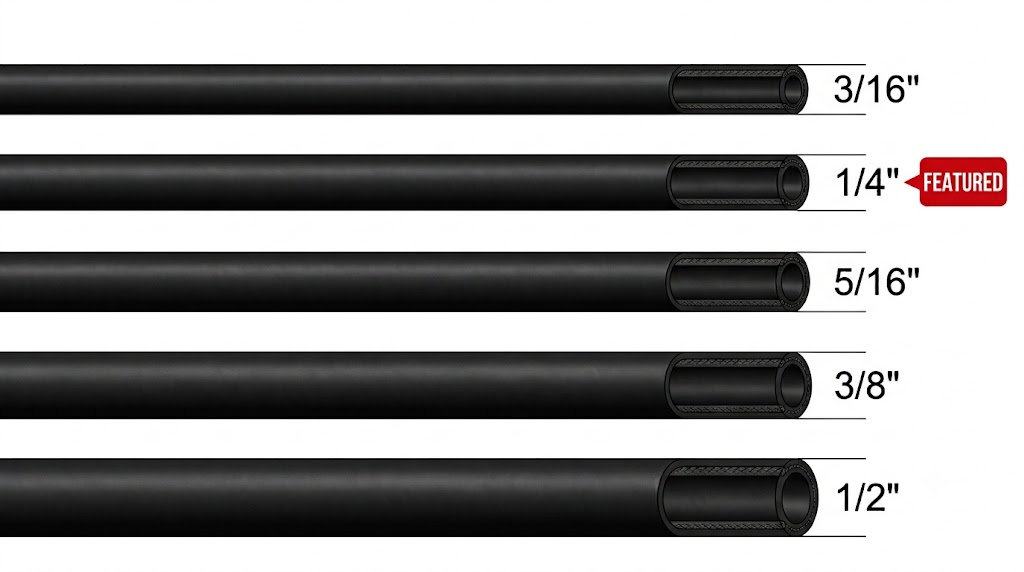
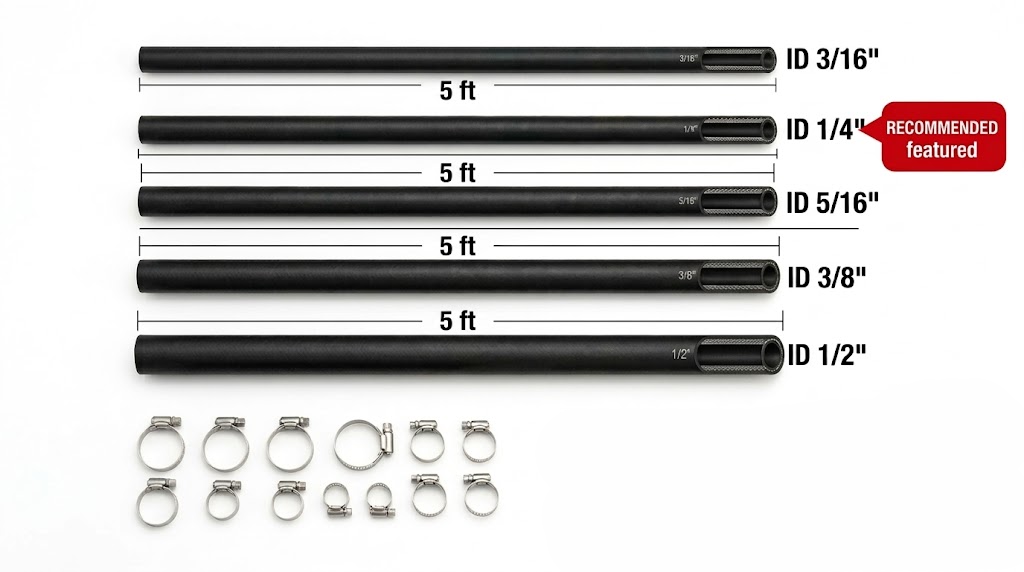
On North American small engines, 1/4″ ID is the workhorse — it shows up across most carbureted mower engines. Our own small-engine line covers 3/16″, 1/4″, 5/16″, 3/8″, and 1/2″ ID, so most machines are covered out of one kit.
A few notes on the rest of the range:
- 3/16″ is common in the aftermarket for smaller handheld engines. (We stock it; what we can’t do is call it an OEM-standard size — we didn’t find it listed as a factory fuel line part number on the major engine brands we checked.)
- 5/16″ appears on fuel-injected engines. If you’re looking at a 5/16″ factory line, check the application carefully — on at least one major brand, the 5/16″ line is marked EFI-only.
- 1/2″ shows up on larger engines and higher-flow setups.
Where rubber is the right answer
For anything carbureted running on pump gasoline, a rubber line of the correct grade is the sensible, proven choice. It’s what the OEM put there, it’s what the parts counter stocks, and it’s what the engine was designed around.
How to Choose the Right Size
Get this wrong and the engine either starves or floods. Get it right and it’s a five-minute job.
Match the inner diameter to the fitting
The number that matters is inner diameter (ID). It’s the hole the fuel passes through, and it’s what has to match the barb on the tank and the carburetor.
Measure the fitting the hose pushes onto, not the old hose. An old line has been stretched and swollen by years of fuel and heat, so it will read larger than the size it started as. If you have calipers, measure the barb’s outer diameter directly. If you don’t, a piece of thin wire wrapped around the barb, marked, and divided by 3.14 will get you close enough to pick the right size off the shelf.
Outer diameter matters too
ID gets all the attention, but OD is the number that has to fit through the tank grommet and past the engine shroud on many mowers. A 1/4″ x 1/2″ line and a 1/4″ x 7/16″ line carry the same fuel, but only one may thread through the space Tecumseh and similar engines leave behind the flywheel cover. If your new line won’t fish through, the OD is usually why.
Length: measure the run, then add a little
Route the new line along the old one’s path and add a couple of inches. Too short and it pulls at the fittings; too long and it sags into a bend that kinks and starves the engine. On a typical riding mower, plan on roughly five feet of 1/4″ line to cover the run with a bit to spare.
Fittings have to match the hose
Spring clamps are standard on small engines for a reason — they hold evenly and don’t cut into the hose wall the way a screw-type worm clamp can. If you’re replacing the line, replace the clamps too; a reused clamp that’s lost its tension is a slow leak waiting to happen.
For a deeper walk-through of sizing and fitment, see our guide on how to choose fuel line hose size.
Installation Overview
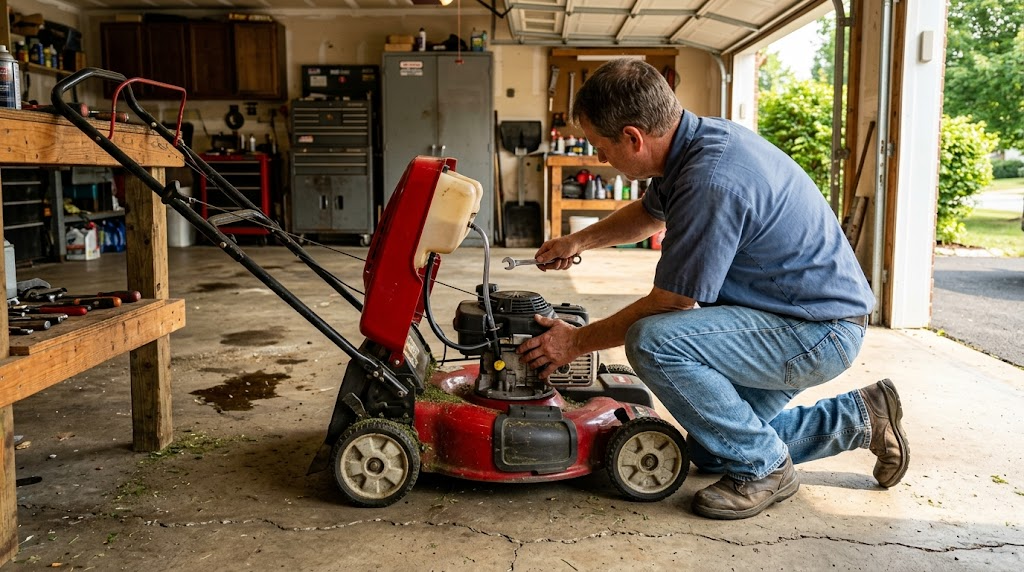
The job is short, but it has a few steps that people skip — and those are the ones that cause problems later.
Before you start
Shut the fuel off and relieve pressure. On a gravity-fed mower, that means clamping the line or draining the tank. On a machine with a fuel pump, pull the fuel pump fuse or relay and run the engine until it stalls from lack of fuel. Work outside or in a ventilated space, away from anything that can spark.
Disconnect the battery if the machine has one. It costs ten seconds and removes a spark source you don’t need.
The core steps
- Remove the old line, cutting it if it won’t release, and keep it as a length template.
- Cut the new line to match, square and clean — a ragged end can shed particles into the carburetor.
- Push the line fully onto each barb and fit a fresh clamp.
- Route it clear of moving parts and hot surfaces, with enough slack to absorb vibration but no sagging loops.
- Refuel, start, and check every connection for leaks before you call it done.
Mistakes we see come back
The two big ones are a line routed against a moving part — we’ve had engines come back through customer shops where the hose had been worn right through by a belt or pulley — and clamps that were left off or reused. A third is heat: people soften a stiff new line with a lighter. Don’t. Hot water is the safe way to make a tight line flexible, and open flame near a fuel system is how fires start.
For the full step-by-step, see our installation guide, and for the tips that keep it from coming back, fuel line installation tips.
Common Problems & Fixes
Almost every fuel line failure we see is one of a handful of things.
Hardening and cracking. This is number one. Fuel line lives in a hot engine bay and is exposed to ethanol-blended gasoline, which is a solvent. Over time the rubber loses its plasticizers, hardens, and cracks — often from the inside, where you can’t see it.
Internal breakdown. Sometimes the tube doesn’t crack so much as disintegrate, throwing black particles downstream into the filter and carburetor. When a mower “suddenly” won’t run and the fuel filter is full of grit, a collapsing line is often the source.
Leaks at connections. Loose clamps, a hose that’s one size off the barb, or a hardened end that’s lost its grip. On push-lock fittings, a hose that wasn’t seated all the way is a common cause.
Clogging. A line can plug with debris or with its own deteriorated lining, starving the engine at full throttle.
Collapse. A thin-walled or low-quality line can be sucked flat under vacuum, especially at a bend. If you can pinch it shut with two fingers, it isn’t strong enough.
When to replace
There’s a lot of folklore about replacing a fuel line on a fixed schedule. The honest answer is that there isn’t one number. What the engine makers actually say:
- Kohler calls for replacing the fuel line every 200 operating hours on its small engines, and specifies a low-permeation line for carbureted models.
- Honda calls for inspecting fuel lines every 2 years, replacing if needed.
- Briggs & Stratton gives no interval at all — it says to check lines regularly for cracks or leaks and replace if necessary.
- Some makers, including Toro and Kawasaki, don’t publish a fuel-line interval in their service documentation at all.
So the practical rule is a combination: check the line every season before you start mowing, and replace it on condition — if it’s hard, cracked, swollen at the ends, seeping fuel, or leaves black residue on your fingers, it’s done.
If you’re chasing a specific symptom — a leak, a no-start, a mower that dies under load —our fuel line troubleshooting guidewalks through the diagnosis, and 6 common fuel line problems covers the broader set.
Rubber vs PTFE — Which Fits Your Application?
Most mowers take a rubber line. There is one other material worth knowing about, because it comes up when people are working on higher-performance fuel systems.
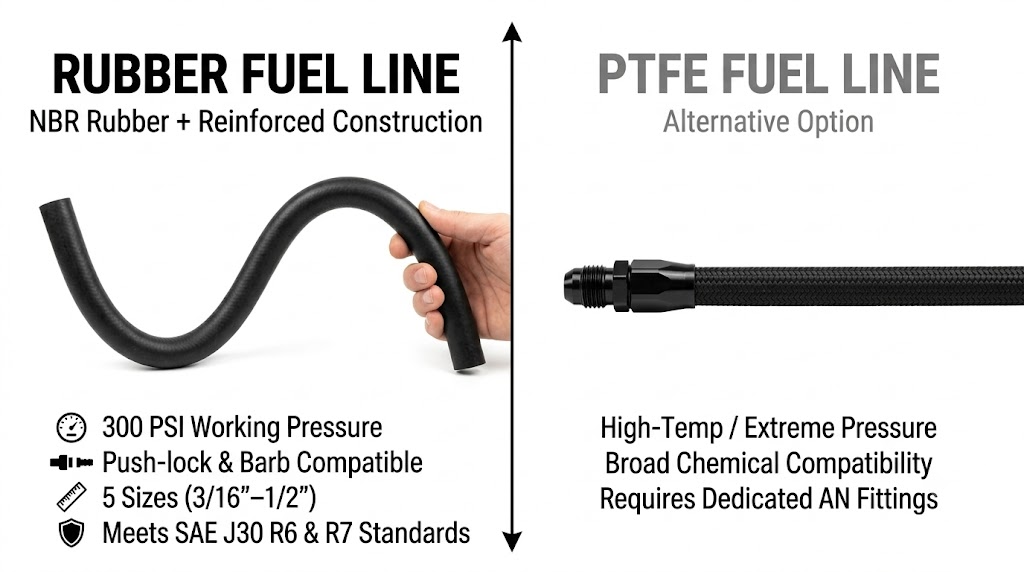
Rubber (SAE J30 R6/R7) is the standard for carbureted small engines: low pressure, flexible, easy to route, sealed with a simple clamp.
PTFE — a braided hose with a PTFE inner core — is a different tool for a different job. It resists heat and chemicals well, including ethanol blends, but it’s stiff, has a larger minimum bend radius, and needs proper end fittings rather than a barb and clamp. On a high-pressure fuel-injection build, that’s the right trade. On a gravity-fed mower, it’s more hose than the job calls for.
| Rubber (SAE J30 R6/R7) | PTFE | |
|---|---|---|
| Designed for | Carbureted small engines, low pressure | High-pressure EFI, high-heat or high-ethanol builds |
| Flex and routing | Flexible, tight bends fine | Stiff, needs a larger bend radius |
| Fittings | Barb + spring clamp | Machined end fittings |
| Ethanol | Suitable for pump gas; service life shortens with ethanol | Resists ethanol blends |
If you’re not sure which one your machine takes, the factory line is the answer — match the material and size it came with.
Our Rubber Fuel Line Products
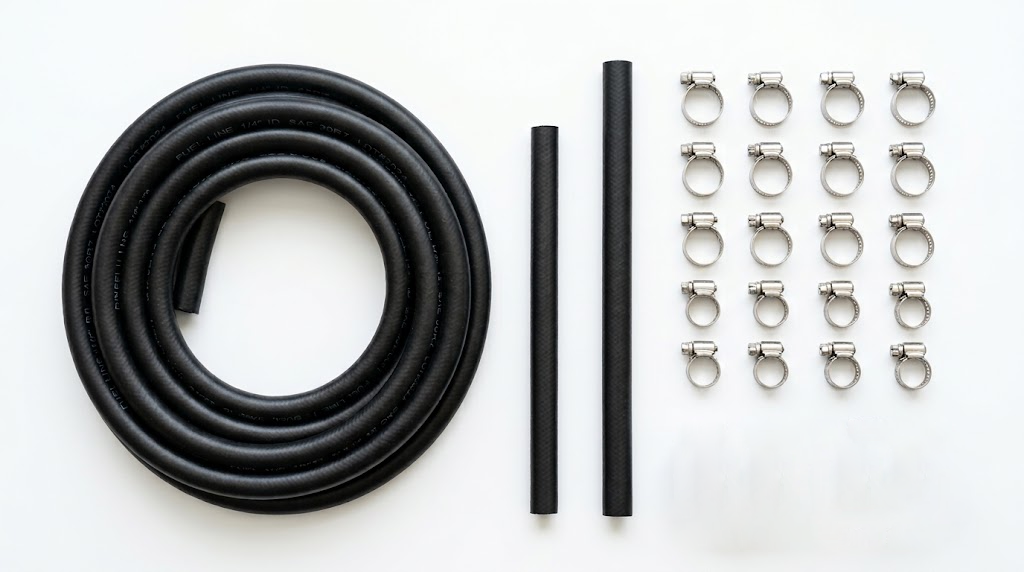
We supply rubber fuel line for small engines in the sizes mowers actually use: , rated to , in practical lengths with clamps. Kits include multiple bore sizes so a shop can cover a range of machines without ordering five separate rolls, and we support OEM and ODM orders for custom lengths, diameters, and packaging.
If you’re stocking up for a repair season or sourcing for a product line, we can quote to your spec.See our rubber fuel line range or send us your sizes and quantities for a quote.
FAQ
What size fuel line does my lawn mower need?
Most carbureted mowers take 1/4″ ID. Smaller handheld engines use 3/16″. Measure the fitting the line pushes onto — the barb — rather than the old hose, which will have stretched.
How often should I replace my lawn mower fuel line?
There’s no universal interval. Kohler specifies 200 operating hours; Honda says inspect every 2 years; Briggs & Stratton says replace on condition. Practically, check it every season and replace it if it’s hard, cracked, swollen, or seeping.
Can I use PTFE fuel line for my lawn mower?
You can, but for a carbureted mower a rubber line is the simpler and correct choice. PTFE is stiff, needs special fittings, and is really designed for high-pressure fuel-injection systems. If your mower came with rubber, keep it rubber.
What’s the difference between SAE 30R6 and 30R9?
They cover different jobs. R6 is a low-pressure hose for carbureted systems; R9 is rated for fuel injection, at higher pressure and temperature. Putting an R6 line on a fuel-injected engine is a common and damaging mistake.
How do I know if my fuel line is leaking?
Look for the smell of fuel, wet spots or staining around the fittings and under the machine, or a line that’s hard and cracked. A pressure test will confirm a leak in the system, but with a mower’s simple plumbing, a careful visual check at each connection usually tells you.
Conclusion
For a lawn mower, the fuel line you want is almost always a rubber one — the right ID, rated to SAE J30 R6/R7, sealed with fresh clamps and routed clear of anything hot or moving. Replace it when it stiffens, cracks, or seeps, not on a calendar. It’s a small part, and it’s the difference between a mower that starts on the first pull and one that leaves you pulling the cord in the yard.
If you need fuel line for small engines — in the sizes and grades mowers actually use — send us your specs and quantities for a quote.