A shop owner wanted to standardize his fuel line buying across a run of mowers and small engines — we get this call pretty regularly. He had been buying whatever was cheapest and closest on the rack. The problem wasn’t leaks — yet. It was inconsistency: three different hose sizes, two kinds of clamps, and nobody could remember which machine had which. When a line failed, the tech had to trace it before he could replace it.
That is the real reason to choose a lawn mower fuel line size correctly the first time and then stick to it. This guide is the short version of what we tell shops and buyers: it is not just about the hose, it is about having a setup you can service without guesswork. We supply rubber fuel line for small engines, so we have sat across the bench from this exact decision many times.
The Three Numbers That Decide Every Fuel Line Purchase
Before you compare anything, get three numbers straight — they are the foundation of every fuel line purchase: inner diameter (ID), outer diameter (OD), and pressure rating. They are not interchangeable, and mixing them up is where selection starts to go wrong.
- ID is what matters for flow. It is the hole the fuel passes through, and it is the number every sizing guide talks about.
- OD matters when you are matching to a fitting or a route. You clamp the outside of the hose, so OD is what the clamp and the tank grommet actually see.
- Pressure rating is the maximum the hose is built to hold. A carbureted small engine runs at very low pressure; a fuel-injected one runs much higher. The hose has to match the system.
You will also see an SAE J30 class printed on better hose. It is the standard family for low-pressure fuel hose, and the classes are not interchangeable:
- J30R6, R7, R8 — low-pressure classes for carbureted systems. R8 was introduced to cut fuel vapor permeation, which is roughly three times lower than R6.
- J30R9 — the fuel-injection class, rated for higher pressure and temperature with far lower permeation.
- J30R10 — submersible hose for use inside the tank.
- J30R14 — the low-permeation class written specifically for small engines: mowers, chainsaws, generators, outboards, and similar equipment. It uses a barrier layer and is the class that meets small-engine evaporative emission requirements.
That last one is worth knowing if you service outdoor power equipment, because R14 is the class designed around your machines rather than borrowed from automotive use. Where a carbureted class like R6 is rated around 600 g/m²/day of fuel vapor permeation, the low-permeation classes including R14 are in the region of 15 g/m²/day — a different order of magnitude, and the reason modern small-engine hose resists ethanol blends considerably better than the old general-purpose stock did.
Lawn Mower Fuel Line Size: Match the ID to the Fitting
Here is where most of the “which size do I need” confusion lives. The rule people get wrong: inner diameter is driven by the fitting on your machine, not by the size of the engine.
A useful starting point for North American small engines, with the outside diameter of each size alongside it:
| Application | Typical ID | Typical OD |
|---|---|---|
| Most carbureted mowers (walk-behind and riding) | 1/4″ | 12 mm (0.47″) |
| Smaller handheld engines (trimmers, small saws) | 1/8″ – 3/16″ | 9 – 11 mm |
| Fuel-injected engines | 5/16″ (check the application — this size is often EFI-specific) | 14 mm (0.55″) |
| Larger engines, higher-flow setups, and longer return runs | 3/8″ – 1/2″ | 16 – 20 mm |
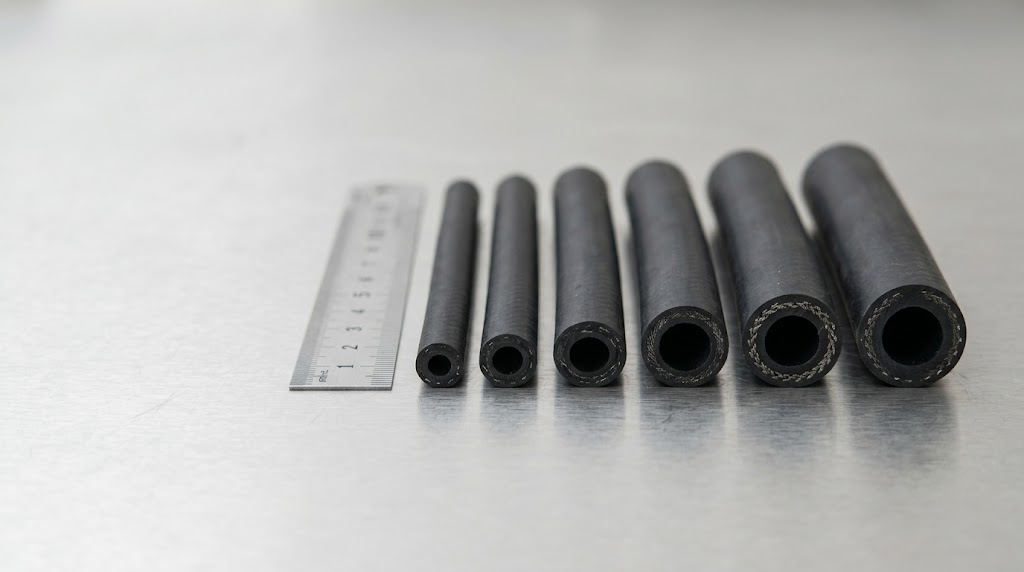
Our own small-engine range covers 1/8″, 3/16″, 1/4″, 5/16″, 3/8″, and 1/2″ ID at 5 ft per hose, so most machines are covered out of one kit.
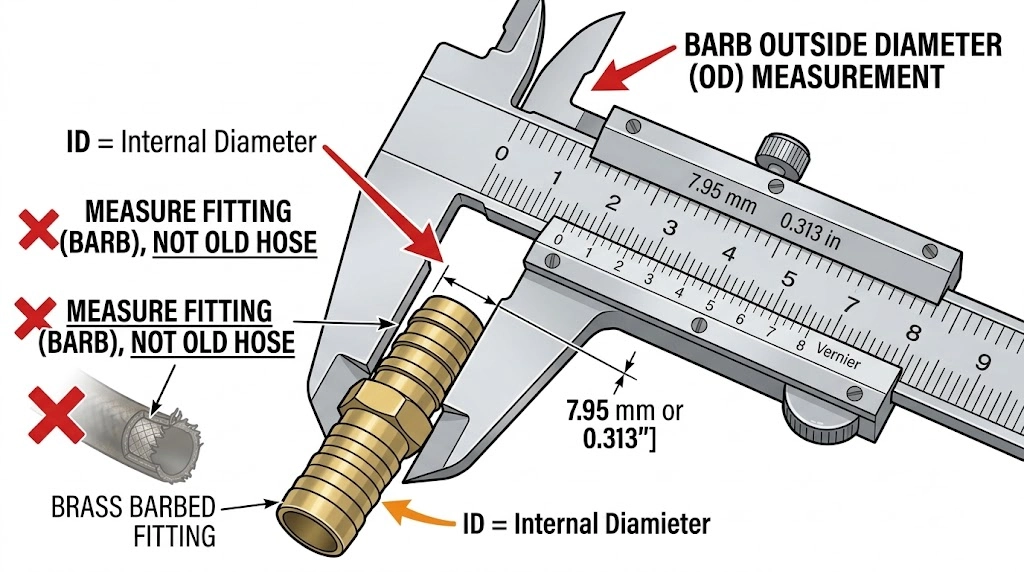
The safest method is not a chart at all — it is measuring. Measure the barb the hose pushes onto, not the old hose. An old line has been stretched and swollen by years of fuel and heat, so it reads larger than the size it started as. If you have calipers, measure the barb’s outer diameter directly. If you don’t, a piece of thin wire wrapped around the barb, marked, and divided by 3.14 will get you close enough to pick the right size off the shelf.
And when you are between two sizes, go with the smaller one. A hose a hair small stretches over the barb and seals well; a hose a hair large will not seal no matter how tight you crank the clamp.
Material: Rubber, PTFE, and What Your Machine Needs
This is the fork in the road most buyers care about. The short version:
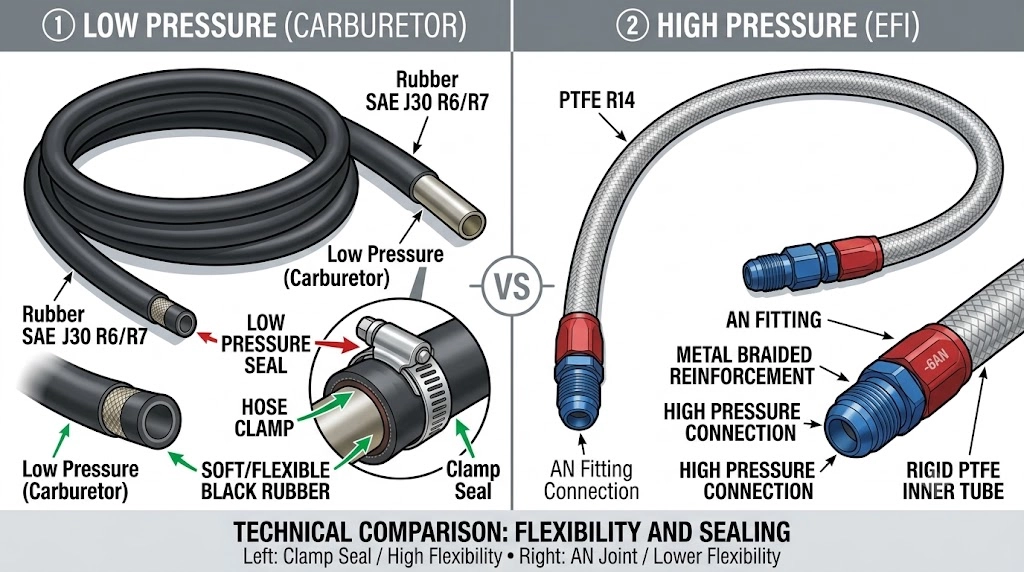
Rubber is the right default for a carbureted mower. Fuel is delivered at very low pressure, and a rubber line of the right grade handles that cleanly — flexible, easy to route, and sealing against a barb with nothing more than a spring clamp. It is what the OEM put there and what the engine was designed around.
PTFE is a different tool for a different job. A braided PTFE line is chemically inert, so it shrugs off ethanol and methanol, and it holds up to far higher pressure and heat — our own 6AN PTFE kits are rated to 3,000 PSI working and -60°C to 230°C, which is why they belong on EFI conversions and turbo builds. What PTFE is not is convenient: it is stiff, needs a larger bend radius, and requires machined end fittings rather than a barb and a clamp. On a gravity-fed mower it is more hose than the job calls for, and harder to route in the space you have.
Rule of thumb: carbureted small engine, rubber. High-pressure or high-heat EFI, PTFE. Know which system your machine has, and match the material to it.
What Fuel Goes Through It
The fuel is the one variable you cannot fudge. Match the hose to what is actually going through it.
- Pump gasoline: a standard fuel-rated rubber line handles it without drama.
- Ethanol blends (E10 and up): ethanol is a solvent. It gradually pulls the plasticizers out of rubber, so a hose loses flexibility and starts cracking from the inside. A general-purpose rubber line still works on E10, but expect a shorter service life and inspect it more often. Low-permeation classes — the R14 type built with a barrier layer — are formulated for this job and perform considerably better.
- High-ethanol fuels (E85 and up): a standard rubber line is the wrong choice here. This is where a lined hose or a PTFE line earns its cost.
The failure mode when a hose is asked to do too much is not dramatic. The rubber hardens, micro-cracks form, and eventually fuel weeps through — by which point it has been sweating vapor for weeks. Match the hose to the fuel, and replace it on condition rather than on a schedule.
Fittings: What Has to Match
The fitting has to match the hose in size, material, and sealing method.
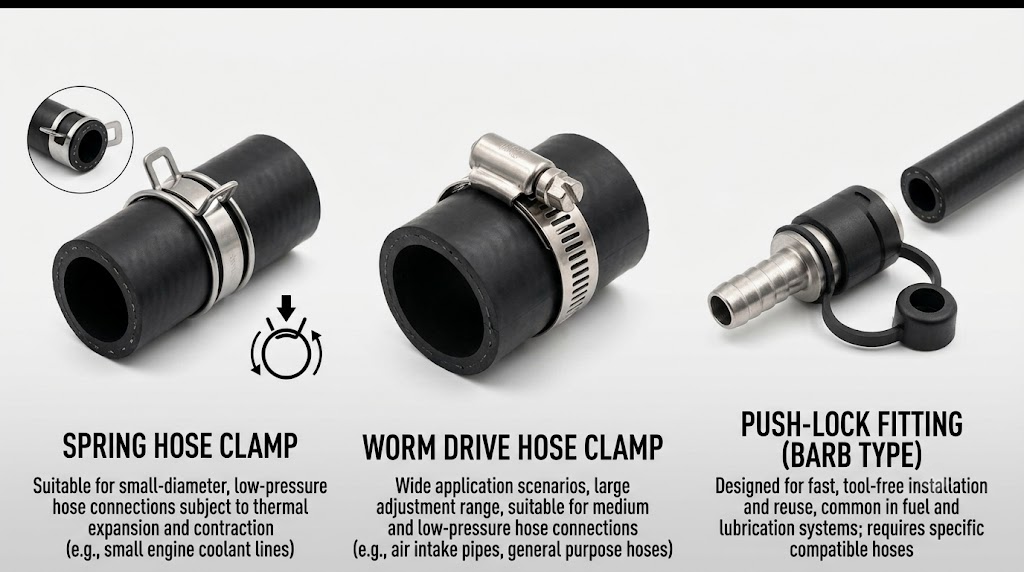
- Barb plus spring clamp is the standard on small engines. The hose pushes over the barb and a spring clamp holds it — simple, serviceable, and what most mowers use.
- Push-lock fittings seat the hose fully onto a barb with a positive lock. Fast to install, but the hose has to be the right ID and pushed all the way on, or it will not hold.
One trap that catches people: fittings are not all interchangeable. If you are adapting between thread types, use a proper adapter — never force mismatched threads and hope. And on small engines, keep it simple: match whatever fitting the factory used.
Length and Routing
You are not just buying the right hose — you are buying the right length and a route that works.
Measure the route, then add fitting depth. A hose cut to the exact run will not have enough material to fully cover the barb at either end. Route a tape or a length of string along the actual path — not the straight-line distance — then add roughly an inch at each end plus a little slack. Our hoses come at 5 ft, which leaves room to trim for a typical riding mower run.
Leave a little slack, but not too much. Hose shifts with engine vibration, so a tight, no-slack install is a failure waiting to happen. Too much slack sags and chafes. The balance is enough to absorb movement, clipped down so it cannot rub anything.
Avoid tight bends. A hard kink at the fitting is how a line pulls loose or wears through early. Keep the run clear of moving parts — we have seen hoses worn right through by a belt or pulley.
Once you have picked the size, the installation itself is short: how to replace a lawn mower fuel line, step by step.
How to Tell a Good Fuel Hose From a Cheap One
When you are comparing products side by side, these are the things that separate a hose you will not have to replace twice from one you will:
- A stated construction. The tube compound, the reinforcement, and the wall thickness. If the listing does not say what the hose is made of, assume the cheapest compound. Ours is an NBR tube with braided polyester reinforcement at 3 mm wall thickness — the wall thickness is what stops a hose from collapsing on a bend.
- A stated temperature and pressure rating. Working pressure and burst pressure, with a temperature range. A hose that will not publish these usually has something to hide.
- Consistency across the range. If you are standardizing, you want the same construction and the same wall thickness in every bore size, not a different hose every time you order.
- A supplier with a track record. One that has been at it for years and supports OEM and ODM work will still be there when you reorder.
A hose that checks all four is worth paying a little more for, because you are not buying hose — you are buying a part you will not have to replace twice.
FAQ
What size fuel line does my lawn mower need?
Most carbureted mowers take 1/4″ ID, and smaller handheld engines use 1/8″ or 3/16″. Measure the fitting the line pushes onto — the barb — rather than the old hose, which will have stretched and swollen over time.
Is PTFE worth it over rubber?
For a carbureted mower, no — a rubber line of the right grade is the simpler and correct choice. PTFE is stiffer, needs machined end fittings instead of a barb and clamp, and is designed for high-pressure fuel-injection systems. If your machine came with rubber, keep it rubber.
Can I run ethanol fuel in a regular rubber line?
On E10, yes, but ethanol shortens the service life of general-purpose rubber, so check the line more often. For high-ethanol fuels such as E85, use a lined or PTFE hose instead — that is what they are built for.
How much extra length should I order?
Measure the actual route, add fitting depth at each end, then a little slack — enough to absorb vibration, but not so much that it sags and chafes.
How do I know what grade my old hose was?
Look for the marking printed on the hose. It usually lists the SAE class and the inside diameter. If it has worn off, match the replacement to the machine’s fuel system: a low-pressure carbureted class for a mower, an injection-rated class for an EFI engine.
What does the SAE J30 rating on a fuel hose mean?
SAE J30 is the standard family for low-pressure fuel hose. The class tells you what the hose is built for: R6 and R7 for carbureted systems, R9 for fuel injection, R10 for use inside the tank, and R14 for small engines with low fuel-vapor permeation. The class has to match the system — fitting the wrong one is how hoses fail early.
If You Remember One Thing
Get the three basics right and the rest follows: match the ID to the fitting, match the material to the fuel, and match the hose to the engine. A hose selected on those three lines will outlast one picked on cost every time, and reordering for the next job becomes a five-minute decision.
If you want the wider picture on which hose suits small engines, including sizes and how they fail, start with our guide to rubber fuel line for small engines. And if a leak already has you chasing your tail, fuel line leak causes and fixes walks through the diagnosis in order.
Get Lawn Mower Fuel Line
Buying for your own machine? Our rubber fuel line hose kit covers six bore sizes from 1/8″ to 1/2″ ID in 5 ft lengths with stainless clamps — one kit to match whatever barb you are looking at.
Standardizing for a shop, dealership, or product line? We supply rubber fuel line for small engines in bulk and ship worldwide, and we support OEM and ODM work including custom lengths, diameters, and kit configurations. Send us your sizes and quantities for a quote.