A surprising number of vacuum leaks trace back to how the replacement hose was sized: someone eyeballs the old one and copies it. That’s the trap. Old rubber and silicone stretch and deform over years of heat and vacuum, so matching the worn hose’s inside diameter is usually wrong. The tech swears the new hose is “the same size as the old one,” yet the lean code comes back a week later. The old hose lied; its ID had crept wider than the size printed on it.
We’ve supplied vacuum and silicone hoses for over twenty years, and this is the sizing mistake that shows up again and again. The hose itself is fine — the measuring logic is off. Choosing the right vacuum hose size comes down to one principle: match by inner diameter (ID), and measure the fitting, not the old hose. Here’s what separates a leak-free install from a recurring diagnostic headache.
TLDR
- Select vacuum hose by inner diameter (ID) . Barbed fittings are sized to match hose ID — the fitting OD is slightly larger than the hose ID to create a seal.
- Wall thickness affects pressure resistance. A 3mm wall resists vacuum collapse and handles positive pressure up to 43 PSI; Shore A hardness and reinforcement layers also matter .
- Leave 5–10% length slack, not 10–15%. Route with zero tension end-to-end; excess length causes chafing and loop wear .
- At bends, maintain a larger bend radius. Leave a straight section at the fitting root before bending; never bend tighter than the spec sheet minimum. Use elbow fittings for sharp turns .
- LEDAUT supplies a full range of silicone vacuum hose kits with stainless fittings and hardware, supporting OEM/ODM customization.
How to Choose the Right Vacuum Hose Size (Sizing Standards)
Vacuum hose sizing follows a simple rule that gets ignored more often than it should: size by inner diameter (ID). This is the dimension that determines flow capacity and fitment on barbed fittings.
Barbed fittings work by compression. The fitting’s outer diameter is intentionally slightly larger than the hose’s inner diameter. When you push the hose onto the barb, the hose stretches just enough to grip tightly, then relaxes into a secure seal. If you size by OD instead, you’ll end up with a hose that’s too loose on the fitting — no amount of clamping fixes that.
Here’s the memory hook we use in our shop training: tubes are sized by ID, clamps are sized by OD. The tube needs to fit inside the fitting (so ID matters); the clamp wraps around the outside (so OD matters). Mixing these up is the single most common sizing error we see from new technicians.
LEDAUT’s vacuum hose kits follow industry-standard ID sizing in millimeters: 3mm, 4mm, 5mm, 6mm, 8mm, and 10mm. Millimeter sizing is the global convention for vacuum and silicone hose, even in markets that otherwise use imperial measurements. Stick with the labeled ID — don’t guess based on visual comparison.
Check our silicone vacuum hose kits product page for available sizes and configurations.
Measuring Your Existing Hose
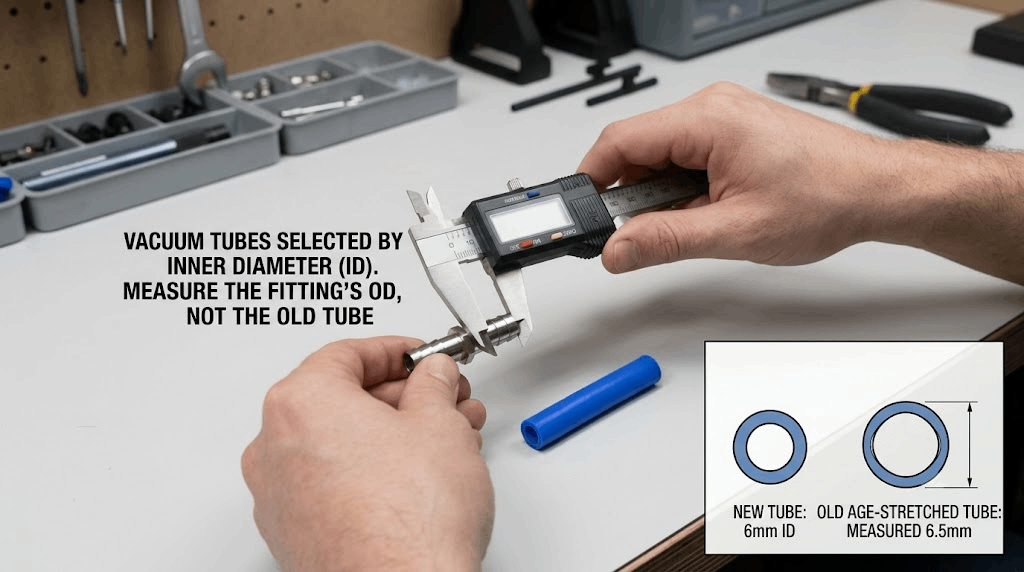
When replacing a worn or cracked vacuum hose, the instinct is to measure the old hose’s inner diameter and order the same size. That approach has a hidden flaw: old hoses stretch and deform over time.
Heat cycling, vacuum suction, and vibration cause the hose material to creep. An original 6mm ID hose might measure 6.5mm or even 7mm after months of service. Ordering a new 6mm hose based on that stretched measurement gives you a hose that’s too tight on the fitting — difficult to install and prone to splitting at the barb.
The correct method: measure the outer diameter of the fitting or pipe you’re connecting to, not the old hose. Use calipers for accuracy. Measure at multiple points around the circumference — fittings aren’t always perfectly round after years of heat exposure. Take the average.
If the fitting is inaccessible or damaged, measure the old hose’s outer diameter and subtract twice the wall thickness to estimate the original ID. For example, an old hose measuring 12mm OD with a 3mm wall had an original ID of approximately 6mm (12 – 3 – 3 = 6). This reverse calculation is less precise but better than trusting the stretched ID directly.
ID vs OD vs Wall Thickness
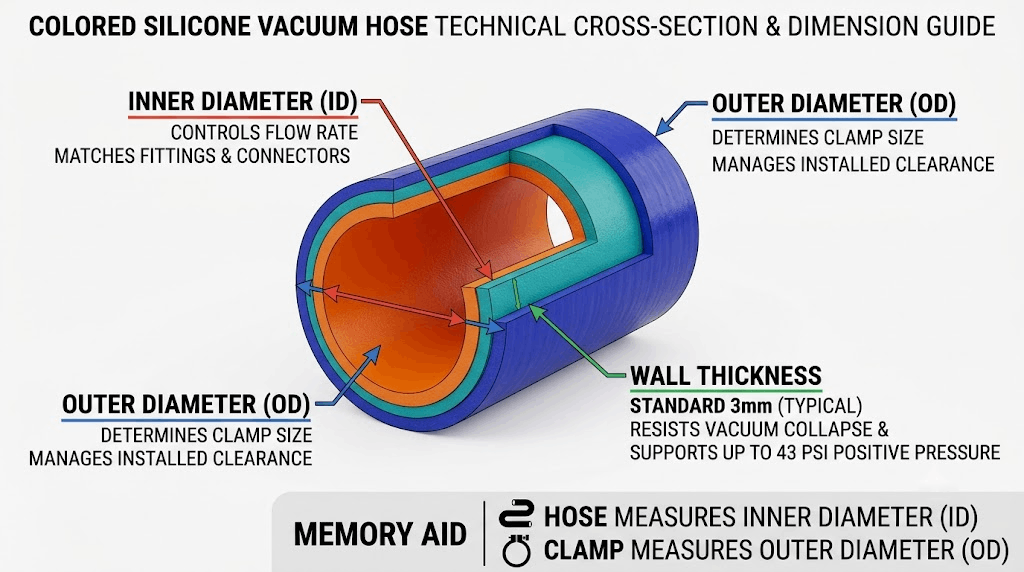
Three dimensions define a vacuum hose, and each serves a different purpose:
| Dimension | What It Determines | Why It Matters |
|---|---|---|
| Inner Diameter (ID) | Flow capacity, fitting compatibility | Must match barb fitting size for proper seal |
| Outer Diameter (OD) | Clamp sizing, routing clearance | Determines which clamp fits and whether the hose clears surrounding components |
| Wall Thickness | Pressure resistance, durability | Thicker walls resist vacuum collapse and handle higher positive pressure |
Wall thickness deserves special attention. A thin-walled hose might fit perfectly on the fitting but collapse under vacuum suction, restricting flow and triggering fault codes. Conversely, an overly thick-walled hose adds unnecessary bulk and may not flex enough for tight routing paths.
Our standard 3mm wall thickness strikes a balance for most applications. It resists vacuum collapse reliably and handles positive pressure up to 43 PSI . For high-pressure boost applications, consider reinforced hoses with embedded braiding or harder Shore A ratings. Shore A measures rubber hardness — higher numbers mean stiffer material that resists deformation but sacrifices flexibility.
Reinforcement layers (fabric braid, wire helix, or aramid fiber) add burst strength without dramatically increasing wall thickness. These are essential for turbocharged applications where positive pressure exceeds typical vacuum levels.
Common Size Mistakes
Even experienced technicians make these sizing errors. Recognizing them early saves diagnostic time and prevents repeat failures.
Mistake 1: Sizing by Visual Comparison
“I grabbed a hose that looked about the same size.” Visual estimation fails because hose materials vary in wall thickness and durometer. Two hoses with the same ID can look completely different if one has a 2mm wall and the other has a 4mm wall. Always measure with calipers.
Mistake 2: Ignoring Bend Radius
Routing a hose through a tight engine bay tempts you to force sharp bends. But every hose has a minimum bend radius specified by the manufacturer. Bending tighter than this kinks the inner liner, restricting flow and creating stress points that crack under vibration.
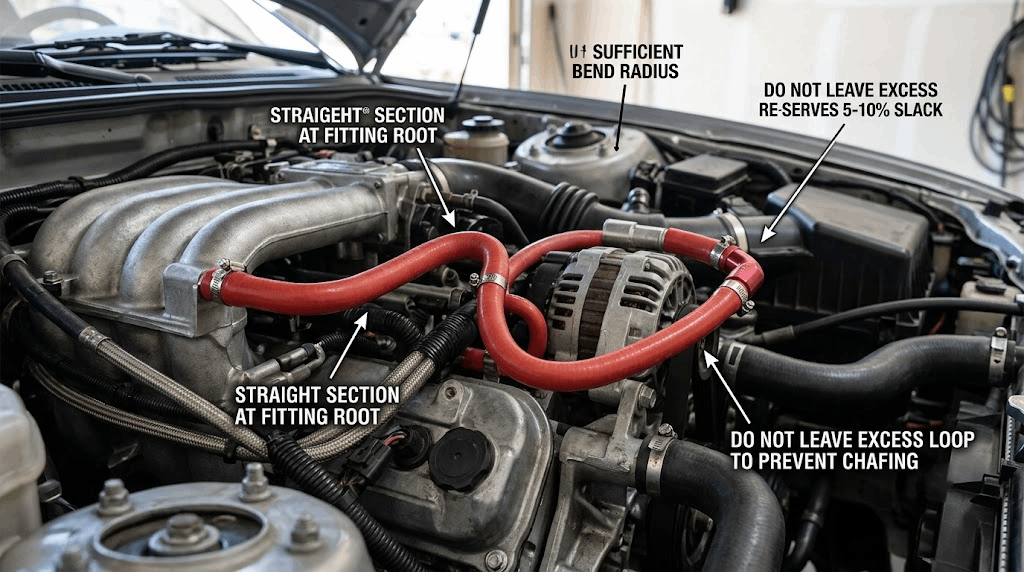
At bends, maintain a larger bend radius than you think you need . Leave a straight section at the fitting root before starting the bend — this distributes stress away from the critical seal point. If the routing path demands a sharp turn, use an elbow fitting instead of forcing the hose.
For guidance on preventing related issues, see our article on Boost Leak Prevention.
Mistake 3: Overcompensating with Length
“Better too long than too short” sounds safe, but excess length creates its own problems. A hose that’s 15% longer than needed forms loops that rub against hot surfaces, sharp edges, or moving components. Chafing wears through the outer layer, exposing the reinforcement and eventually causing leaks.
Leave 5–10% length slack, not 10–15% . Route the hose with zero tension from end to end — it should rest naturally without pulling or sagging excessively. If the path includes vibration-prone areas, add a small service loop (a gentle U-bend) rather than extra linear length.
Mistake 4: Using the Wrong Clamp Size
Clamp sizing follows OD, not ID. A clamp that’s too small won’t close fully; one that’s too large bottoms out before generating adequate sealing pressure. Measure the hose OD after installation (with the hose on the fitting) and select a clamp rated for that diameter range.
Size Chart Reference
LEDAUT’s vacuum hose kits come in standard ID sizes. Use this chart as a starting point for selection:
| ID (mm) | Typical Application | Compatible Fitting Barb OD (mm) |
|---|---|---|
| 3mm | Small vacuum lines, PCV systems, brake booster feeds | ~3.5–4.0mm |
| 4mm | General vacuum routing, emissions controls | ~4.5–5.0mm |
| 5mm | Medium vacuum lines, throttle body connections | ~5.5–6.0mm |
| 6mm | Primary vacuum distribution, intake manifold ports | ~6.5–7.0mm |
| 8mm | High-flow vacuum, larger engines, turbo wastegate lines | ~8.5–9.0mm |
| 10mm | Heavy-duty vacuum, commercial vehicles, large displacement engines | ~10.5–11.0mm |
Note: Fitting barb OD is typically 0.5–1.0mm larger than hose ID to ensure interference fit. Always confirm with actual measurements before ordering bulk quantities.
For custom sizes or OEM specifications, contact LEDAUT directly. We support OEM/ODM customization for distributors and performance shops.
FAQ
Q: How do I know what size vacuum hose I need?
Measure the outer diameter of the fitting you’re connecting to, or measure the old hose’s outer diameter and subtract twice the wall thickness. Don’t rely on visual comparison — use calipers for accuracy. Match the hose’s inner diameter to the fitting’s outer diameter.
Q: Can I use a slightly larger hose with a stronger clamp?
No. A hose that’s too large for the fitting won’t seal properly, regardless of clamp tightness. The barb needs to compress the hose wall evenly around its circumference. An oversized hose leaves gaps that suck unmetered air. Size correctly the first time.
Q: Does wall thickness affect vacuum performance?
Yes. Thin walls collapse under vacuum suction, restricting flow. Thick walls resist collapse but reduce flexibility. Our standard 3mm wall handles typical vacuum levels and positive pressure up to 43 PSI. For extreme applications, consider reinforced hoses.
Q: How much slack should I leave when routing vacuum hose?
Leave 5–10% extra length, routed with zero tension. Avoid excess length that forms loops — these chafe against hot surfaces and wear prematurely. If the path includes vibration, add a gentle service loop instead of linear slack.
Q: What happens if I bend vacuum hose too tightly?
Tight bends kink the inner liner, restricting flow and creating stress concentrations. Over time, vibration cracks the hose at the bend point. Always respect the manufacturer’s minimum bend radius. Use elbow fittings for sharp turns instead of forcing the hose.
Conclusion
If there’s one thing to take away, it’s this: match by inner diameter, respect the wall thickness limits, and route with appropriate slack. That combination is what keeps a vacuum hose leak-free for years instead of weeks.
Want Custom Specifications?
LEDAUT manufactures silicone vacuum hose kits with stainless steel fittings, with OEM/ODM support for distributors and performance shops. Contact LEDAUT for custom diameters, specifications, and OEM/ODM options tailored to your application requirements.
For more on material selection, read our guide on Silicone vs Rubber Vacuum Hoses.