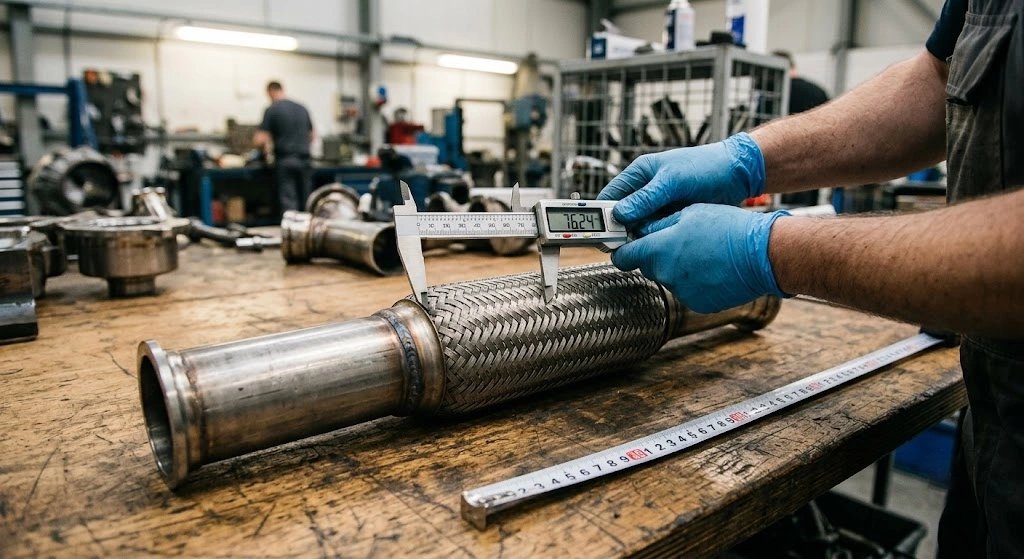
You cut the old pipe out of the car, carry it to the counter in a shopping bag, and get asked one question you can’t answer from looking at it. Is it “two and a half”? Two and a quarter? The tape measure says something like two and three sixteenths, and now you’re arguing with a stranger about fractions in a parking lot.
This is the entire problem in one sentence: a flex pipe has three different sizes on it — inside, outside, and length — and which one matters depends on who’s asking. Get them mixed up and the part you take home doesn’t fit, or fits too loose to seal. Here is how to measure the old one properly, and what to do with the three numbers you get back.
The One Number That Decides Everything: Inside Diameter
Walk into any parts business and the first spec on a flex pipe is its ID — inside diameter. Universal pipes are sold as “the measurement is the inside diameter of the flex pipe,” in the words of one exhaust catalog, and retail listings follow the same convention: a pipe labeled 4 in. is 4 in. on the inside, paired with the length (“4 in. ID x 4-FT,” as listings read).
Why ID, when the pipe clamps onto a tube you could measure from the outside? Because the end necks of the flex pipe slip over or into the tubing — the joint is a fitting, and fittings mate by inner-to-outer agreement. This is exactly the rule we use across the plumbing side of the shop too: the exhaust clamp size chart is built around outer diameter, because a clamp wraps around the outside of a pipe. Same part of the exhaust, opposite convention. Get both in your head together and every exhaust fitting problem collapses into one line:
Buy the tube by ID. Buy the clamp by OD. Measure what each one touches.
That distinction is why so many “wrong size” returns aren’t wrong at all — someone measured the outside of the old pipe, found 2-1/2 inches, ordered a 2-1/2 inch flex pipe, and got a sleeve that swallows their 2-1/4 tube with no clamp able to pinch it down.
How to Measure Your Old Flex Pipe (Three Numbers, Ten Minutes)
Do this before you open a browser tab. The old pipe is the spec sheet.
- Inside diameter (ID). Caliper jaws go inside the end neck, not on the body. Flex pipe ends are usually the tightest, most round part of the pipe — that’s what your size is. If the pipe is old it will not be round; heat and vibration work it into an ellipse. When that happens, take two readings across the same bore at 90 degrees to each other and average them. Measure both end necks separately — they are not guaranteed to match, and the next section says why.
- Outside diameter (OD). Same tool, jaws around the outside of the body. You’re not buying to this number, but your clamp is: the band that holds the pipe on grabs the OD, so record it.
- Length. End-to-end along the axis, including both end necks — that’s how listings state it. If the pipe was cut out of a tight run, also measure the gap it has to bridge in the car, because flex pipe length is chosen, not matched.
Two tools, honestly: a dial caliper gives you clean readings in seconds and costs less than the flex pipe you’re buying. A tape measure with a straight edge pressed across the bore works in a pinch for ID, but it reads high — the edge bridges the ellipse instead of seating in it, which is the difference between ordering right and shopping-bag round trip.
A caliper reads to a hundredth; sizes are sold in eighths. Measure twice, then round each number to the nearest standard fraction only after you’ve written down what you actually saw — rounding early is where the 2.25-becomes-2-and-half mistakes live.
The Standard Size Chart
The industry ladder runs from small-diameter pipes for compact systems up to large-bore pipes for trucks and diesel work. The most common catalog spread is 1-1/4 inches through 6 inches ID.
In lengths, 12, 18 and 24 inches are what catalogs list most commonly; shorter and longer sizes exist but vary by seller.
| ID (inches) | Typical pairing you’ll actually find |
|---|---|
| 1-1/2 / 1-3/4 | Small cars, older compacts |
| 2 | 4-cylinder and many 6-cylinder systems |
| 2-1/4 / 2-1/2 | Mid-size cars, V6 and small-V8 lines |
| 3 | Truck and performance piping |
| 3-1/2 / 4 | Larger trucks, diesel mid-pipes |
| 5–6 | Heavy/commercial runs |
Deliberately, this is not a grid of every ID crossed with every length. Be wary of any chart claiming every length in every diameter — real stock varies by seller and season, and the honest version of a size chart is the one that tells you what is standard to ask for versus what needs a phone call. The moment a chart starts printing combinations nobody verified, it stops being a chart and becomes a guess with borders.
How to use the table: find your measured ID row, note the lengths a seller offers it in, and cross-check the OD against your clamp. If your caliper said 2.28, you’re a 2-1/4 pipe, not a “2 and a half, close enough” — close in exhaust fittings means either a gap or a stretch, and both shorten the pipe’s life.
Length Matters More Than You Think
Once the ID matches, the second decision — the length — is the one people get wrong in the “comfortable” direction, and it’s not comfortable at all.
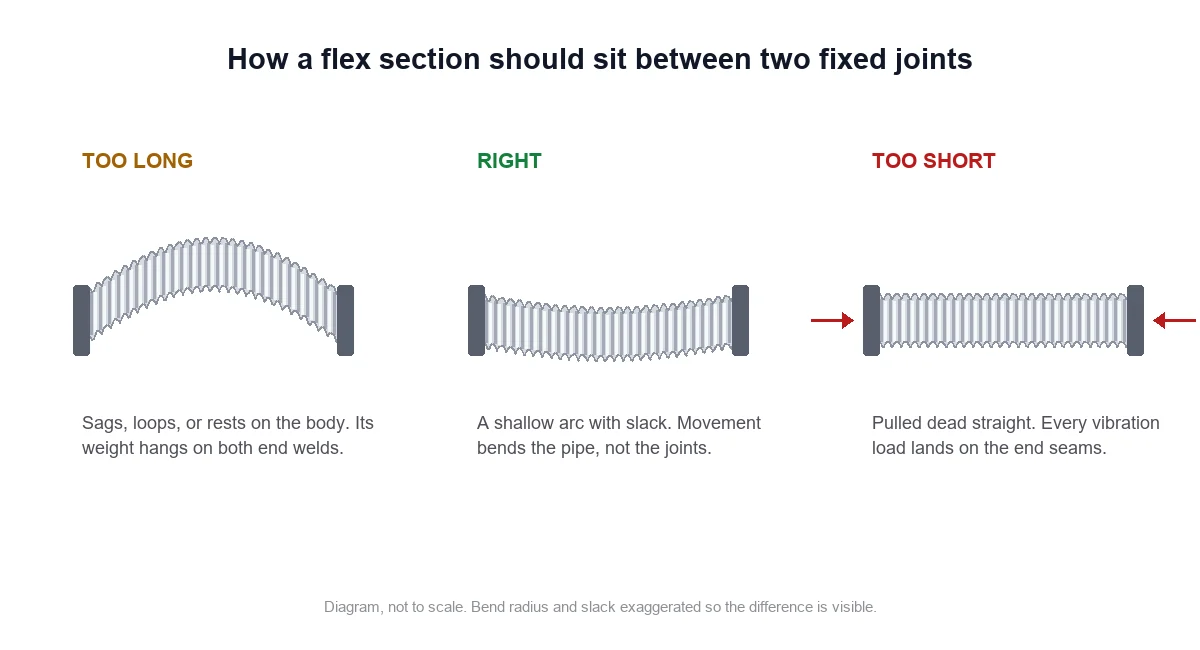
Too long: the extra pipe has nowhere to go, so it bulges into a loop. Every acceleration, every rev, that loop whips once — and the whip loads the sleeve right where it dies: at the ends, where the wall meets the fittings. An unsupported loop converts vibration into a fatigue cycle the pipe was never counted on. This is the same mechanism that turns a pinhole into a tear on the failure-signs side; we cover that process in signs your flex pipe is failing.
Too short: the pipe is pre-loaded in tension, holding the exhaust’s weight through the sleeve instead of through a hanger, pulling the joints apart sideways every time the engine rocks on its mounts. 7 installation mistakes — including the cut-too-short one — are laid out here, with the orientation and support rules that decide whether your new pipe lasts a season or a few years.
The working rule we give shops: the pipe should sit slack, not stretched and not looping. If installing it means pushing components out of place to make the length work, the length is wrong — a short piece in the right place beats the perfect-looking size that fights the engine. When you do it right, the torque note is small but real: a band clamp over a properly sized joint settles around 40–45 ft-lb; over-tightening crushes the wall, and a crushed wall starts a fresh fatigue clock.
Why the Two Ends Can Be Different Sizes
Ask around the forums long enough and you’ll find the post where someone measures a factory pipe and gets two different numbers — something like 2-1/4 at one end, 2 at the other — and the replies split between “you measured wrong” and “mine does that too.” They both did the same thing: they measured right.
The pattern behind it is that many factory systems step down through the car. The hot-end side of a flex pipe often attaches near the collector or downpipe, where tubing is bigger; the rear side tucks into mid-pipe, which runs smaller. Some OEM builders take advantage of the step by molding or necking one end of the flex section to match each side, so one pipe carries two IDs. We see the same thing on replacement pipes that came pre-bent on a junkyard donor.
The practical rule is one line: measure both ends, write both numbers. If they differ by a full standard size, you have a choice — match the new pipe to the smaller side and adapt the larger joint, or buy a stepped/reducing pipe if one’s available in your span. Either way, do it from two real measurements, not one average that matches nothing.
What Size Flex Pipe Do I Need for a 2.5-Inch Exhaust?
If your system runs 2.5-inch tubing, the question that decides everything is what “2.5” is describing. On the pipe, 2.5 inches ID means the bore — and a 2.5 ID pipe slips over a 2.5 OD tube. On the flex section you measured, a bulged body can read 2.5 over the outside while its necks are 2-1/4 inside. Same number, opposite ends of the fitment.
So when a seller asks “2.5 flex pipe?” for a 2.5-inch exhaust system, confirm the answer in the same terms they’ll build to: 2.5 ID, measured at the end necks inside. If both your tubing ends genuinely run 2.5 OD, a 2.5 ID universal pipe in 12, 18, or 24 inches is the standard shelf answer — the length rung is your choice, the ID is fixed by the tube. If your old pipe measured 2.5 over the body but 2-1/4 at the necks, buy 2-1/4 and let the clamp handle the step — that is a clamp decision, not another pipe size.
FAQ
Do flex pipes come in standard sizes? Yes, in eighths of an inch, on a ladder from roughly 1-1/4 up to 6 inches ID — with the popular sizes being 1-3/4 through 4-1/2. Non-standard (1-5/8, 2-3/16) happens on factory pipes; bring your caliper reading to the seller rather than rounding it away.
Can a flex pipe be too long? Absolutely — too-long is worse than it looks. The extra slack becomes a whipping loop under acceleration, and the whipping loads the pipe ends, which is where fatigue failure starts. Slack, not looped, not stretched.
Do I measure the pipe or the flex part? The pipe’s end necks, not the body. The necks are what join the system; the body stretches and bulges and doesn’t tell you the truth anymore. ID inside the neck, OD over it if you’re sizing a clamp.
What is neck size on a flex pipe? The finished opening each end presents to the tubing — often smaller than the body bulge. When listings and forum people talk about “neck,” they mean the fitting end, and it’s usually the number that decides fit.
Universal flex pipe or vehicle-specific — which should I buy? Universal covers 90 percent of flex-pipe replacements when measured right, and it lets you choose length. Vehicle-specific pieces exist for tight OEM routes with shaped bends. If your system is straight between two joints, universal with proper sizing is the standard shop answer.
Conclusion
Three numbers settle the whole transaction: ID from inside each end neck, OD from the outside, and the length that fits with slack instead of loops. Write all three down — and photograph the old pipe on the tape measure while you’re at it. If you’re ordering from a supplier who can’t see the part, that one photo answers questions a fraction can’t: which end is bigger, how the necks are shaped, and what the sleeve actually looks like at both ends.
Find the flex pipe that matches your three numbers
Clamps, band hardware and lap-joint styles for the joint side of the job live under exhaust clamps; the specific lap joint band clamp page carries the OD range.
Sources
Matrix and convention claims were cross-checked against: (1) 1320performance product copy — “the measurement is the inside diameter of the flex pipe”; (2) retail listings showing “4 in. ID x 4-FT” format — ID-first convention with length, verified Nov 2026; (3) Nickson Industries product/news page stating the 1-1/4″–6″ size range and 12/18/24-inch length rungs (single source — flagged in body, not asserted as universal fact; lengths beyond 12/18/24 exist per retail listings but are seller-dependent, so the body claims only the three catalog-listed rungs); (4) forum threads documenting factory step-down/necked ends (observation-grade, no manufacturer definition doc located). Length×ID availability: not verifiable per-combination across sellers at review date — body table intentionally omits a cell grid; IMG-01 renders only verified ranges with blanks preserved.