
Most drivers file the cold-start roar under “normal for an older car” — it barks for a minute, then settles. Sometimes that really is just a system waking up with condensed moisture in the tail section. But the same pattern — loud when cold, quiet when warm — is also how a failing flex pipe first introduces itself, and the reason the noise fades is not a reason to relax.
Here is the mechanism that makes this sign so easy to misread. At a cold start, every joint in your exhaust has contracted slightly. Metal shrinks as it cools, and a small gap or pinhole that formed over months of vibration is at its widest in the first few minutes of a drive. As exhaust heat soaks into the pipe, the metal expands and the same opening can narrow enough to go quiet. The leak did not repair itself with warm-up. It just got quieter.
Once you know that, the diagnosis falls into place: A flex pipe announces itself through sound first, then smell, then feel — and each of those channels tells you something different about how far along the failure is.
What a Flex Pipe Actually Does (and Why It Fails From the Ends)
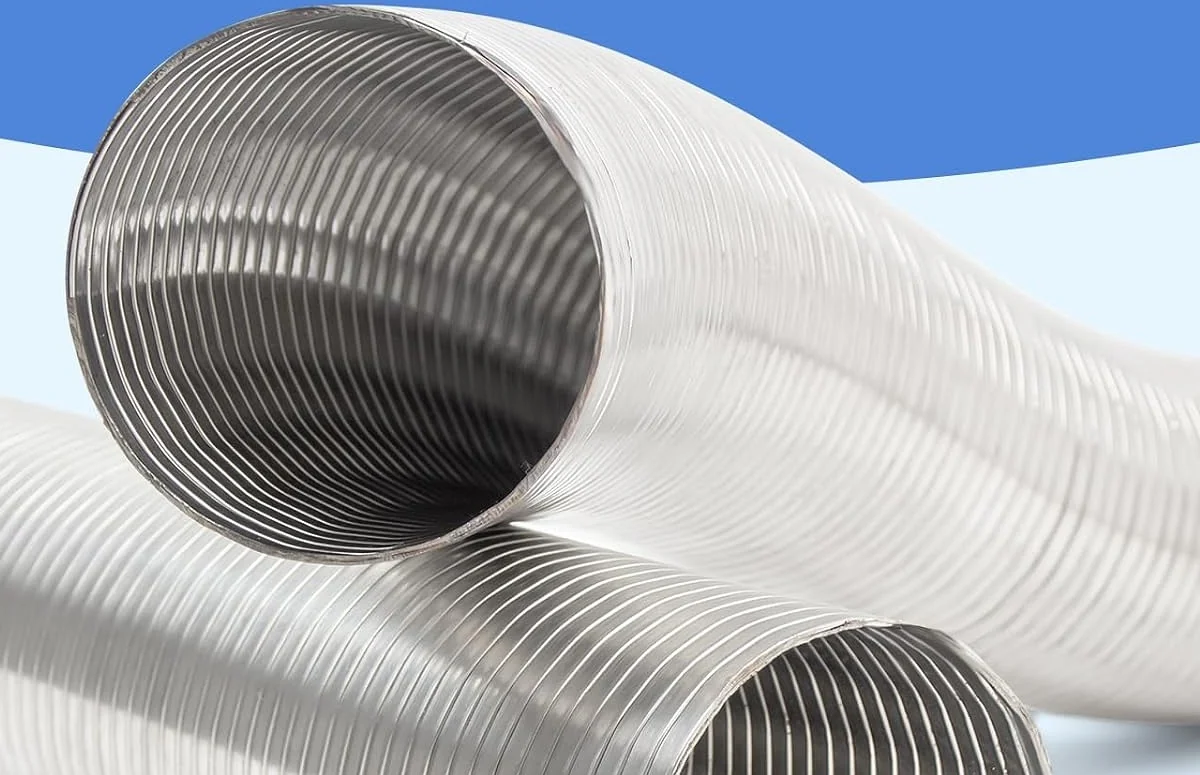
Your engine does not sit still. It rocks on its mounts when you accelerate, twists under load, and shimmies at idle. A rigid pipe running straight from the manifold back to the catalytic converter would crack at its first welded joint. The flex pipe exists to absorb that movement: a woven or interlocked metal sleeve between the hottest, most mobile part of the system and the rest of it. Depending on construction — the interlock, braided and bellows types are covered in our type guide — it bends thousands of times a season without tearing.
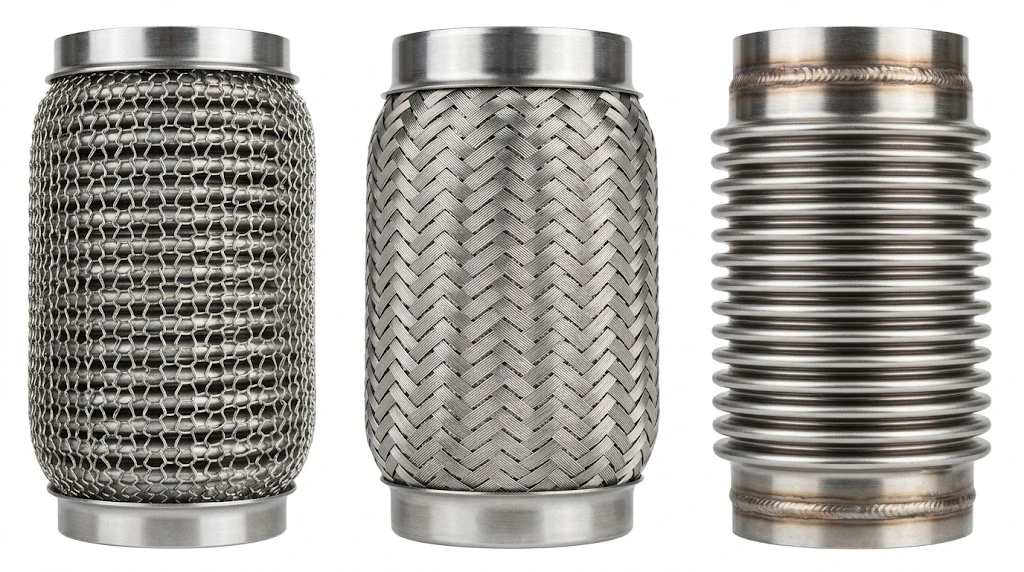
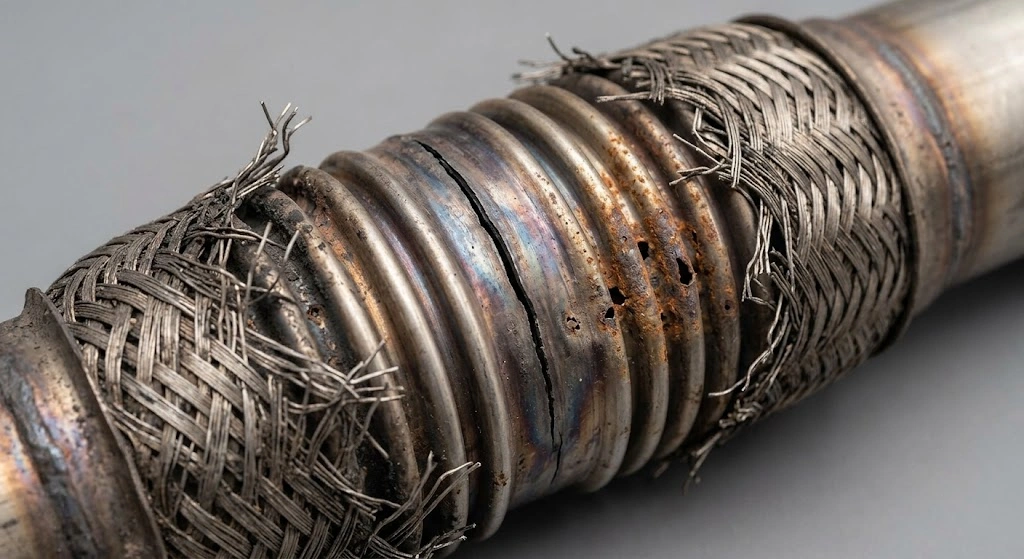
What it cannot do is bend forever without a cost — and that cost lands at the ends, where the sleeve meets the welded fittings. Almost every failure we see starts at that transition. That transition point is a stress concentrator: the wall material there flexes while also carrying the weight of everything behind it. Metal fatigue works the same way it does in a paperclip you bend back and forth — nothing gives at first, then the flex zone starts giving up a little at a time. On a braided sleeve the strands snap one by one; on an interlock sleeve the strip edges lift and start to separate. Either way the wall thins. Thinner walls crack. The first crack is a pinhole.
This is why the ends, not the belly, are where you look first. A dark sooty trail around an end collar — exhaust carbon staining the metal around the clamp — is often the very first visible sign, before you hear anything at all. And it explains the progression most owners experience: a tired sleeve weeps quietly for weeks before it roars.
The Sounds: Matching Each Noise to What’s Happening
The four sounds below map to four states of the same component. Learning to sort them saves you from two opposite mistakes: ignoring a small leak that will grow, and replacing a pipe that is actually fine.
| What you hear | What’s usually happening | When it’s loudest |
|---|---|---|
| Faint ticking or pattering that fades as the engine warms | Pinhole-size gap, open when cold, pinched near-closed when hot | First minutes after cold start |
| Steady hissing, higher-pitched, rises with rpm | Pressurized gas escaping a narrow crack near the hot end, or a leaking joint face | Constant while running |
| Pulsing blow or flap, rhythm matches engine speed | An open hole or a failed gasket — gas taking every exit it can find | Whole rpm range, loud under acceleration |
| Low, truck-like rumble | A whole section of wall has let go; the hole is now an opening | All the time, worse at speed |
The ticking-then-fading row deserves the extra explanation it rarely gets. Shops and repair guides describe it the same way from different directions: cold weather and cold metal make an existing leak obvious, and the sound calms as components expand and seal themselves temporarily. One exhaust specialist notes a crack “most pronounced when the engine is cold and reduces as it warms” as a classic symptom; a Colorado shop describes the same leak “becoming less obvious once the exhaust heats up,” and adds the line this whole section hangs on — that change does not mean the leak disappeared.
The hissing row has one trap. A hiss can come from a clamp face or manifold gasket instead of the sleeve itself, and misattributing it leads people to condemn a pipe that is fine. The 15-minute check at the end of this article separates the two. And a rattle over bumps, for what it’s worth, usually traces to a heat shield or a rubber hanger, not the flex section — it belongs on this list only as a decoy.
Smells, Smoke and Feel: Signs You Catch Inside the Cab
Sound happens under the car. Smell reaches you. Fumes that drift into the cabin at a stoplight, or with the windows down, mean the opening sits forward of the fresh-air intake — near the hot end, exactly where a hissing flex pipe leaks. Nothing escalates priority faster than this: “audible nuisance” and “fumes where you breathe” is the whole subject of the next section.
Two cautions before you trust your nose. Carbon monoxide is odorless; what you smell are its companions, so your nose is an alarm, not a detector. And condensation puffing from the tailpipe for the first few minutes is normal on every exhaust. What isn’t: a thin vapor stream tracing along the pipe instead of exiting its end, visible in cold air. That line points straight at the hole.
The feel channel is the one people skip. New vibration through the floor or the gas pedal at idle, or a pipe that visibly hangs lower than it used to, says the exhaust has lost a hanger or a mount has torn. A sagging system stops absorbing its own weight through rubber and starts absorbing it through the sleeve — which accelerates exactly the end-of-sleeve fatigue described above. If you fix nothing else this weekend, straightening what holds the pipe up protects the part you can’t yet afford to replace.
Can You Still Drive With a Failing Flex Pipe?
The forums ask this constantly. It deserves a direct answer with honest limits. Most shop guidance we can find lands on a scenario-based split — it’s not about whether the pipe is bad, it’s about how far gone it is and where the gases end up. Three tiers:
Green — watch it, drive normally, check soon. Only the faint cold-start ticking, no smell reaching the cabin, no sag. The opening is small enough that heat seals it during your drive. Short errands and commutes are fine; what’s not fine is letting this state last for months. The pinhole has a trajectory, and it goes one way.
Yellow — drive minimally, get it checked this week. Steady hissing, or a smell that reaches the cabin at stops, or the pipe sitting visibly low. You can still move the car, but keep windows cracked on short trips, avoid long idling, and don’t add passengers who’ll ask why it sounds like a muscle car. This tier is where the when to replace a flex pipe decision list earns its keep — ticking off which symptoms you’re actually in turns “maybe soon” into a date.
Red — stop driving it. A visible gap or torn section in the sleeve, a loud blow or rumble, or fumes in the cabin on every drive with a headache or drowsiness to match. The shop guides we reviewed treat a front-section leak with exhaust smell inside the cabin as a stop-driving situation — exhaust gas contains carbon monoxide. Park it and have it inspected. Move the car to a diagnosis, not to a destination.
One red line with no tier attached: never idle a leaking exhaust inside a closed garage. That is a house-and-people rule, not a flex-pipe rule, and it is non-negotiable regardless of how “small” the leak seems.
And when the yellow tier turns into a decision, the money question arrives next. We keep every number out of this article on purpose, but what drives the cost — part, labor, and the welding variables — has its own page so you can budget the repair honestly.
A 15-Minute DIY Check (Verdicts Only, No Wrenching)
You’re not fixing anything in this section. You’re sorting your symptoms into “clamp,” “sleeve,” or “both,” so the next step is a fact instead of a guess. Do it on a cold engine, ideally the first thing in the morning before the car has warmed through.
- Look at the ends before the middle. Flashlight and a phone camera are enough. Go straight to the two transitions where the sleeve meets the fittings, because that’s where failures start. You’re hunting sooty streaks, frayed wire or lifted strip edges, and any visible gap.
- Run the glove test. Have someone idle the engine outdoors. Press a work glove or a thick damp cloth against the tailpipe outlet — not a full seal, you want pressure to build slightly — then move your covered hand along the pipe run. Escaping gas feels like a distinct tickle of airflow against the palm even where you can’t yet hear it. Hot metal and one careful hand, and the engine off the moment you’re done.
- Separate clamp leaks from pipe leaks. With the engine off and cool enough to touch, try to shift each clamp by hand and look at the joint faces. A weeping, soot-stained clamp face points at a loose or failed joint; a cracked or open sleeve points at the pipe itself. Same loud noise, two different repairs, and the difference matters when someone quotes you.
- Take your verdict and branch. Clamp or joint symptoms → walk through fix a leaking flex pipe first; a shop re-torquing band clamps should be around 40–45 ft-lb, and over-tightening flattens the wall — a fresh fatigue clock. Torn sleeve → the replacement-timing list above sets your pace. Sagging but quiet → hangers and mounts first.
FAQ
Why does it sound worse at startup and quieter later? Because the cold contracts the metal around the gap and the heat closes it again. The fading noise is the leak’s signature, not proof of health. If it only happens on every cold start for months, the hole is still there in July.
Can a flex pipe fail completely without warning? Rarely. The pinhole-to-tear sequence passes through quieter stages first — how long each stage lasts depends on position and vibration load, not a fixed clock. What feels like “it went bad overnight” is usually the last stage of a ticking that started with the first cold mornings.
Does a bad flex pipe hurt fuel economy? A small leak in the rear section is mostly a noise problem, not a fuel problem. A large leak, or one upstream of the oxygen sensors, can distort sensor readings enough that the engine’s fueling goes slightly off — if mileage drops and the note got louder, suspect the second scenario.
Can a shop catch it by smell before it sounds? Yes — routine on a lift. A tech reads soot trails before owners notice a sound change. Mention any cabin smell specifically; it changes the urgency of the recommendation.
How fast can a small hole become a tear? There’s no reliable timeline. Leaks at the ends tend to worsen faster than mid-pipe ones because that’s where the flex load concentrates — recheck at every oil change, and sooner if the sound changes.
Conclusion
The sound gives the size; the timing — loud cold, quiet warm — hints where the hole sits. Write down which noise peaks when, run the check once, and your next talk with a shop starts from a diagnosis instead of “it’s louder than it used to be.”
Match your flex pipe by measuring the old one
If the verdict came back as joints and hardware rather than the sleeve itself, start with exhaust clamps — clamp and pipe have to agree on size before anything seals.
Sources
- Independent UK exhaust specialist, “Exhaust Sounds: What Different Noises Mean for Your Car” (March 2025) — cold-ticking pattern, hissing vs blowing distinction, heat-shield rattle decoy.
- Independent Colorado repair shop blog, “What Causes an Exhaust Leak and Why Is It More Concerning During Cold Weather?” (September 2026) — metal contraction/expansion behavior of leaks across temperature.
- Two further US shop guides on manifold-leak ticking rhythms and cold-start symptom changes (Sep 2025 / Oct 2026) — corroborating the ticking row.
- “Fumes in cabin = drive-stopping scenario” phrasing reflects consensus shop guidance as collected above; no regulatory source was located for a structured statement. Safety wording stays scenario-hedged throughout, and no concentration or dose figures appear in the body text.