Ask most people what an exhaust cutout does and they’ll tell you it adds horsepower. The truth is duller — and more useful. For most street cars the measurable gain is small: roughly 0–3% on a typical build, which works out to maybe 0–10 hp on a 300–500 hp car. The change you’ll actually feel isn’t power at all; it’s sound.
What a cutout really does is give exhaust gas a shortcut around the muffler, the single biggest flow restriction in most stock systems. Open the valve and backpressure drops, so the engine breathes out a little easier — but the effect shows up mostly up top, where exhaust flow is highest. Down low, the difference is often within the margin of error, and low-end torque can shift either way depending on the build. Heavily modified setups can nudge toward 5%, but that’s the ceiling, not the rule.
We’ve supplied exhaust components for over twenty years, and we’ve seen this pattern repeat: customers expect double-digit gains, get single digits, and then decide whether the trade-off (noise, legality) was worth it. Here’s what the data actually shows, stripped of the marketing hype.
How Exhaust Flow Affects Performance
Exhaust backpressure is the resistance your engine fights to push spent gases out of the cylinders. Think of it like breathing through a straw — the narrower, the harder your lungs work. In an engine, that “straw” is the whole exhaust system: headers, cats, mufflers, and tailpipes.
Backpressure isn’t inherently evil. Some restriction helps scavenging — the process where exiting exhaust pulses create a low-pressure zone that pulls fresh air-fuel mixture into the cylinder. Too little backpressure and you lose that tuning effect. Too much and the engine chokes on its own waste. The goal isn’t zero restriction; it’s optimal flow for your specific setup.
Most factory exhausts are designed for noise compliance, emissions, and cost — not peak performance. That means they’re often more restrictive than necessary, especially in the muffler section where sound-deadening chambers force gases through tortuous paths. Cutouts give the exhaust a bypass around the most restrictive sections.
Exhaust flow increases with engine speed — at idle, a typical V8 moves maybe 100–150 CFM (cubic feet per minute). At 6,000 RPM, that same engine pushes 800–1,000 CFM. The muffler that barely notices flow at idle becomes a serious bottleneck at high RPM. Cutouts fix that bottleneck with a straight path when you need it.
What Cutouts Actually Do
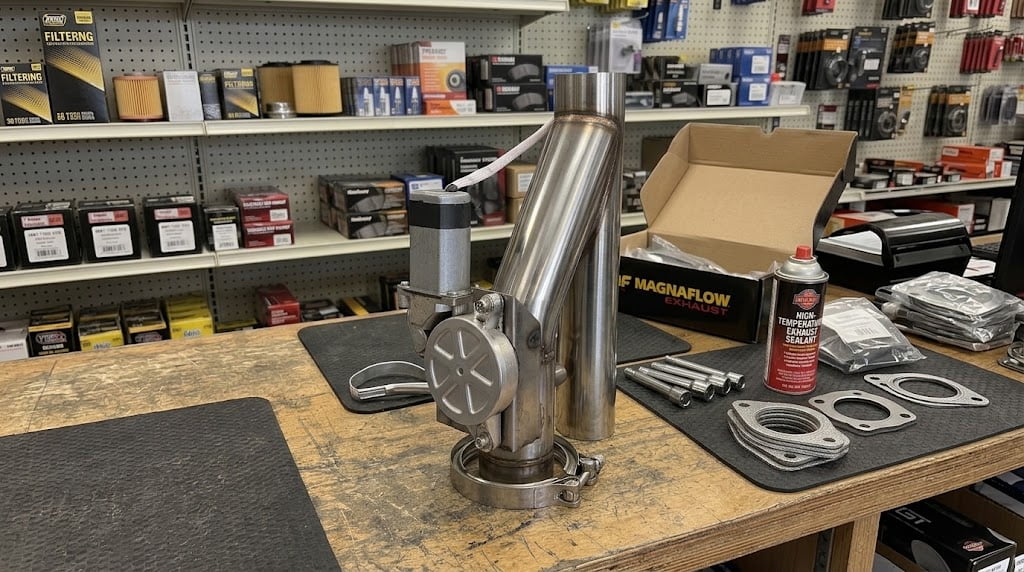
An exhaust cutout is essentially a Y-pipe with a valve that diverts exhaust flow. When closed, gases travel through the full system — cat, muffler, resonator, tailpipe. When open, they take a shortcut around the muffler (and sometimes the cat, depending on placement), exiting through a short, straight section of pipe.
Opening the cutout reduces exhaust backpressure by giving waste gases a direct path that bypasses the muffler’s internal baffles and chambers. It’s not removing restriction entirely — there’s still pipe length, bends, and potentially a catalytic converter upstream. But it eliminates the single biggest flow obstacle in most stock systems: the muffler.
The mechanism is purely mechanical. There’s no tuning, no ECU remap, no change to fuel delivery. You’re simply reducing the resistance the engine sees on the exhaust side. For naturally aspirated engines, this can improve volumetric efficiency slightly — the engine breathes out better, so it can breathe in better on the next cycle. For turbocharged applications, reducing post-turbine backpressure helps the turbine spin more freely and cuts spool lag.
Placement matters. A cutout installed before the catalytic converter affects flow more dramatically but risks running afoul of emissions laws (more on that below). A cutout after the cat but before the muffler is the most common configuration — it preserves emissions compliance while still bypassing the primary restriction.
Real Exhaust Cutout Horsepower Gains
Let’s talk numbers, because this is where expectations diverge from reality.
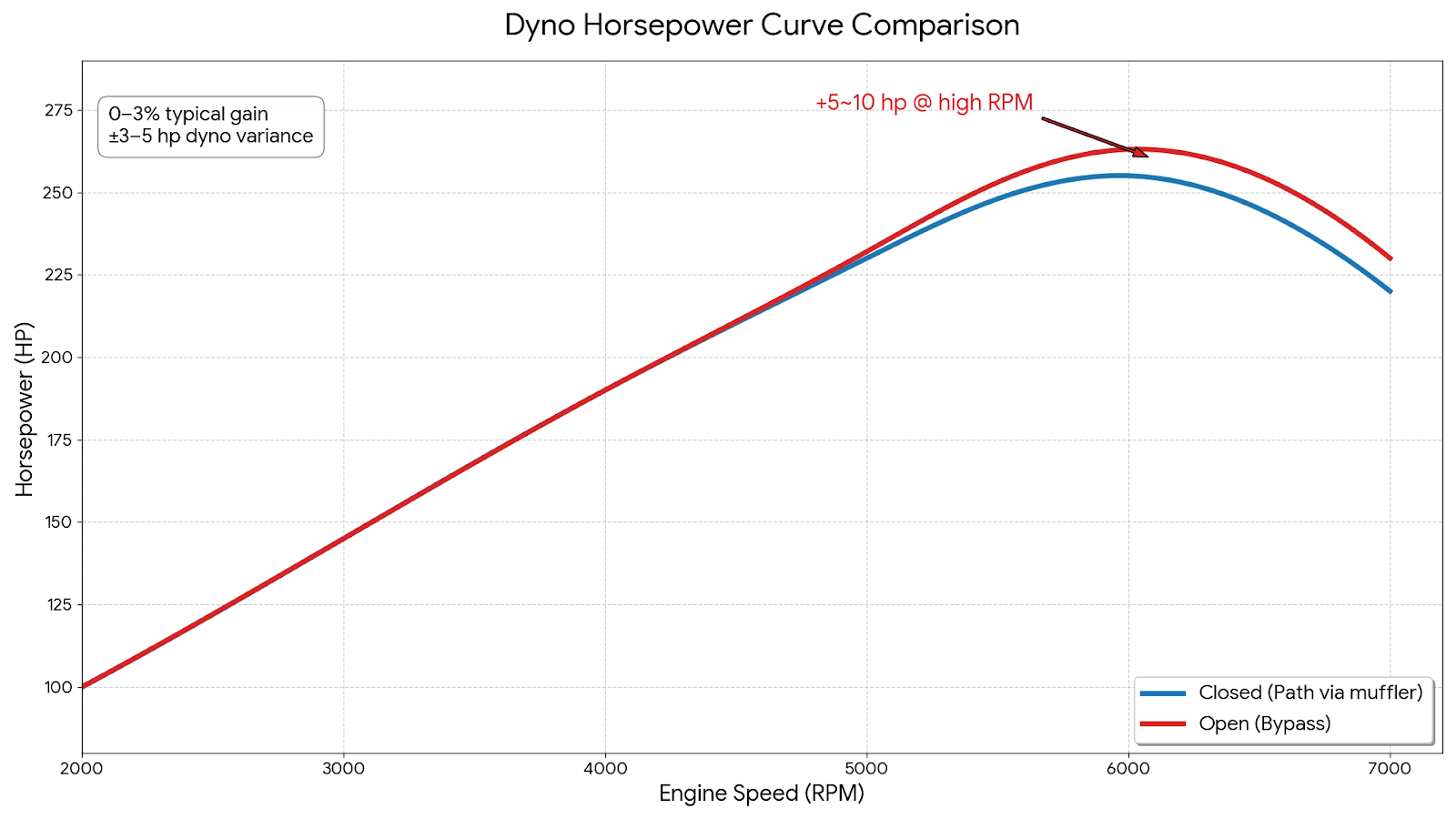
Exhaust cutout horsepower gain typically falls in the 0–3% range for most street-driven vehicles. On a 300–500 hp car, that translates to roughly 0–10 hp — measurable on a dyno, but barely perceptible behind the wheel. Heavily modified builds with aggressive cam profiles, high-compression ratios, or forced induction can see gains approaching 5%, but that’s the upper end, not the norm.
Why so modest? Because the exhaust system is one piece of the power puzzle, not the whole of it. If your intake, fuel delivery, ignition timing, and cam profile aren’t optimized to take advantage of reduced backpressure, the gain is limited. A cutout on a completely stock car is like putting racing tires on a vehicle with worn suspension — you’ve upgraded one piece, but the rest can’t exploit it.
Real-world testing bears this out. Independent dyno shops routinely see 5–10 hp gains on moderate builds (bolt-ons, mild cam, basic tune). Aggressive builds (forced induction, big cams, ported heads) can see 15–25 hp, which represents 3–5% on a 500+ hp platform. But these are exceptions, not the baseline.
The other factor: dyno variance. A well-calibrated chassis dyno has a margin of error of ±3–5 hp. A gain of 8 hp could be real, or it could be within the noise floor of the test. That’s why serious tuners run multiple pulls and average them instead of trusting single-data-point claims.
If you have not picked a unit yet, the exhaust cutout buying guide covers electric versus manual and what the differences mean in practice.
When You’ll Notice the Difference
The horsepower curve tells the real story. On a properly instrumented dyno, opening a cutout shows minimal difference in the low-to-mid RPM range — the curves nearly overlap from idle to about 4,000 RPM. But above 5,000 RPM, the lines diverge. The open-cutout pull maintains torque longer and peaks higher, while the closed-cutout pull starts to fall off as backpressure builds.
This happens because exhaust flow scales with engine speed. At low RPM, the volume of gas exiting the cylinders is low enough that even a restrictive muffler doesn’t create significant backpressure. As RPM climbs, flow increases exponentially, and the muffler’s internal restrictions become a genuine bottleneck. The cutout relieves that bottleneck at high RPM, where peak power is made.
For daily drivers who rarely exceed 4,000 RPM, the difference is negligible. For track enthusiasts or highway pullers who run the upper rev range, the gain is more meaningful. It’s about extending the powerband — keeping torque flat where it would otherwise drop.
Low-RPM effects vary by engine type. Most vehicles see virtually no change in low-end torque — the difference is within the margin of error. Some naturally aspirated engines with carefully tuned exhaust scavenging may actually lose a small amount of low-RPM torque when the cutout is open, because the sudden change in pulse timing disrupts the scavenging effect. Turbocharged engines, by contrast, generally benefit across the entire RPM range because reducing backpressure after the turbine helps spool and sustain boost.
Other Benefits
If horsepower gains are modest, why do people install cutouts? Because the secondary effects are immediate and dramatic.
Sound transformation is the primary reason most buyers pull the trigger. Opening a cutout turns a muted, factory-quiet exhaust into something aggressive and raw — the equivalent of going from library voice to stadium roar. For enthusiasts who want a race-car soundtrack without permanently modifying their exhaust, a cutout offers on-demand volume.
The acoustic change comes from bypassing the muffler’s sound-deadening chambers. Mufflers work by reflecting and absorbing sound waves through internal baffles, perforated tubes, and packing material. When you route exhaust around the muffler entirely, those waves exit unimpeded. The result is a deeper, louder tone that changes with throttle and RPM.
There’s also an aesthetic component: many kits include visible dump pipes or polished tips that add visual aggression out back — a tangible benefit for show cars.
Some users report slightly improved throttle response, particularly in turbocharged applications. It’s hard to separate this from the psychological effect of a louder exhaust. But in our experience, customers with turbo setups do notice quicker spool when the cutout is engaged.
Potential Drawbacks
No mod is free. Here’s what you give up.
Noise. This is the obvious one, but it bears repeating: an open cutout is loud. Not “sporty” loud — genuinely loud. In residential areas, early mornings, or enclosed spaces like parking garages, it will draw attention. Some jurisdictions have decibel limits for street-driven vehicles, and an open cutout almost certainly exceeds them.
Legality. In most U.S. states, operating a vehicle with an exhaust cutout open on public roads is illegal. The Clean Air Act prohibits defeating emissions equipment like the catalytic converter; state and local laws separately require a functioning muffler and set noise limits. While enforcement varies, the legal risk is real — fines and failed inspections are the most common outcomes. Treat cutouts as track-only or closed-course accessories.
Durability concerns. Cheaply made cutout valves can fail mechanically — sticking open, leaking exhaust, or seizing after exposure to heat cycles. A stuck-open cutout means you’re driving with a permanently unmuffled exhaust, which brings legal and social consequences. A stuck-closed cutout means you paid for a feature you can’t use. Quality matters here, which is why we manufacture our cutouts from SS304 stainless steel — it resists corrosion and handles thermal cycling better than mild steel or lower-grade stainless.
Resale impact. Modified exhausts, especially those with visible cutout hardware, can reduce resale value or complicate private sales. Buyers who want a stock vehicle won’t pay extra for a mod they’ll likely remove. Fleet operators and commercial buyers are particularly sensitive to this.
Choosing between electric and manual comes down to how you’ll use the car — our Electric vs Manual Exhaust Cutout guide walks through the trade-offs, and the Exhaust Cutout Installation Guide covers the install side.
FAQ
Questions we hear regularly from customers and shops:
Q: Does open exhaust increase performance?
Yes, but modestly. Reducing backpressure via an open cutout or straight pipe improves high-RPM flow, yielding 0–3% horsepower gains for most builds. The primary noticeable effect is sound, not power.
Q: Will a cutout hurt my engine?
Not directly. Reduced backpressure doesn’t damage internal components. However, running extremely lean or with improper tuning alongside a cutout can cause issues. The cutout itself is mechanically neutral — it’s the supporting mods and tune that matter.
Q: Can I install a cutout myself?
If you have basic welding skills and access to a lift, yes. Clamp-on kits exist for bolt-on installation without welding, but they’re less durable and more prone to leaks. For a permanent, leak-free install, professional welding is recommended.
Q: Electric vs. manual cutout — which is better?
Electric cutouts offer remote activation — a cabin switch or wireless remote — letting you toggle between quiet and loud modes from the driver’s seat. Manual cutouts require physical access to the valve (usually under the vehicle) and are simpler mechanically. For street-driven cars, electric is far more practical.
Q: Will an exhaust cutout cause problems on my street car?
On public roads, yes. In most U.S. states, running with an open cutout is illegal because it bypasses required emissions and noise-control equipment. Expect failed inspections or fines if you’re caught with it open. Keep it closed on the street and save the open setting for the track.
Where the cutout goes in the system matters as much as the unit itself — the cutout installation guide covers routing and legality by position.
Conclusion
So, do exhaust cutouts increase HP? They do — but in single-digit percentages, not double-digit jumps. Expect 0–3% for most applications, with the upper end reserved for heavily modified builds. What you’ll get immediately is a dramatic change in sound and the ability to toggle between street-legal quiet and track-ready volume. If you’re chasing horsepower alone, there are more effective mods. If you want flexible exhaust character with a small performance bump, a cutout delivers.
LEDAUT manufactures exhaust cutout systems in SS304 stainless steel, available in electric and manual configurations, with OEM/ODM support for distributors and modification shops worldwide. Contact LEDAUT for specifications on custom diameters, valve types, and integration kits.