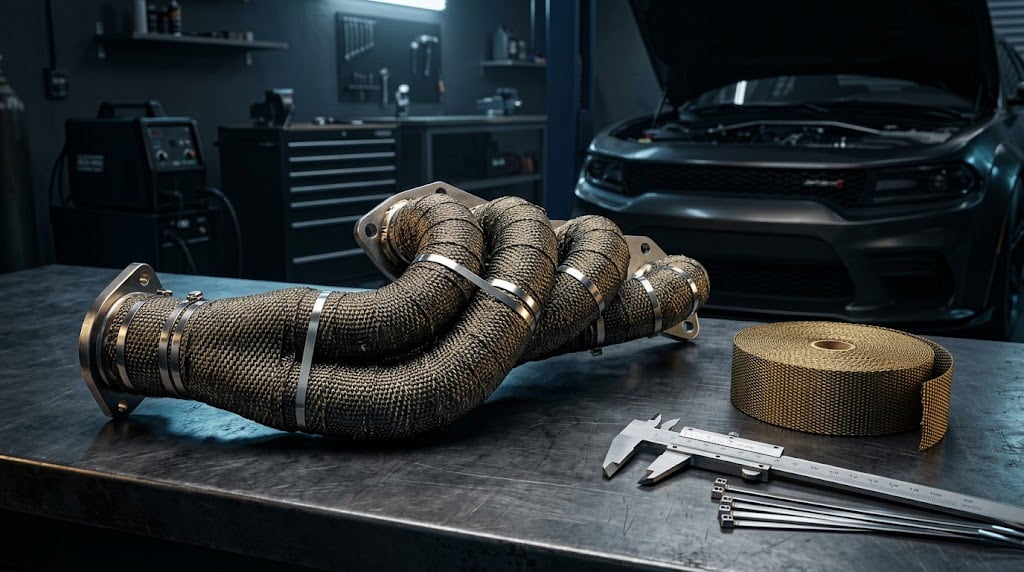
Most wrap complaints misdiagnose themselves. A DIYer or a young tech wraps an entire system in one material. Three months later, the section right behind the header is scorched brown and flaking off. Everything downstream of the cat looks like it went on yesterday. The instinct is to blame the roll. After twenty-some years of supplying exhaust components, we’ve seen that pattern often. We don’t call it bad luck anymore. The same fiberglass runs two years on a mild-steel mid-pipe. Behind a turbo manifold, it can cook itself in a single summer. The product didn’t fail. The pairing did.
That’s the heart of how to choose exhaust wrap. Match the fiber to the temperature it will actually sit in. Then worry about size. Get the first decision wrong and the second one doesn’t matter.
Why Exhaust Heat Wrap Material Matters Most
One expectation has to be cleared away first, because it drives every material call after it. Wrap does not cool your pipes. The tube underneath keeps running at full operating temperature. A turbo manifold passes 1200–1600°F, with a wrap on it or without one. What the wrap cuts is radiant heat trying to leave the pipe. Manufacturer figures put that at 30–50%. That is why wiring looms, hoses and paintwork survive within inches of it. Want the full case for what a wrap does and doesn’t buy you? Our breakdown is honest about the limits: Does Exhaust Wrap Work?
The pipe never cools down. So every wrap lives or dies by one number on the spec sheet. That number is the maximum temperature the weave itself is rated for. Go past that ceiling and the binders and coating scorch first. The fibers go brittle. Road speed plus water spray then strip the wrap off in flakes. This is why we treat exhaust heat wrap material as the first question. It comes before size or anything else in a wrap buying guide.
Fiberglass Wrap: The Workhorse, to a Point
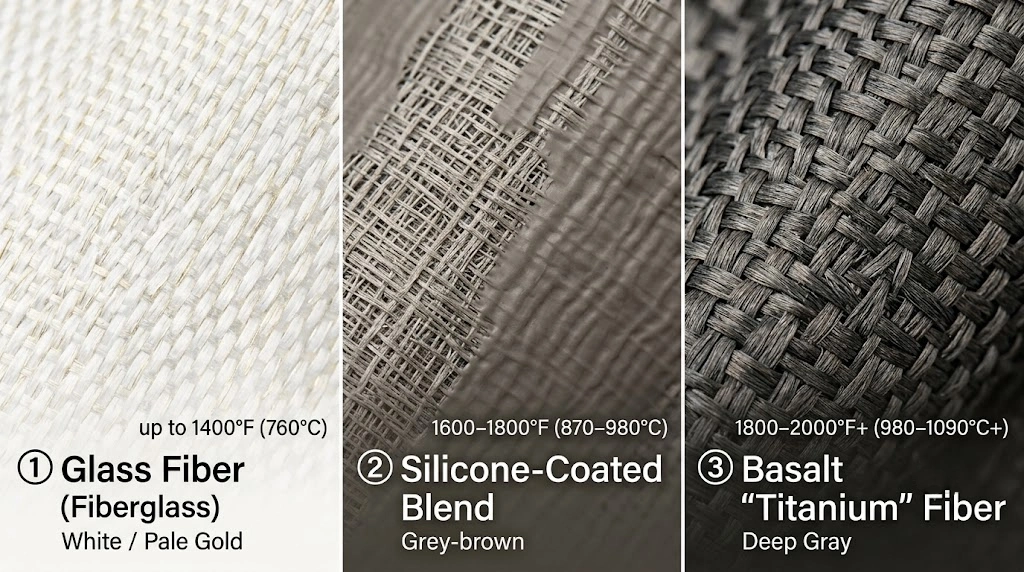
Fiberglass is the cheapest weave on the shelf. It is what most people picture when they hear “exhaust wrap.” Its ceiling sits around 1400°F. On a normally aspirated cat-back, surface temps mostly stay under that line. A cat-back is the pipe downstream of the converter, plus the resonators and tailpipe. Fiberglass does the job fine there. Expect roughly 1–2 years from the bare material. That’s the realistic ceiling, not the marketing number.
That’s the realistic ceiling, not the marketing number. The uncoated rolls we supply carry a more conservative 12–18 month line before we’d want them inspected — we’d rather set the expectation we can defend than promise a lifespan we’d have to walk back. One physical habit worth knowing: fiberglass sheds splinters. Gloves and a long sleeve on install day aren’t heat protection. They’re anti-itch insurance. Every tech who’s skipped them learns that the hard way.
Silica Wrap: The Step Up for Sustained Heat
Silica-blend weaves come in a softer, draping form. That conforms to compound header curves without bridging at the tube junctions. You can feel the difference when you work it around a merge collector. The fiberglass vs silica exhaust wrap decision reduces to one question, in our opinion. How hot does the pipe get in the first foot or two of the system? And does it stay there? If that zone sits at or above what fiberglass is rated for, skip the cheap roll for that section. Run the correct weave where the heat concentrates. Use fiberglass the rest of the way. Mixed-material installs are a perfectly sensible way to spec a system.
Titanium Fiber Wrap: The Ceiling (and a Naming Caveat)
One confession before the numbers. Despite the name, most consumer “titanium” wrap is a basalt-based weave. That is mineral fiber sold under a flashier label. It’s not a scam. It’s just a fact worth having when you compare spec sheets. What you’re really buying is basalt’s temperature behavior. It runs well above what fiberglass can take — there’s no honest way to pin it to a single spec-sheet ceiling, and the numbers quoted for “titanium” wrap are all over the map. Lifespan ceiling runs 2–5 years with a clean install. Track cars, motorcycles, and salt-belt winter fleets sit at the short end of any range. Check them every 12–18 months. That applies regardless of what the roll claimed on day one. This is the material for turbine housings and race headers. It also fits tight engine bays. There, a harness has no choice but to live next to a red-hot downpipe.
What the Ceiling Doesn’t Cover
Material sets the ceiling. Coating, installation, and operating conditions decide where you land under it. Two shared traits apply no matter which weave you pick. First, fresh wraps smoke for 10–15 minutes over the first several starts. That shows up at a surface temperature around 400°F, cooking off sizing and residual binder. That’s normal. A wrap that keeps smoking a week later was installed wrong, or it is sitting wet. Second, all of these weaves hold moisture against the pipe. On mild steel or cast iron, a wrap is a rust accelerant as much as a heat blanket. Stainless pipe is wrap’s better partner. Wrapping a pipe that isn’t clean and dry is a guaranteed comeback.
How to Measure for the Right Size
With material decided, size is arithmetic. Three numbers: the pipe’s real girth, the roll’s width, and total footage.
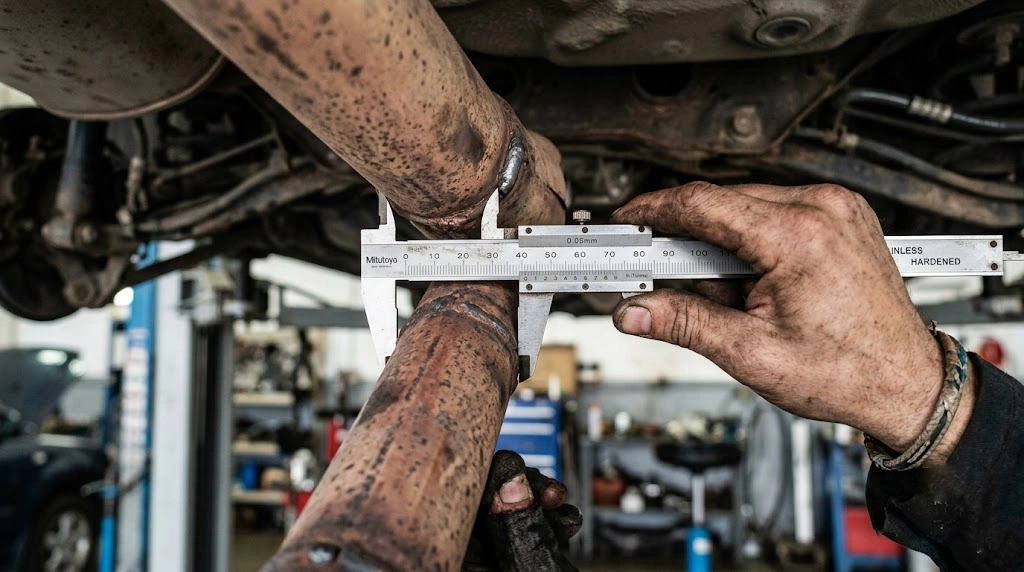
Measure the circumference, not just the diameter. Across a bent pipe, a tape measure catches the edge and reads short. Instead, wrap a strip of paper or a piece of string around the tube. Mark the overlap point, then lay it flat against a ruler. Divide that number by 3.14 if you want a diameter to match against a pipe spec. But keep the circumference. It’s the number the next step runs on.
Width is about pipe size and how twisty the run is. A 2-inch roll suits header tubes and 1.5–2.5″ pipes with plenty of bends. The narrow width conforms where a wide roll would tent over a curve. A 4-inch roll suits long, straight mid-pipe runs. It covers ground three turns to one and cuts install time. Our rolls are 2″ wide, 50-foot lengths, fiber-woven construction.
The length math catches most people buying too little. A 3″ pipe is about 9.4″ around. Work a 2″ roll at a half-inch overlap. Each turn then advances roughly an inch along the pipe. So you’re burning close to ten feet of wrap for every foot of 3″ pipe. A 50-footer covers about five feet of it. An entire cat-back plus a set of headers isn’t one roll. Running short mid-job is how bare pipe shows up on a lift.
Before the first turn goes on, soak the wrap for at least 15 minutes. Keep overlaps in the 1/4–1/2″ band. Finish with stainless ties. The full installation technique belongs to its own walkthrough. None of it works on the wrong size.
Match Wrap to Your Application
Material choice sounds abstract until you are holding a roll over a specific pipe. The job picks the material, not the other way around. Three zones decide it: how hot the pipe runs, how long the run is, and what is sitting next to it.
Headers: The Hot Short Run
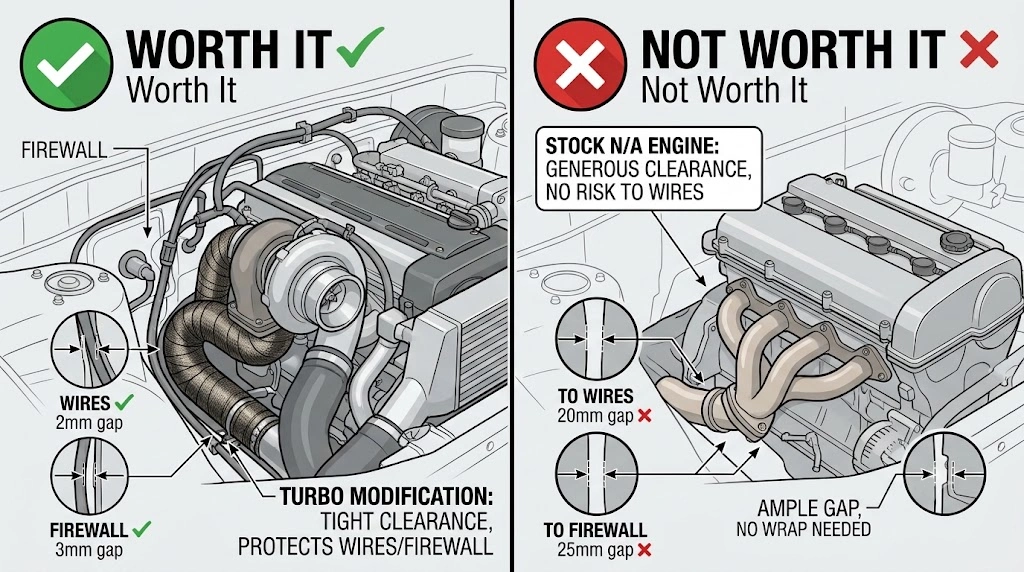
Header runners sit closest to the combustion event, which makes them the hottest and shortest section on the system. On a naturally aspirated build, primaries typically see exhaust gas temperatures in the 1,100-1,400°F range under load. Add a turbo and that climbs, with EGTs through the primary tubes capable of passing 1,400°F on a hard pull. Crucially, header wrap never gets a cool-down cycle during a long drive. The heat soaks in and stays.
That combination is what shortens wrap life here more than anywhere else on the system. Our after-sales records back up what the forum threads keep asking about. Header-zone wrap tends to come back for replacement far sooner than the same material on a mid-pipe.
For this zone, the material call is straightforward. Fiberglass is rated to roughly 1,400°F continuous, which puts it right at the edge of a hot manifold. Silica blends drape better and carry a higher nominal ceiling. Basalt-based “titanium” fiber goes higher still. Where a runner sits above what fiberglass is rated for, run the higher grade on that first foot or two and fiberglass on the rest. Mixed-material installs are how shops spec this realistically. On quantity, a typical four-cylinder header job takes two to three 50-foot rolls once overlaps are counted.
Downpipes: The Middle Ground
Downpipes carry hot gas, but they also see longer exposure to underbody airflow, road spray, and repeated heat-soak cycles. Gas temps at the downpipe commonly land in the 800-1,200°F band, below the worst of the header zone but still hot enough that a cheap weave will not last. Mid-grade material handles the temperature here, and fiberglass is entirely reasonable for a downpipe on a daily-driven car.
What kills downpipe wrap is physical abuse rather than heat. Think curb rash, moisture, and a loose tail end that flaps until it tears. Weight and tightness matter as much as the grade you pick. Two rolls usually covers a downpipe section with room to spare, depending on length and diameter.
Full Exhaust: The Cool Long Run
From the catalytic converter back, temperatures drop and distances grow. A cat-back section can run ten feet or more. Surface temps here mostly sit in the 400-800°F range. Ten feet of premium basalt wrap is mostly paying for heat resistance you do not need. This is budget-grade territory. Fiberglass or a narrower roll does the job at a fraction of the material cost.
The sensible pattern to quote by: spend the material grade where the heat is, and spend nothing extra where it is not. One job, two grades. Premium on the first two feet behind the turbine. Economy covering the rest. That is also the reasoning behind how we stock the Exhaust Heat Wrap Kit, in the standard shop widths and fiber grade so a shop can buy the hot-zone roll and the long-run roll together.
Common Buying Mistakes
Buying on the roll price, not the material. Here’s the failure mode. A shop orders the cheapest 2-inch roll for a header job and installs it. The customer is back in six to ten weeks. There’s black dust and bare metal where the wrap was. By then, the labor to strip and re-wrap costs multiples of the material difference between grades. Every return we’ve traced back to a grade mismatch followed this path.
Guessing the size instead of measuring. Pipe diameter decides which roll width you need. Width decides how many rolls a job eats. Wrap width narrower than the pipe means more passes and more material. A 1-inch roll on a 3-inch runner takes three times the spiral passes of a 3-inch roll. Each pass adds weight and loose-edge risk. Use the caliper, not the spec sheet from the last build.
Underestimating the install before buying. Exhaust wrap is slippery fiberglass. It wants to shift as you pull tension. And the 50% overlap discipline means every inch of pipe eats two inches of roll. A full header job at a busy bay is a two-person, coffee-break-and-gloves kind of afternoon. Shops that skip the prep call us afterward. They wonder why their wrap fuzzed off in a month. Loose installs chafe. And chafe kills a good material faster than heat will. If the install isn’t your strong suit, at least watch the technique before you order: “How to Install Exhaust Wrap: Step-by-Step Guide with 50% Overlap Technique”.
FAQ
“What size exhaust wrap do I need for a set of headers?”
Measure first, then match roll width to pipe outside diameter. For a typical 2-1/2″ to 3-1/2″ header primary, a 2-inch wide roll is the common pick. It lays down cleanly on curves. And it keeps tension easy on a one-man job. Big-diameter straight sections (4″ and up) go faster with a 4-inch roll. Then double your linear footage for the 50% overlap, and round up a roll size. Running short halfway through a hot exhaust is not a fun problem.
“Can I use header wrap on my downpipe, or do I need something different?”
Yes, and it’s the right direction. Anything rated for header heat handles a downpipe with room to spare. The opposite doesn’t work. Downpipe-grade fiberglass shrivels when it inherits a header’s job.
“Will wrapping my exhaust cause it to rust faster?”
It can, if you trap moisture. Wrap is porous. Road water wicked into the layers sits against the metal instead of flashing off. That’s a live concern in the diesel forums, and it’s real. Don’t wrap over surface rust. Make sure the pipe is dry on install. And expect a shorter wrap life on anything that sees winter salt. Proper stainless tie straps and a tight spiral keep water out better than a loose one ever will.
“How long should exhaust wrap actually last?”
Depends entirely on the temperature zone. On headers we tell shops to think in seasons, not years. Six to eighteen months is normal before it thins. On downpipes and cat-backs, the same material can last several years. The heat isn’t cooking it there. When it frays at the edges or you see bare pipe, it’s done. Don’t patch over old wrap.
“Do I need titanium wrap or is fiberglass enough?”
Fiberglass is enough for everything downstream of the turbo’s hottest zones. Titanium- or silica-based pays for itself on headers, manifolds, and anything upstream of the turbine outlet. There, a grade mismatch fails in weeks. For a street cat-back, it’s overkill. That budget belongs in stainless ties instead.
Conclusion
Before you order, write down three numbers per section. Note the outside diameter in inches and the run length in inches. Then note which heat zone it lives in. That one line per pipe — header, downpipe, mid-pipe — is all a supplier needs. It gets you the right grade and the right quantity in one shipment, instead of three.
Our Exhaust Heat Wrap Kit ships in the standard shop sizes for exactly this reason.
Need Bulk Pricing or Custom Sizes?
Send your specs or part numbers for a quote within 24 hours.